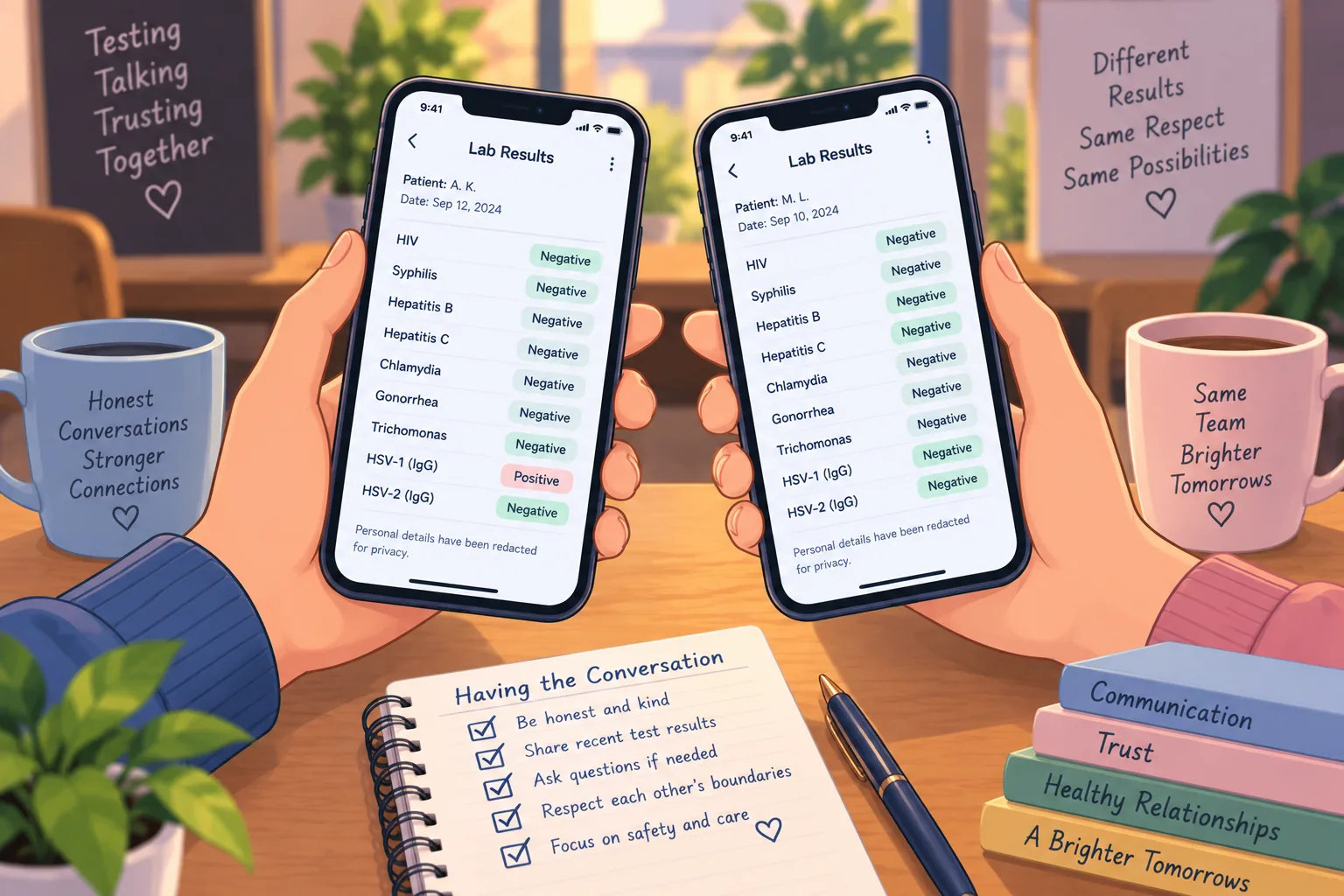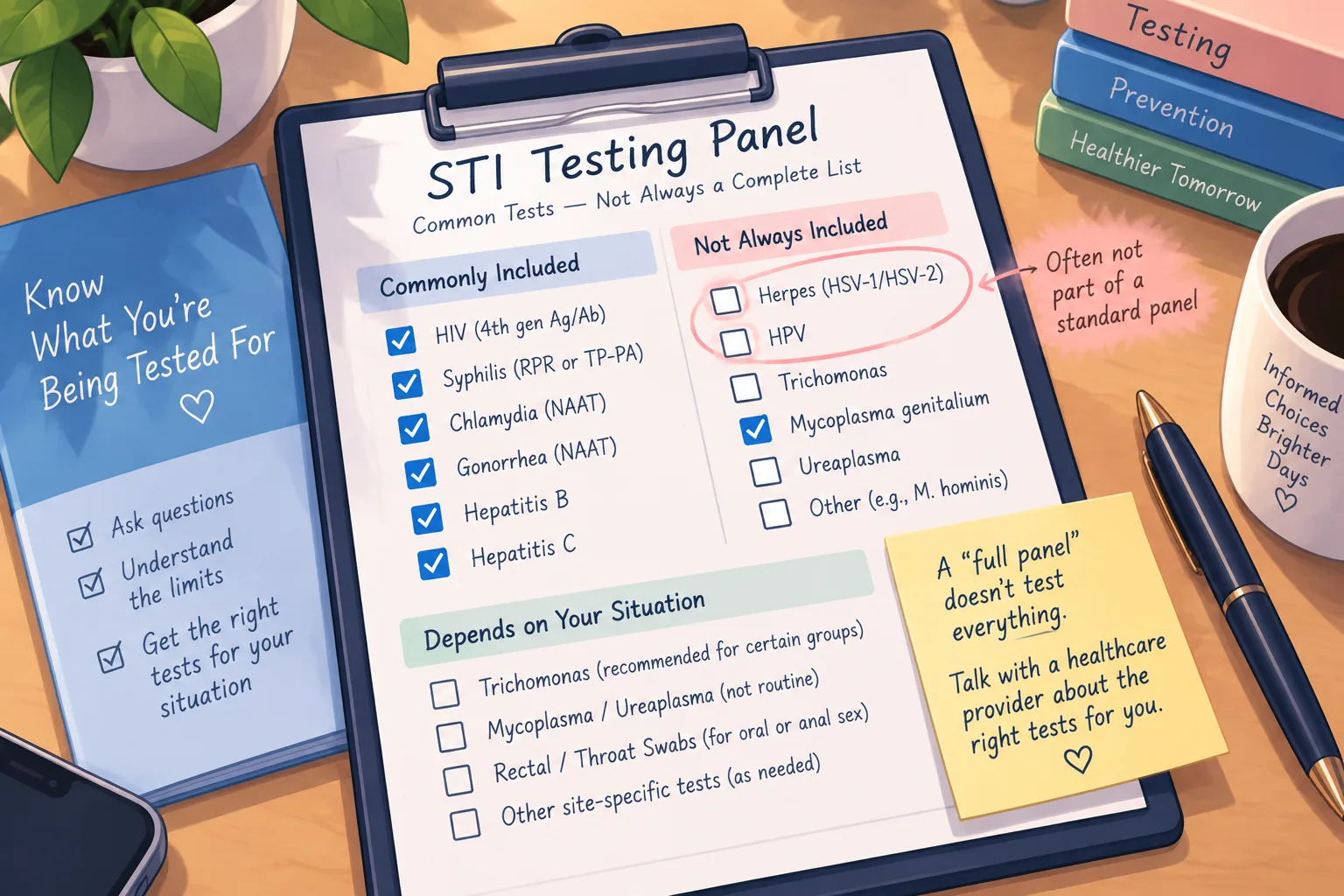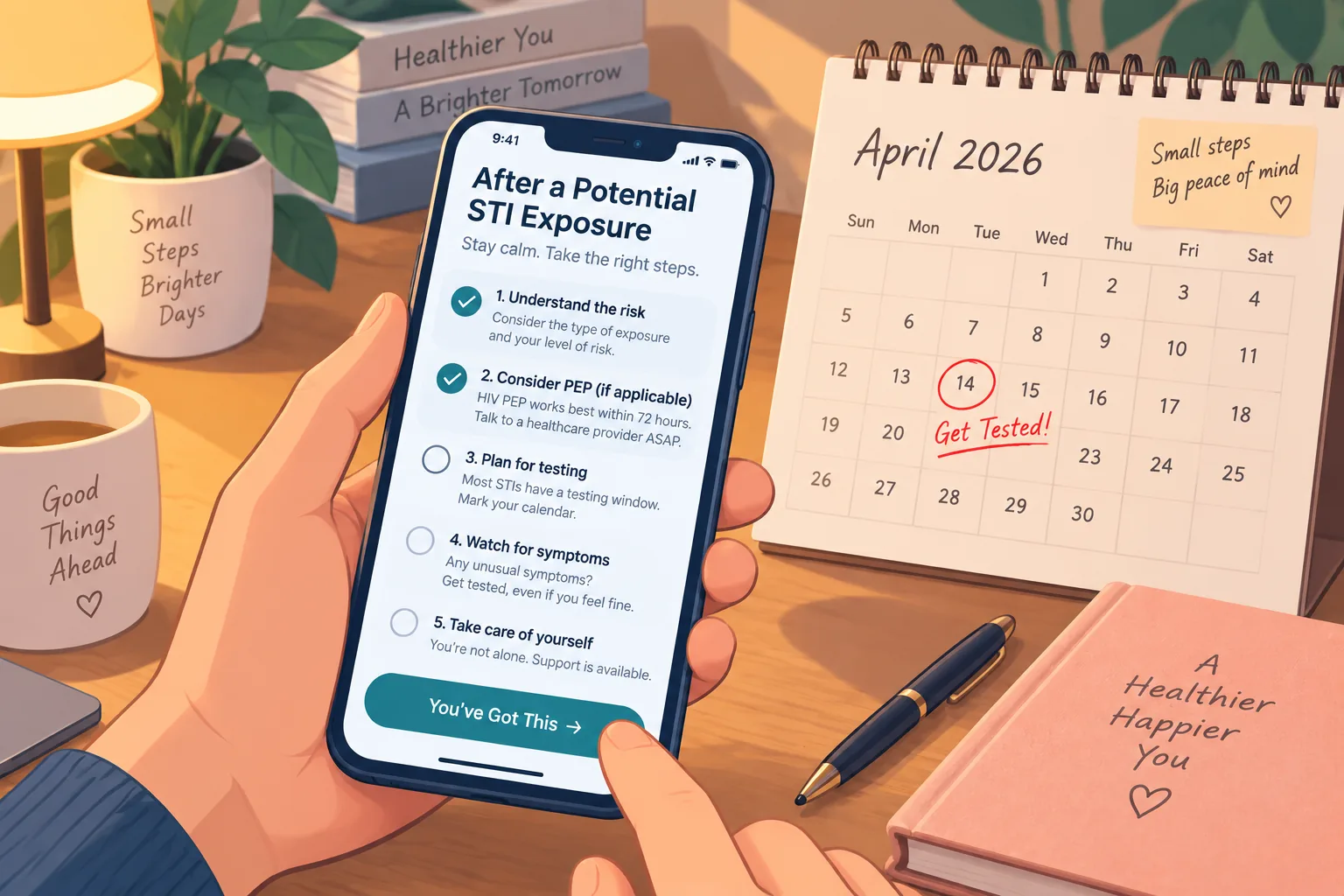

A negative STI test taken too soon after an exposure may not rule out a new infection, and having no symptoms does not prove that you are STI-free.
The reason is simple: tests need time to detect an infection, and many STIs can exist without noticeable symptoms.
The most useful way to think about STI testing is therefore not:
"I tested negative, so I'm completely safe."
It is:
"What infection was tested, what test was used, when was the exposure, and was the test performed outside the relevant window period?"
There is no single testing day that makes every STI 100% conclusive. HIV, chlamydia, gonorrhea, syphilis, and herpes all have different testing considerations, while HPV does not have a universal test that can establish someone's overall "HPV status."
The Testing Window Cheat Sheet: When Are Results Reliable?
A window period is the time between an exposure and the point at which a particular test can reliably detect an infection.
Testing during that period can produce a negative result even when an infection was acquired.
The exact timing depends on the organism, test method, specimen, anatomical site, and individual circumstances. For that reason, the table below is a practical guide, not a guarantee of zero risk.
STI Testing Window Period Comparison
| Infection | Practical earliest useful testing | Follow-up / more reliable timing | Common test |
|---|---|---|---|
| Chlamydia | Around 2 weeks after exposure is a commonly used practical window for NAAT testing | If tested earlier and negative, repeat testing around 2 weeks may be appropriate depending on exposure and clinical advice | Urine or site-specific NAAT |
| Gonorrhea | Around 2 weeks after exposure is commonly used when an early test was negative | Repeat around 2 weeks when initial testing was too early and no presumptive treatment was given | Urine or site-specific NAAT |
| HIV | NAT: about 10–33 days; laboratory 4th-generation Ag/Ab test: 18–45 days | Follow the window period of the specific test; recent PEP changes the follow-up schedule | NAT or Ag/Ab blood test |
| HSV-1 / HSV-2 | Lesion PCR/NAAT is useful when a fresh lesion is present; blood tests are not reliable immediately after a new infection | For suspected recent HSV-2 acquisition, CDC recommends repeat type-specific antibody testing at 12 weeks; some current CDC patient guidance notes detection may take 16 weeks or longer | Lesion NAAT/PCR or type-specific serology |
| Syphilis | Early testing may be negative even after infection | When recent exposure cannot be excluded, CDC guidance uses repeat serology at 4–6 weeks and 3 months in relevant situations | Serologic blood tests; lesion testing in selected settings |
| HPV | No universal "days after exposure" test exists | HPV testing is used mainly within specific cervical cancer screening contexts, not as a general post-exposure STI test | Cervical HPV testing in indicated screening |
For chlamydia and gonorrhea, BASHH guidance states that infection cannot be ruled out when testing is performed within two weeks of sexual contact with an infected partner and recommends repeat testing after that window when appropriate. CDC's current PEP guidance likewise allows repeat chlamydia and gonorrhea NAATs 1–2 weeks after exposure when the initial test was negative and no presumptive treatment was given.
HIV has one of the clearest test-specific window-period models. CDC states that a laboratory antigen/antibody test using blood from a vein can usually detect HIV 18–45 days after exposure, while a NAT can usually detect infection 10–33 days after exposure. Antibody-only tests can take 23–90 days.
For HSV, the situation is different. CDC states that type-specific HSV-2 antibody testing can be falsely negative early in infection and recommends repeat serology 12 weeks after the presumed acquisition when recent infection is suspected. CDC also notes that current blood tests may take 16 weeks or longer to detect infection in some people.
Syphilis requires another type of timeline. When initial testing is negative but recent infection remains possible, CDC uses 4–6 weeks and 3 months as follow-up points in relevant exposure situations.
HPV should not be forced into the same framework. CDC states that there is no test for a person's general "HPV status," and HPV testing is used in specific cervical cancer screening settings rather than as a universal STI test.
Why There Is No Universal "Final Test Day"
This is one of the most important ideas to understand.
A person might reasonably ask:
"If I wait 12 weeks, can I test for everything and be done?"
Not necessarily.
Twelve weeks is relevant to some follow-up strategies, particularly syphilis and recent HSV-2 serology, but it is not a universal endpoint for all infections.
A test can become less about "when is the infection detectable?" and more about:
What test is recommended for this infection?
Was the correct body site tested?
Was the person exposed again afterward?
Was treatment or PEP used?
Does this infection even have a routine screening test for this person?
That is why an STI testing plan should be individualized rather than reduced to one calendar date.
What Is a "Window Period" and Why Do False Negatives Happen?
A window period is not the same thing as a period when an infection "doesn't exist."
The infection may already be present.
The problem is that the amount or type of biological evidence available to the test may still be below its detection threshold.
The Biology of the Lag Time
Different tests look for different things.
A NAAT or PCR-based test looks for genetic material from the organism.
An antigen test looks for a component of the pathogen.
An antibody test looks for the immune response produced by your body after infection.
These markers do not become detectable simultaneously.
For example, HIV NATs detect viral RNA earlier than antibody-only tests because they are looking directly for viral material. Laboratory HIV antigen/antibody tests can detect infection earlier than antibody-only tests because they can detect p24 antigen before antibodies are fully established. CDC currently places the laboratory 4th-generation window at 18–45 days and NAT at 10–33 days.
This leads to an important principle:
A negative result is only as informative as the timing and test method allow it to be.
PCR/NAAT vs. Antibody Tests: Speed Is Not the Same as "Better"
It is tempting to assume that PCR or NAAT is simply a "better" version of every other test.
That is not correct.
A NAAT is particularly useful when the organism's genetic material can be detected directly at the exposed site. That makes NAAT central to testing for infections such as chlamydia and gonorrhea. WHO describes molecular testing as a key diagnostic method for these infections, while CDC recommends site-specific NAATs based on exposure.
Antibody tests answer a different question.
They are useful when the immune response is the diagnostic marker, as in many syphilis and HSV testing strategies.
This is why you cannot take the window period for one type of test and apply it to another.
For example:
A negative HIV antibody test at 20 days is not interpreted the same way as a negative laboratory 4th-generation HIV test at 20 days.
Similarly:
A fresh herpes lesion tested by NAAT is not the same diagnostic situation as an HSV antibody test taken shortly after exposure.
The test method is part of the result.
What an Early Negative Test Actually Means
Suppose you had a new sexual exposure on Monday and received a negative STI panel on Tuesday.
That report may be useful as a baseline, especially for documenting infections that were already present before the new exposure.
But it usually cannot answer every question about what happened on Monday.
A negative test one day after exposure does not automatically exclude a newly acquired infection whose diagnostic window has not yet passed.
This is particularly important for HIV and HSV, where the test method and timing can dramatically change what a negative result means.
For chlamydia and gonorrhea, CDC guidance in recent-exposure situations allows repeat NAAT testing after approximately 1–2 weeks when an early test was negative and presumptive treatment was not given.
The practical translation is:
An early negative result may be encouraging, but it is not always the final answer.
The Asymptomatic Reality: Why "Feeling Fine" Means Very Little
Symptoms are a poor screening tool for STI status.
The World Health Organization states that the majority of STIs have no symptoms, and that asymptomatic infections are particularly important because they can remain undetected.
This does not mean that every person who feels healthy has an STI.
It means that:
Feeling healthy cannot reliably tell you whether an STI is present.
That distinction is essential in dating.
The Silent Statistics
There is no single percentage that accurately describes "asymptomatic STI infection" because symptom patterns vary by infection, anatomy, and body site.
For chlamydia, CDC states that asymptomatic infection is common in both men and women. WHO similarly reports that many people with chlamydia have no symptoms or only mild symptoms.
Gonorrhea is also frequently asymptomatic. WHO reports that most women with gonorrhea have no symptoms or do not notice them, while throat infections are often asymptomatic as well.
The numbers become particularly striking when the infection occurs outside the genital area.
A person can have a pharyngeal or rectal infection without obvious symptoms, meaning that someone who feels completely healthy can still carry an infection at a site they cannot reasonably self-check. WHO specifically highlights asymptomatic infections at non-urethral sites such as the pharynx and rectum.
HSV: Why "I Never Had an Outbreak" Is Not Proof
HSV is one of the clearest examples of silent infection.
CDC states that most people with genital herpes have no symptoms or only very mild symptoms, which may be mistaken for something ordinary such as a pimple or ingrown hair.
CDC's clinical guidance also notes that the majority of people infected with HSV-2 have not had the condition diagnosed, and that many have mild or unrecognized infection while shedding virus intermittently. As a result, many genital herpes infections are transmitted by people who are unaware of their infection or who are asymptomatic when transmission occurs.
That is not evidence of dishonesty.
It is one of the reasons STI prevention cannot be based on visible symptoms alone.
HPV: Usually Silent by Design
HPV provides an even stronger example.
CDC states that the majority of HPV infections are asymptomatic and resolve spontaneously, and that most people never know they have been infected.
CDC also notes that nearly everyone who is not vaccinated will acquire HPV at some point in life.
The important dating lesson is not:
"Everyone has HPV."
It is:
"A person cannot determine their HPV status by looking or by asking whether they have symptoms."
Asymptomatic Shedding Explained
Some viral infections can be transmitted even when there is no visible lesion.
With HSV, the virus can be shed from genital or oral skin without an obvious blister or ulcer. CDC specifically notes that genital herpes can spread from someone who does not have a visible sore or who is unaware of the infection.
This is what makes asymptomatic shedding different from the idea of an "outbreak."
An outbreak is visible or symptomatic disease.
Shedding is the presence of infectious virus at a site without necessarily producing noticeable symptoms.
Therefore:
No lesion does not mean no virus.
And:
No symptoms does not mean no transmission potential.
This does not mean transmission is inevitable.
It means that symptom checking is only one layer of prevention rather than a complete screening strategy.
The Smart Testing Protocol for New Relationships
A useful dating testing plan should follow your actual exposure timeline, rather than being driven by anxiety.
Phase 1: The Initial Baseline Test
If you have recently had a new partner or are preparing to enter a new relationship, a baseline test can establish what was already detectable before the most recent exposure.
This can be particularly useful when you are about to change your prevention strategy, such as becoming exclusive or discussing whether to stop using condoms.
But make sure the baseline is actually appropriate.
Ask:
Which infections are being tested?
Which body sites are being tested?
When was my last exposure?
Could the result still be inside a window period?
The baseline is a snapshot.
It is not necessarily a final assessment of the newest exposure.
Phase 2: Respect the Window Period
After a new exposure, avoid using an early negative result as permission to assume everything is resolved.
Instead, map out the follow-up window for the specific infection and test.
For chlamydia and gonorrhea, a practical follow-up point is around 2 weeks when an early test may have been too soon. BASHH guidance specifically states that infection cannot be ruled out by testing within two weeks of contact with an infected partner, while CDC's recent-exposure guidance supports repeat NAATs at 1–2 weeks when the initial test was negative and no presumptive treatment was given.
For HIV, use the window period of the actual test. A laboratory 4th-generation blood test generally detects HIV 18–45 days after exposure, while a NAT generally detects it 10–33 days after exposure.
For recent suspected HSV-2 acquisition, CDC recommends repeat type-specific serology at 12 weeks, while current CDC patient guidance notes that detection by blood test can take 16 weeks or longer in some people.
For syphilis, recent-exposure follow-up commonly includes repeat serology at 4–6 weeks and 3 months when the infection cannot initially be excluded.
Phase 3: The Follow-Up Test
Your follow-up test should answer a specific unresolved question.
For example:
"Was my first chlamydia test too early?"
"Has enough time passed for my HIV test to be informative?"
"Was my HSV-2 antibody test performed after the recommended interval?"
This is much better than repeatedly ordering the same panel every few days because you are anxious.
Repeated testing too early does not necessarily create certainty.
It can simply create a cycle of:
Exposure → panic → early test → negative result → temporary relief → more panic → another early test.
A scheduled follow-up based on the relevant window period is much more useful.
What About the "12-Week Rule"?
Twelve weeks is useful in certain testing scenarios, but it is not a universal STI clearance date.
For example:
- HSV-2 serology may be repeated at 12 weeks after suspected acquisition.
- Syphilis follow-up may include testing at 3 months after a recent exposure when infection could not initially be excluded.
- HIV testing depends heavily on the actual test method; CDC gives different windows for NAT, laboratory Ag/Ab tests, and antibody-only tests.
- HPV does not have a universal post-exposure screening schedule.
So "wait 12 weeks and test everything" is simpler than the science, but it is not a reliable universal protocol.
How Long After Sex Should You Test for STIs?
There is no single answer because "STI testing" is not one test.
A practical dating-oriented timeline can look like this:
| Time after exposure | What this period is useful for |
|---|---|
| Immediately / first few days | Medical assessment, baseline testing where appropriate, evaluation of symptoms, and time-sensitive interventions such as HIV PEP when indicated |
| Around 2 weeks | Practical follow-up point for chlamydia and gonorrhea NAAT when an early test may have been too soon |
| 4–6 weeks | Important follow-up window for some HIV and syphilis testing strategies, depending on the test and exposure |
| 6 weeks onward | A laboratory HIV Ag/Ab test is within its usual detection window, but interpretation still depends on exact timing and exposure |
| 12 weeks | Relevant follow-up point for recent HSV-2 serology and some syphilis testing strategies |
| Beyond 12 weeks | Certain tests, including some HSV serology strategies, may be more informative later; the correct endpoint depends on the infection and test |
For HIV, CDC specifically says that if you test after a potential exposure and the result is negative, you should test again after the window period for the specific test you used.
If PEP was taken, do not simply apply the standard HIV testing table. Current CDC PEP guidance uses a dedicated follow-up schedule because antiretroviral medication can affect detection timing.
Testing at the Right Body Site Matters Too
Timing is only half the equation.
The other half is where the sample came from.
A person may have:
- genital infection;
- rectal infection;
- throat infection;
- or infection at more than one site.
A urine test cannot automatically answer a question about the throat.
That is why CDC screening recommendations include site-specific testing based on sexual behavior and exposure, particularly for infections such as gonorrhea and chlamydia.
For example, someone who had receptive oral sex may need a throat swab to evaluate an exposure that a urine-only panel would not fully address.
This creates another important formula:
Accurate STI testing = appropriate test + appropriate timing + appropriate body site.
A perfectly performed test can still answer the wrong question if the wrong anatomical site was sampled.
How to Explain Testing Windows to a Date Without Awkwardness
Window periods can accidentally sound like an accusation:
"I don't believe your test."
A better framing is:
"The test isn't the problem. The timing is just part of how biology works."
Script Template: Framing It Around Biology, Not Trust
Try:
"I like getting tested between partners, but some STI tests have a window period after exposure. Since our timing is recent, I'd rather keep using condoms for now and repeat the relevant tests when they're more informative. It's not about doubting either of us — I just prefer to make decisions based on the testing timeline."
Or:
"Your negative result is reassuring. I just want to make sure we're not interpreting an early test as a final answer. Let's follow the recommended window for the specific tests."
Or, when discussing a repeat test:
"I'd rather wait for the right testing window than keep taking tests too early. That way when we get the result, we know what it actually means."
This language does something important.
It moves the conversation away from:
"I don't trust you."
and toward:
"I understand how the test works."
If Your Partner Says, "But I Feel Fine"
You can respond:
"That's good, and I hope you stay feeling fine. Some STIs don't cause noticeable symptoms, though, so I'd rather base our decisions on the testing and the timing than on symptoms alone."
That is neither accusatory nor alarmist.
It simply distinguishes symptom status from infection status.
If You Need More Time Before Sex
You can say:
"I don't think either of us has done anything wrong. I just want to wait until the relevant testing window has passed. We can still keep dating and be close; I just want to use barriers until we're more certain."
That is an example of a health boundary without turning the situation into a relationship rejection.
What If the Result Is Negative but Symptoms Appear?
A negative test should never override symptoms that require medical evaluation.
Some tests are highly dependent on timing or sampling site, and some infections are diagnosed differently depending on whether lesions or other signs are present.
HSV is a particularly important example: CDC notes that testing a fresh lesion with a virologic test is useful when lesions are present, while blood testing has different limitations.
Likewise, persistent urinary, genital, rectal, or throat symptoms after a negative screening test should be discussed with a clinician rather than repeatedly assuming that "the panel was negative, so nothing is wrong."
The correct response to a mismatch between symptoms and test results is clinical reassessment, not panic and not false reassurance.
Knowledge Replaces Anxiety With Agency
The testing window is not an obstacle created to make sexual health more complicated.
It is simply a consequence of how infections and diagnostic tests work.
A test cannot detect what its target has not yet become detectable.
A person cannot reliably diagnose an STI by looking healthy.
And a negative result has meaning only when you know:
What was tested.
How it was tested.
Where it was tested.
When it was tested.
Whether the test was performed outside its relevant window period.
This is especially important for dating because modern sexual health is not about obtaining a magical document that says:
"100% safe."
That document does not exist.
A better goal is well-timed information.
If you recently changed partners, build your testing plan around the exposure date.
If an early test is negative, understand whether follow-up is needed.
If your partner has no symptoms, remember that asymptomatic infection is common.
If a result seems unclear, ask what the test actually covered rather than guessing.
And if you need to wait, waiting does not mean you are doing nothing.
You are using the information available to you at the appropriate time.
The Dating Testing Timeline at a Glance
After a new exposure:
Record the date, type of exposure, and body sites involved. Seek medical advice promptly if there is a time-sensitive concern such as possible HIV exposure.
Around 2 weeks:
Chlamydia and gonorrhea NAATs become more informative; if testing was performed earlier and was negative, repeat testing may be appropriate depending on the circumstances.
18–45 days:
A laboratory HIV antigen/antibody blood test is within its CDC-listed detection window.
4–6 weeks:
Some HIV and syphilis follow-up testing becomes relevant depending on the exposure and test used.
12 weeks:
Repeat HSV-2 type-specific serology is recommended by CDC when recent acquisition is suspected; syphilis follow-up may also extend to the 3-month point in relevant exposures.
After the appropriate window:
Interpret the result together with the test type, exposure site, subsequent exposures, symptoms, and any treatment or PEP that occurred.
You do not need to guess.
You do not need to inspect your partner for evidence of an STI.
And you do not need to treat every negative result as meaningless.
You simply need to put the result on the correct timeline.
That is what turns STI testing from a source of uncertainty into a practical tool for informed dating decisions.