🚨 Immediate Crisis Box
If someone is threatening to expose your STI status unless you do what they demand, do these three things first:
1. Do not negotiate or comply. Do not pay, provide more information, continue a relationship, or agree to sexual contact simply to make the threat stop. FBI guidance on sextortion similarly advises victims not to pay or continue engaging, because compliance does not reliably prevent further demands and may lead to additional ones. (FBI)
2. Stop the back-and-forth. Do not plead, argue, insult, or reveal how frightened you are. Preserve the evidence first. If there is an immediate threat to your physical safety, prioritize getting somewhere safe and contacting local emergency services rather than confronting the person.
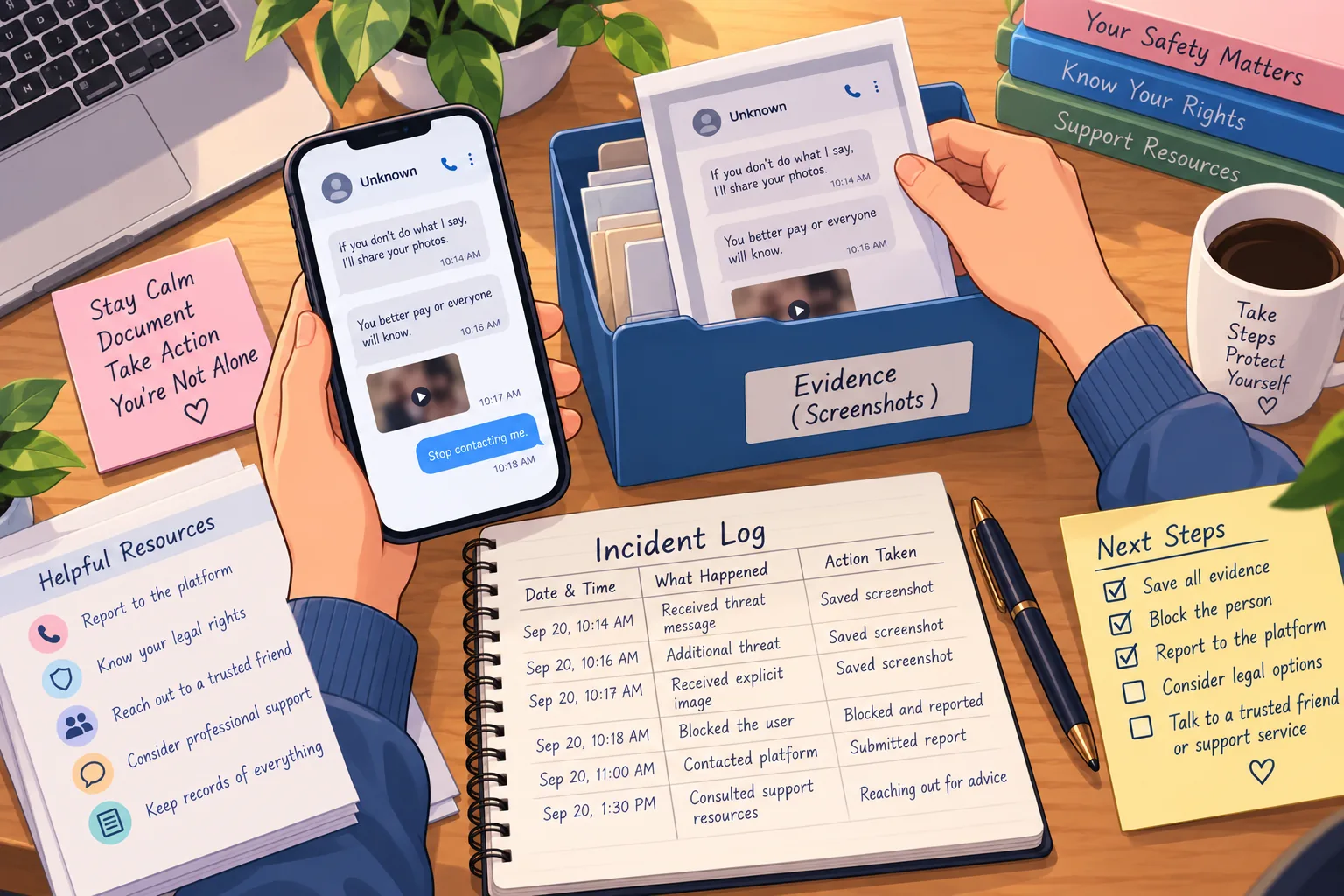
3. Document everything before deleting or blocking. Preserve complete messages, account information, URLs, dates, times, voicemails, emails, and any stalking-related incidents. IC3 specifically advises victims to retain original evidence because investigators may later request it. (IC3)
You are not required to handle this alone. If the threat is immediate or you are in danger, contact local law enforcement or emergency services. In the United States, an online crime can also be reported to the FBI's Internet Crime Complaint Center (IC3), while time-sensitive matters should be reported directly to local law enforcement. (IC3)
Emergency Protocol: What to Do Immediately When Facing STI Disclosure Extortion
An STI disclosure threat turns private health information into a pressure tool: "Do this, or I will tell your family," "Pay me, or I will tell your coworkers," or "Stay with me, or I will post your diagnosis online."
That is not a normal disagreement about sexual health.
The exact legal classification depends on what the person is demanding, what they threaten to do, where the conduct occurs, and which laws apply. Depending on the facts and jurisdiction, conduct may involve extortion, stalking, cyberstalking, harassment, threats, or other offenses. It is therefore safer to preserve the evidence and describe exactly what happened rather than promising yourself that a particular criminal charge will apply.
The important distinction is between the existence of an STI and the conduct used against you.
Your health information may be sensitive and deeply personal. That does not mean a person who learns it automatically acquires a right to control your decisions.
And while the term "sextortion" is commonly used for threats involving intimate images or sexual material, a threat to expose an STI status does not automatically meet a particular legal definition of sextortion. In this guide, "disclosure extortion" refers more broadly to using private STI information as leverage, while "sextortion" is used where the facts actually involve sexual exploitation or intimate material.
The Zero-Compliance Rule: Why You Must Never Negotiate or Pay
The safest default is to stop rewarding the threat.
That means you should not:
- Send money.
- Send cryptocurrency or gift cards.
- Provide passwords or additional personal information.
- Agree to unwanted sexual activity.
- Resume or maintain a relationship solely to prevent disclosure.
- Promise future compliance in exchange for silence.
- Keep negotiating after you have preserved the evidence.
FBI guidance on sextortion states that continued contact and compliance with payment or other demands have not been shown to reliably prevent further distribution and can result in additional demands. (FBI)
This does not mean that every victim should confront the person or immediately announce, "I am reporting you."
It means do not treat the threat as a negotiation in which the other person gets to keep increasing the price of your privacy.
The more useful question is:
"How do I preserve evidence and regain control?"
rather than:
"What can I give them so this finally ends?"
If you have already paid or complied, do not assume that you have ruined your options. Save the payment records, messages, usernames, and subsequent demands and report what happened.
Stopping the Panic: Understanding the Blackmailer's Leverage
The threat becomes powerful because the target believes disclosure would be catastrophic.
That fear is real.
You may be imagining your employer finding out, your family reacting badly, your friends judging you, or future partners learning about your health history.
But the threat itself is an attempt to turn that fear into leverage.
A useful crisis reframe is:
The problem is no longer whether your STI is embarrassing. The problem is that another person is attempting to control you with private information.
This distinction matters because shame often encourages secrecy and isolation. Isolation makes it easier for a threatening person to convince you that there is nobody you can tell.
There are people and institutions whose job is to respond to stalking, harassment, threats, and cybercrime. The National Domestic Violence Hotline notes that stalking can involve repeated unwanted communication, surveillance, information gathering, online harassment, and technology-facilitated abuse, and recommends documenting patterns and seeking law-enforcement or protective-order assistance when appropriate. (The National Domestic Violence Hotline)
You do not need to feel completely calm before taking action.
The objective is simply to move from:
Fear → Reaction
to:
Evidence → Security → Reporting → Support.
Step-by-Step Evidence Gathering: Building a Legal-Grade File
Do not assume that one screenshot will be enough.
You cannot guarantee in advance what a police department, prosecutor, attorney, platform, or court will consider sufficient evidence. What you can do is preserve information in a way that makes the pattern easier to understand and authenticate.
IC3 specifically asks complainants for detailed information about the subject, what happened, and available digital identifiers, and advises people to keep original evidence securely because investigators may request it later. (IC3)
Technical Screenshot and Metadata Protocol
Start by capturing the full context of the threat.
A useful evidence set should include:
The message itself — Capture the exact statement containing the threat, demand, or harassment.
The surrounding conversation — Do not save only the most dramatic sentence. Preserve enough context to show what happened before and afterward.
The account identity — Capture the username, display name, profile page, phone number, email address, profile ID, or other identifier available on the platform.
The source — Where possible, preserve the original conversation URL, profile URL, email header, or platform location where the threat appeared.
Date and time — Keep the visible date and time associated with the communication. Also record the time you received it in your incident log.
Attachments — Preserve threatening photographs, files, voice messages, videos, or other material in their original form where possible.
Repeated contact — Do not document only the first threat. A pattern of repeated calls, new accounts, messages, profile changes, appearances at locations, or threats to contact third parties may be important.
The National Domestic Violence Hotline recommends saving texts, emails, voicemails, letters, social-media evidence, and other records, with identifying information and dates preserved where possible. (The National Domestic Violence Hotline)
Do not crop everything down into isolated fragments if the original context can be preserved separately.
A good rule is:
Create the clean evidence copy first; create any shortened presentation copy later.
If a message disappears automatically, take a screenshot or screen recording immediately.
If the platform allows you to export a conversation, preserve the export as well.
If you are considering recording a phone or in-person conversation, check the recording-consent law where you are before doing so. Recording laws can differ significantly by jurisdiction. Do not create a new legal problem while attempting to create evidence.
Organizing the Digital Paper Trail for Law Enforcement
Create a simple incident timeline.
You do not need sophisticated forensic software. A spreadsheet or text document can contain:
| Date & Time | Event | Platform / Location | Evidence | Action Taken |
|---|---|---|---|---|
| Sept. 20, 8:42 PM | Threatened to disclose STI | Instagram DM | Screenshots 001–004 | No response |
| Sept. 21, 9:10 AM | Contacted from new account | Screenshots 005–007 | Reported account | |
| Sept. 21, 2:15 PM | Threatened to contact employer | SMS | Screenshots 008–010 | Police contacted |
Also preserve:
- Original screenshots.
- Original message exports.
- Emails with full headers where available.
- Voicemails and call logs.
- URLs and usernames.
- Payment records, if money was demanded or sent.
- Information about witnesses.
- Notes about physical appearances or following behavior.
- Copies of platform reports and confirmation numbers.
IC3 specifically lists electronic copies of emails, webpages, chat transcripts, and telephony logs among the types of evidence that may be relevant to a cybercrime complaint. (IC3)
Store the evidence somewhere the other person cannot access. That might mean an encrypted storage location, a secure cloud account, or a separate device or account controlled only by you.
Do not alter the original evidence unnecessarily. If you annotate a screenshot for your own understanding, preserve an untouched original separately.
And do not assume that "I have screenshots" automatically means "the case will be prosecuted." The goal is to make the evidence complete, chronological, and understandable.
Digital Privacy Lockdown: Securing Your Accounts and Location Data
Once the evidence is preserved, reduce the amount of additional information the person can access.
This is especially important when stalking or repeated unwanted contact is involved. Technology-facilitated stalking can include monitoring, repeated unwanted communication, information gathering through public records, and misuse of location or social-media data. (NNEDV)
Social Media and Friend List Hardening
Think of your online presence as several doors rather than one switch. Start with the accounts that reveal the most about your real-world relationships. Review:
Profile visibility — Set personal social accounts to the most restrictive practical settings.
Friend and follower visibility — Hide your friend list or restrict who can view connections where the platform allows it. Facebook, for example, provides settings for controlling who can see your Friends section, although mutual connections may remain visible through other profiles. (Facebook Help Center)
Old posts — Review older public posts that reveal your workplace, neighborhood, family members, routines, or frequently visited locations.
Tagged photos — Limit who can tag you and review existing tags.
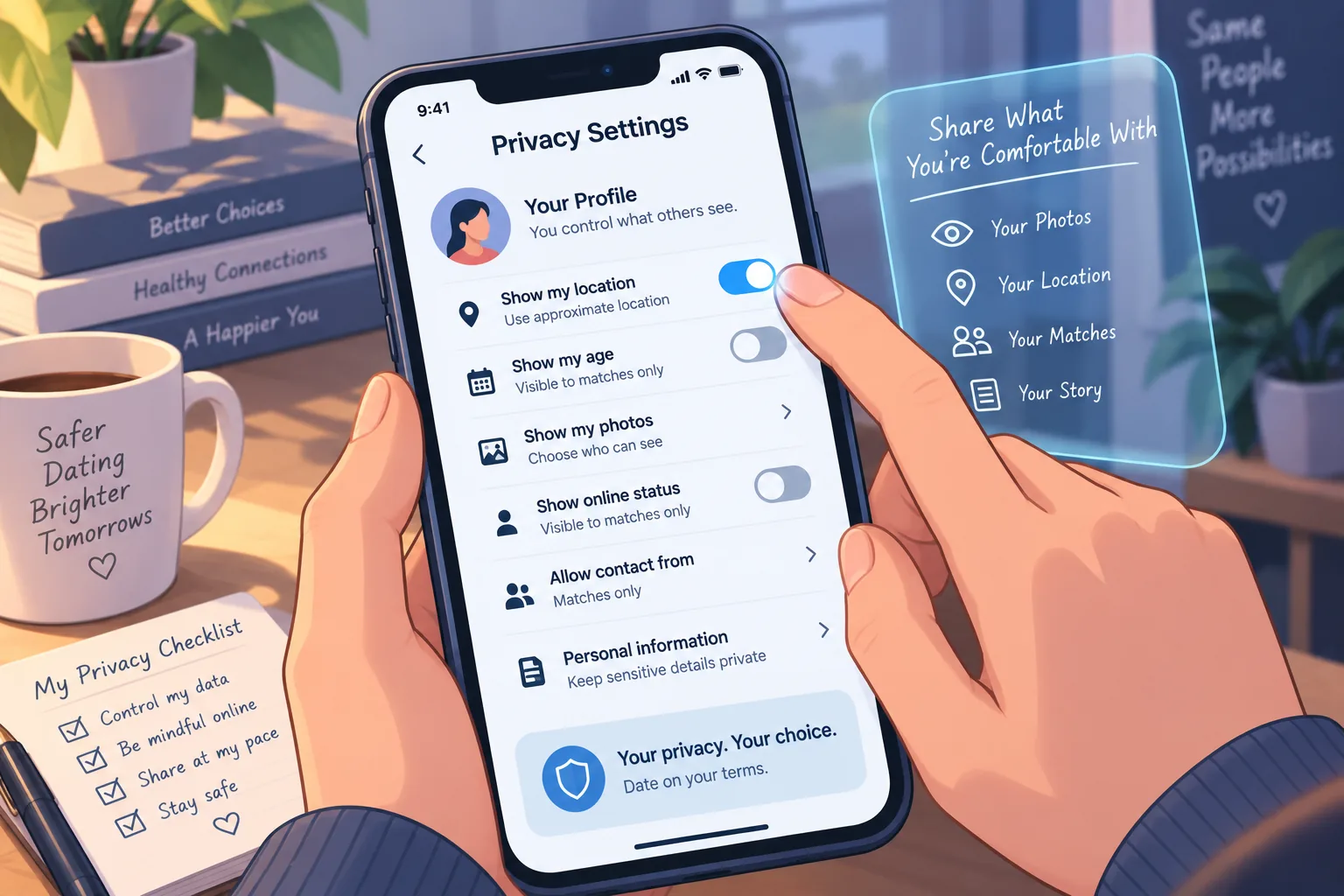
Location sharing — Check location sharing in social-media apps, mapping services, family-sharing systems, ride-sharing services, and other applications that may expose your location.
Account security — Change passwords for important accounts, especially if the other person may know or guess them. Use unique passwords and multi-factor authentication where available.
Active sessions — Review logged-in devices and revoke access you do not recognize.
Recovery information — Check account recovery emails, phone numbers, and authentication methods. A stalker who cannot access your main account may still exploit an unsecured recovery channel.
If you suspect spyware or unauthorized monitoring on your device, do not assume that immediately deleting apps or resetting everything is always the safest first move. Depending on the situation, those actions may destroy useful evidence or alert the person monitoring you. Consider using a different trusted device to seek professional assistance.
NNEDV's Safety Net Project specifically focuses on technology-facilitated abuse, privacy, surveillance, stalking, and safety planning, and recommends survivor-centered approaches to technology rather than assuming that simply abandoning technology is always practical. (NNEDV Safety Net Project)
Data Broker Opt-Outs and Physical Location Safety
A person does not necessarily need hacking skills to find your address. People-search and data-broker sites can compile information from public records, social media, and other sources. The FTC notes that these reports may contain addresses, phone numbers, relatives, employment information, property records, and other identifying information. (FTC)
Search for yourself using combinations such as full name + city, phone number, email address, old address, and username.
When a people-search site provides an opt-out process, follow it. The FTC notes that many people-search sites provide opt-out mechanisms, although opting out does not remove information from public records and information can reappear later. (FTC)
This should be treated as an ongoing privacy-maintenance task rather than a one-time magic deletion.
Also review whether your public profiles reveal:
- Your employer.
- Your home neighborhood.
- Your regular gym.
- Your child's school.
- Your daily routine.
- Frequently visited locations.
- Family members' public accounts.
Do not post your exact location in real time when you are concerned about stalking.
And if the person has already demonstrated that they know where you live or work, treat that as more than a social-media problem. Ask law enforcement or a victim-services professional about the appropriate safety measures in your jurisdiction. The Hotline specifically recommends safety planning, documenting stalking behavior, and involving law enforcement where appropriate. (The National Domestic Violence Hotline)
Cease-and-Desist Protocols: Word-For-Word Warning Templates
A written warning can be useful in some situations, but it is not automatically the safest move.
If the person is escalating, threatening physical harm, following you, appearing at your home or workplace, or demonstrating unpredictable behavior, do not confront them simply to obtain a cleaner final message. Preserve the evidence and seek professional guidance instead.
Likewise, do not falsely claim that a specific statute has already been violated unless you know that the law applies. "This is definitely a felony under state law" may sound intimidating, but an inaccurate legal statement weakens your credibility.
The strongest message is usually short, factual, and difficult to argue with.
The Grey Rock Response: Neutralizing Emotional Manipulation
"Grey rock" is commonly used to describe deliberately minimizing emotional engagement with a manipulative person. In this context, the principle is simple:
Do not give the threatener the emotional conversation they are trying to create.
That means avoiding:
"Please don't do this. I'm begging you."
"How could you do this to me?"
"You know how much this would destroy my life."
"I will ruin you if you tell anyone."
Instead, use neutral language when a response is necessary. For example:
"I will not discuss this further."
or:
"Do not contact me again."
Then stop.
The National Domestic Violence Hotline states that people experiencing stalking do not owe the stalker a response and notes that, after telling the person to stop contacting them, it is typically safer not to continue engaging. (The National Domestic Violence Hotline)
Grey rock should not become a rigid rule. The right response depends on the threat, the relationship, the person's behavior, and your safety plan.
Formal Cease-and-Desist Script Templates
Template A: First Written Warning
Use this only when sending a written boundary is reasonably safe and you have already preserved the evidence.
"Your message on [DATE] threatened to disclose my private medical information unless I complied with your demand. I will not comply with that demand. Do not contact me again or disclose, publish, or distribute my private information. I am preserving records of your communications and will provide them to the appropriate platform and law-enforcement authorities if the threats or harassment continue. I will not respond to further messages."
This version deliberately avoids claiming a specific criminal statute. That is intentional. Whether the conduct constitutes extortion, harassment, stalking, or another offense depends on the facts and jurisdiction. The goal of this message is to establish a clear boundary and create a written record — not to impersonate an attorney.
Template B: Final Notice and Cutoff
Use this when the pattern has continued and you have already preserved the relevant evidence:
"This is my final notice. Do not contact me by phone, email, social media, through another account, or through another person. Do not disclose, publish, or distribute my private medical information. Your communications and prior threats have been documented and preserved. Any further threats, harassment, stalking, or disclosure of my private information will be reported to the appropriate platform and law-enforcement authorities. I will not respond to further contact."
After sending one final notice, continuing to debate the situation usually defeats the purpose. Do not send five more messages explaining why you are serious.
One boundary is enough.
Reporting and Legal Recourse: Taking Action Against Cyber Extortion
The legal response should match the actual conduct.
If the person only made one unpleasant comment, the appropriate response may differ from a pattern involving repeated threats, stalking, demands for money, threats against your workplace, or attempts to force sexual activity.
If someone threatens you with physical harm or you believe you are in immediate danger, contact emergency services or local police rather than waiting for an online reporting process. IC3 explicitly directs people in immediate danger to call 911 or local police and recommends contacting local law enforcement directly for time-sensitive matters. (IC3)
Reporting to Dating Apps and Social Platforms
Use the platform's official reporting tools rather than trying to negotiate with the account owner.
When reporting, keep your explanation factual — what happened ("The person threatened to disclose my private STI/medical information unless I complied with a demand"), when it happened ("The first threat occurred on [date/time]. Additional threats occurred on [dates]"), how the behavior continued ("After I stopped responding, the person contacted me from two additional accounts"), and what evidence exists ("I have preserved screenshots, account identifiers, URLs, and a chronological incident log").
Report the account for the most accurate category available, such as threats, harassment, stalking, blackmail, extortion, or privacy abuse.
Do not assume that a platform will automatically reveal the person's IP address to you or permanently ban the account. Platform investigations and data preservation are controlled by the platform. Your role is to provide an accurate record and preserve the confirmation of your report.
If the person creates new accounts, add those developments to your incident timeline rather than starting a completely separate story each time.
Involving Law Enforcement: Local Police and FBI IC3
For stalking, threats, or harassment, local law enforcement is often the most direct starting point, particularly when the conduct is ongoing or you are concerned about your physical safety.
The Department of Justice advises stalking victims to document dates, times, contacts, threats, correspondence, and witnesses because those records can support an investigation or prosecution. (U.S. Department of Justice)
When you report, bring or provide your incident timeline, screenshots, account identifiers, phone numbers and email addresses, URLs, voicemails, call logs, copies of relevant correspondence, information about witnesses, any evidence of physical following or unwanted appearances, and payment records if money was demanded or transferred.
Ask for the incident or report number and keep it with your evidence file.
Filing an IC3 Complaint
For cyber-enabled crime in the United States, you can also file a complaint with the FBI's Internet Crime Complaint Center.
IC3 accepts complaints from people affected by cyber-enabled crime, including people outside the United States, and asks for information about the complainant, the subject, and the specific conduct. (IC3)
One important detail is often overlooked: IC3 is not an evidence-upload portal. IC3 says it does not collect evidence or accept attachments with complaints and instructs complainants to preserve original documents securely because investigators may request them later. (IC3)
After submitting your complaint, save or print the confirmation because IC3 states that the confirmation page is the point at which you can retain a copy of the complaint. (IC3)
And do not expect IC3 itself to provide an investigation-status update. Its FAQ states that complaints are reviewed and may be forwarded to appropriate agencies, while investigation and prosecution decisions belong to the receiving agencies. (IC3)
Can Someone Be Arrested for Threatening to Expose Herpes?
Potentially, but there is no universal rule that threatening to reveal herpes automatically results in arrest.
The legal outcome depends on the exact threat, what the person demanded, whether money or another benefit was sought, whether there was stalking or repeated harassment, whether the threat crossed a criminal threshold, and which jurisdiction applies.
For example, U.S. federal and state authorities have prosecuted extortion schemes involving threats to disclose sensitive information, but those cases depend on specific facts and applicable statutes. (U.S. Department of Justice)
Do not rely on a generic internet statement that "revealing someone's STI is illegal." That is too broad.
In the United States, HIPAA also does not automatically make a private person's disclosure of health information illegal. HHS explains that HIPAA's Privacy Rule applies to covered entities and business associates, not ordinary individuals acting privately. (U.S. Department of Health & Human Services)
The stronger legal question is: what exactly is the person doing to you, what are they demanding, and what laws govern that conduct where you live? That is the information to take to law enforcement or a qualified attorney.
When a Protection or Restraining Order May Matter
If the conduct involves stalking, repeated unwanted contact, threats, or physical safety concerns, ask local law enforcement, a victim advocate, or a lawyer whether your jurisdiction provides a protective or restraining order.
The rules differ by state and country, and the availability of an order depends on the facts.
A protection order should not be treated as a substitute for a safety plan. The Department of Justice notes that police reports can create an independent record of stalking incidents and may support applications for protective orders. (U.S. Department of Justice)
If you believe requesting or serving an order could provoke an escalation, discuss that risk with a victim-services professional or attorney before taking that step.
Reclaiming Your Power: Your Health Information Is Not a Weapon
Your STI status is part of your private health story. It is not a permanent debt you owe to someone who learned about it.
A person may choose not to date you. They may have questions. They may need time to understand your situation. Those are legitimate personal decisions.
But turning private health information into a threat is a different behavior.
The important legal distinction is that not every disclosure is automatically a crime, but threats, extortion, stalking, harassment, or coercive conduct may create criminal or civil consequences depending on the facts and jurisdiction.
That is why the strongest response is not shame. It is documentation. Not panic. A plan. Not endless negotiation. A clear boundary followed by appropriate reporting.
You do not have to convince the person that your STI is nothing to be ashamed of before you deserve to be left alone.
You do not have to prove that your diagnosis is medically ordinary before your privacy matters.
And you do not have to buy your way out of a threat.
Your objective is to move the situation out of the private emotional battlefield and into a structured process:
Preserve the evidence. Secure your accounts. Reduce the person's access to your information. Report the conduct through the appropriate channels. Get professional support when the behavior escalates.
Most importantly, separate your health condition from their conduct.
The shame belongs nowhere in your decision-making process.
Your job is not to protect a blackmailer's leverage. Your job is to protect yourself.