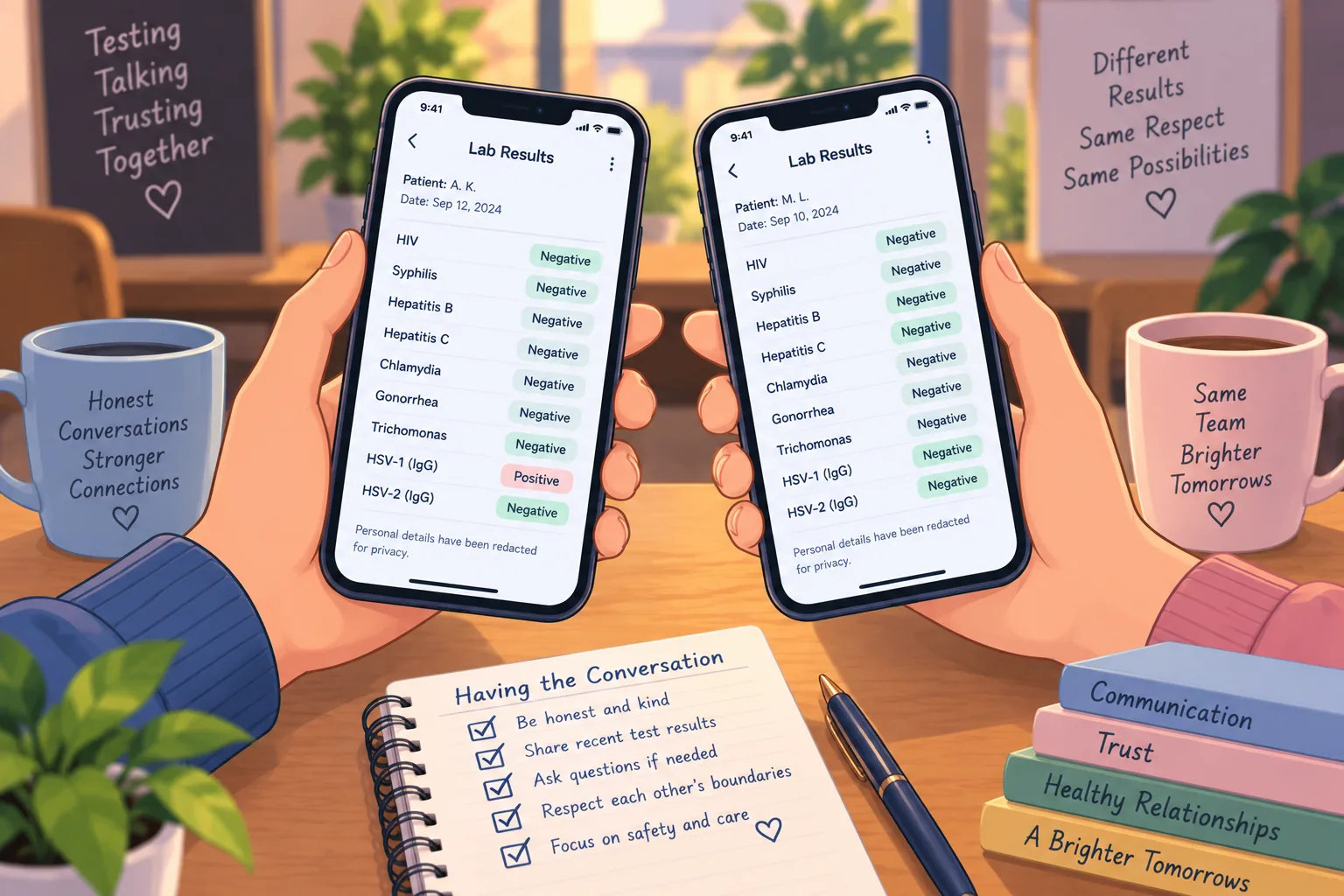
The safest way to exchange STI test results is to make it mutual, specific, and privacy-conscious: share your own recent results, ask what your partner was tested for and when, and review the actual report without demanding unnecessary personal information.
You do not need to turn a date into an interrogation.
You also do not need to accept "I'm clean" as a substitute for useful health information.
CDC recommends talking with sexual partners before sex about when each person was last tested and considering getting tested together.
A practical approach is:
Ask → Share → Verify → Decide.
That process protects your health without turning sexual-health communication into a trust test.
The Golden Rule: Lead With Yours, Normalize the Process
The easiest way to ask for STI results is to make the conversation reciprocal from the beginning.
Instead of:
"Can I see your STI test results?"
try:
"I usually exchange recent results before having sex with someone new. I'm happy to show you mine too."
The difference is small, but the social meaning is very different.
You are no longer asking someone to prove they are trustworthy.
You are establishing a shared health practice.
CDC specifically recommends talking about when you and your partner were last tested and suggests getting tested together as one way to make sexual-health conversations easier.
Why "I'm Clean" Is Not a Test Result
"I'm clean" sounds reassuring, but it does not tell you:
- when the person was last tested;
- which infections were tested;
- whether the testing happened after the person's most recent exposure;
- which body sites were tested;
- whether the test was appropriate for the exposure;
- or whether some infections were not included.
A more useful statement is:
"My last STI screen was in June, and it included HIV, syphilis, chlamydia, and gonorrhea."
That gives you something concrete to work with.
It also avoids treating STI status as a judgment about whether someone is "clean" or "dirty." A test result is health information, not a character assessment.
Just as importantly, a negative result is never a permanent certificate. CDC notes that STI testing recommendations depend on factors such as age, sexual history, current practices, symptoms, and exposure sites.
Step 1: How to Ask for STI Results With Word-for-Word Scripts
Timing matters almost as much as wording.
The best moment is usually before sex becomes imminent, when both people can talk without feeling cornered.
You do not need to introduce the subject during the first five minutes of a date. But waiting until clothes are already coming off can make a simple health conversation feel like a confrontation.
A good rule is:
Talk before the decision, not after the decision has already been made.
Scenario A: Casual Dating / Before First Intimacy
A natural version is:
"I'm really enjoying getting to know you. Before we take things further, I usually talk about STI testing. I had my own tests done recently, and I'm happy to show you the results. When was the last time you were tested?"
A more direct version:
"Before we have sex, I like us both to know where we stand with recent testing. My latest results are here. Do you have recent results you'd be comfortable sharing?"
A shorter version for dating apps or text:
"Before we hook up, I like to exchange recent STI testing info. No pressure to share anything beyond the results themselves — I just prefer that we're both informed."
The important feature is mutuality.
You are not saying:
"Prove you're safe."
You are saying:
"Let's make an informed decision together."
Scenario B: Transitioning to a Monogamous Relationship
The conversation often changes when a couple is considering becoming exclusive or reducing barrier use.
Try:
"Now that we're talking about being exclusive, I'd feel better if we both got current STI testing and compared what was actually tested before we make any changes to our usual protection."
Or:
"Before we stop using condoms, I'd like us both to have recent testing and talk through what the results cover."
That second version is important because an "updated panel" does not necessarily test every STI for every person.
CDC emphasizes that testing should be tailored to sexual practices, symptoms, risk factors, and anatomy rather than assuming every person needs exactly the same tests.
So the real goal is not:
Get a test.
It is:
Get the relevant tests, understand them, and decide what the results mean for both of you.
When Should You Ask?
There is no medically mandated "third date" or "before the fifth hookup" rule.
A useful practical sequence is:
Before first sexual contact: discuss testing, recent partners, barriers, and any known STI.
Before changing your protection strategy: review more recent testing and discuss whether the results actually cover the risks relevant to both of you.
After a new exposure or diagnosis: do not rely on older results; reassess the situation and seek appropriate medical advice.
The closer a test date is to the current situation, the more relevant it may be — but there is no universal 3- or 6-month expiration date that makes every STI result automatically valid or invalid. The right interval depends on the person, exposure, infection, and testing strategy.
Step 2: How to Share Your Results Safely
Sharing your results should provide enough information for an informed decision without turning your entire medical history into relationship property.
In the United States, HIPAA generally gives patients rights to access copies of their own medical records, including clinical laboratory test reports. Many providers make these records available through online portals.
That makes an official patient portal or laboratory report a useful starting point for sharing your own results.
Digital Portals vs. PDF Reports
A practical preference is:
1. Original patient portal
Show the result from your healthcare provider's or laboratory's official portal, or download the report directly from it.
This helps establish where the information came from and lets you review the original test details.
2. Official laboratory PDF
A PDF downloaded directly from the testing provider can also be useful.
The important point is not that every PDF is automatically authentic.
It is that the document should identify the issuing organization and show the underlying test information rather than simply displaying a single sentence such as "STI negative."
3. Screenshot
A screenshot can be convenient, but it contains less context than viewing the underlying report.
If using a screenshot, make sure the important information is still visible and do not crop away the test date or the test names.
4. Verbal statement
A verbal statement can be a reasonable first conversation, but it provides less information than an actual report.
For example:
"I tested negative recently."
is useful background.
It is not the same as:
"My HIV, syphilis, chlamydia, and gonorrhea tests were negative on June 10."
Even then, you still need to know whether the testing was appropriate for the exposure and whether the timing makes sense.
Privacy Masking: What to Show and What to Hide
You do not need to share your entire medical record just to establish your STI testing history.
Before sending a report, consider removing information that is irrelevant to the sexual-health decision, such as:
- home address;
- phone number;
- email address;
- insurance member or policy information;
- Social Security number or similar government identifier;
- account numbers;
- billing details;
- unrelated diagnoses or medications.
The information that usually matters most for this conversation is:
- issuing clinic or laboratory;
- patient identifier sufficient to establish that the report belongs to you, when you are comfortable sharing it;
- collection date or test date;
- specific tests performed;
- test results;
- relevant specimen type or testing site when shown;
- any laboratory comments that affect interpretation.
There is an important balance here.
Privacy masking should remove unnecessary sensitive information, not the information needed to understand the test.
For example, masking your home address makes sense.
Masking the test date does not, because timing can materially affect how a result should be interpreted.
If you are uncomfortable sending a copy electronically, another option is to open the official patient portal in person or on a video call and show only the relevant test section.
Your medical record belongs to you to access and control within the applicable privacy framework; sharing a particular part with a dating partner is a personal choice, not a general requirement.
Step 3: How to Verify STI Results for True Peace of Mind
"Verify" should not mean trying to investigate someone's private medical history.
A dating partner generally does not have access to the healthcare system's internal records needed to independently authenticate another person's medical information.
Instead, verification should mean:
Does the report appear to come from a legitimate source, is it recent enough to be relevant, does it clearly show what was tested, and does it belong to the person showing it?
The Verification Checklist: 4 Things to Look For
1. Issuing Laboratory or Clinic
Look for a clearly identified healthcare provider, laboratory, public-health service, or other legitimate testing organization.
A report should not rely only on a decorative logo or a generic statement such as "100% STI FREE."
The goal is to identify the actual source of the test.
You do not need to become a laboratory-accreditation investigator. The practical question is simply:
"Where did this test come from?"
If the person obtained the test through a recognized clinic or laboratory's official system, that provides substantially more context than an unattributed image.
2. Collection Date or Test Date
Look at the collection date or the date associated with the actual test.
Do not focus only on when a PDF was downloaded or printed.
A report printed yesterday may contain a test performed months earlier.
At the same time, there is no universal rule that says every STI result becomes invalid after exactly 90 or 180 days.
The relevance of the result depends on what happened afterward, the infection being tested for, and the testing guidance that applies to the person. CDC recommends different testing intervals for different populations and situations.
A better question is:
"When were you last tested, and have you had any partners or exposures since then?"
That question can tell you more than arguing over whether a result is "three months old."
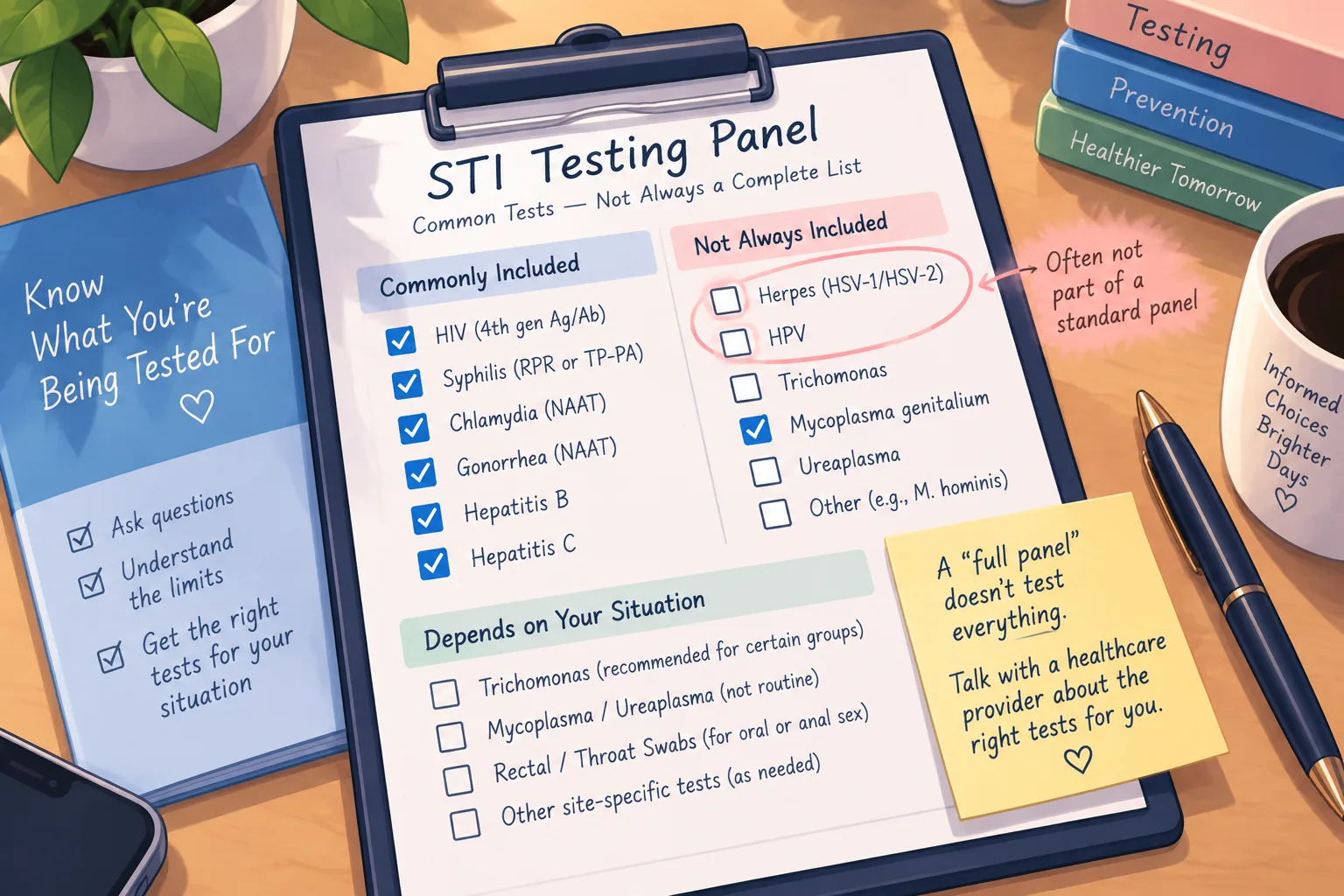
3. Panel Breakdown
A meaningful report should show what was actually tested.
Look for specific test names such as:
- HIV;
- syphilis;
- chlamydia;
- gonorrhea;
- hepatitis B or C;
- or other specific tests performed.
Do not assume that the phrase "full panel" means everything.
Different testing packages include different tests, and some STIs are not routinely screened for in asymptomatic people. CDC encourages people to ask their healthcare provider which STI tests are appropriate for their situation.
The same principle applies to body sites.
A urine or genital sample does not automatically tell you what happened at the throat or rectum. Depending on sexual practices and exposure, additional site-specific testing may be appropriate.
4. Patient Identity
If someone is voluntarily sharing a report, it should be reasonably clear that the report belongs to them.
That does not mean demanding unrestricted access to their identification documents.
A person may choose to show their name while masking unrelated identifying information such as their address or insurance number.
The aim is to establish context, not collect someone's personal data.
What a Real Report Still Cannot Prove
Even a genuine laboratory report has limits.
A report can show that a particular test was performed and what the result was on that date.
It cannot prove:
- what happened after the test;
- whether a new exposure occurred afterward;
- whether an infection outside the tested scope was present;
- whether the test was taken during a window period;
- whether an anatomical site not tested was infected.
That distinction is crucial.
Authenticity and completeness are different questions.
A perfectly genuine report can still be insufficient for the decision you are trying to make.
What to Do If They Hesitate, Get Defensive, or Refuse
Someone's refusal to share a medical document is not automatically evidence that they have an STI.
People have legitimate privacy boundaries.
They may have concerns about their name, address, insurance information, medical history, or the general idea of sharing healthcare records with someone they do not know well.
The more useful question is:
Can we find another way to make an informed sexual-health decision?
De-escalating Defensive Responses
If someone says:
"You don't trust me?"
you can respond:
"This isn't about assuming anything about you. I use the same standard for myself. I like both of us to have clear information before deciding how we want to have sex."
Or:
"I'm not asking for your entire medical history. I just want to know what you were recently tested for and when."
Another option is:
"You don't have to send me a copy if you'd rather not. We can talk about the tests, test together, or keep using condoms until we're both comfortable."
That last response is especially useful because it separates their privacy choice from your sexual-health boundary.
A person can say:
"I don't want to share my report."
And you can say:
"That's your choice, and I respect it. I'm also not comfortable having unprotected sex without more information."
Those statements can coexist.
When to Pause Instead of Arguing
Pay attention not just to whether someone shares a report, but to how they respond to your boundary.
A healthy response might be:
"I understand. I'm private about medical records, but I can show you the relevant results."
Another reasonable response might be:
"I haven't been tested recently. Let's both get tested."
A less constructive response is:
"If you loved me, you wouldn't ask."
Or:
"You're insulting me by even bringing this up."
The issue is no longer simply the document.
It is whether the two people can discuss health boundaries without coercion or humiliation.
Knowing When to Walk Away
You do not need to prove that someone is dishonest before deciding not to have sex with them.
Your boundary can simply be:
"I'm going to pass for now. I need more clarity about sexual health before I'm comfortable moving forward."
Or:
"Let's get tested first. I'm happy to do it together."
Or:
"I'm comfortable continuing to date, but I'm not comfortable having unprotected sex without current information."
That is not punishment.
It is ordinary risk management.
You are also free to choose barriers even when someone has a recent negative test. Testing and barrier use are complementary tools, not mutually exclusive decisions. CDC lists regular testing and condom use among the measures that can reduce STI risk.
The Three Questions That Matter More Than "Are You Clean?"
When discussing a partner's STI results, the most useful questions are remarkably simple:
When were you last tested?
What exactly were you tested for?
Have you had any sexual exposures since then?
Depending on the situation, add:
Were the relevant body sites tested?
These questions are more informative than asking:
"Are you clean?"
because they produce information you can actually use.
CDC similarly encourages people to discuss the timing of testing, sexual practices, and testing needs with both partners and healthcare providers.
A Simple Ask-Share-Verify Protocol
For readers who want a repeatable process, use this four-step version.
ASK
Lead with your own standard:
"I exchange recent STI testing information before having sex. I'm happy to share mine too."
Then ask:
"When were you last tested, and what did the testing cover?"
SHARE
Use your official laboratory or patient-portal results when possible.
Show the relevant pages.
Mask unnecessary identifiers.
Keep the test date and actual test names visible.
VERIFY
Check:
Source → Date → Tests → Results → Relevant body sites → What happened after the test
Do not attempt to access records you are not authorized to see.
Do not ask for passwords, insurance portals, full medical histories, or unrelated health information.
DECIDE
A test report is information, not an instruction.
You still decide:
- whether to use condoms;
- whether to get tested together;
- whether you need additional information;
- whether the timing is sufficient for your situation;
- whether you are comfortable having sex;
- whether you want to wait.
That final step is important because informed consent includes the freedom to say "not yet."
Transparency Is the Foundation of Great Sex
Exchanging STI results does not have to make dating clinical, cold, or awkward.
In fact, a calm conversation about sexual health can make intimacy easier because both people know what the other person values.
The goal is not to create a world where every date arrives carrying a certified "risk-free" certificate.
That document does not exist.
The goal is to create a culture where people can comfortably say:
"Here's when I was tested."
"Here's what was tested."
"Here's what wasn't included."
"Here's what I'm comfortable with."
"What about you?"
That is much more useful than relying on vague reassurance.
A recent negative result can be valuable information. A genuine report can help two people make informed decisions. But neither should be treated as a guarantee of zero STI risk.
The healthiest approach is therefore not maximum disclosure.
It is relevant transparency.
Share enough information for informed consent.
Protect the information that is not relevant.
Ask questions without interrogating.
Set boundaries without accusing.
And remember that respecting someone's medical privacy does not require you to ignore your own health boundaries.
A mature sexual-health conversation can be as simple as:
"I'll show you mine. Tell you when it was done and what it covered. I'd like to understand yours too. Then we can decide together what feels right."
That is not distrust.
It is two adults taking responsibility for the same decision.