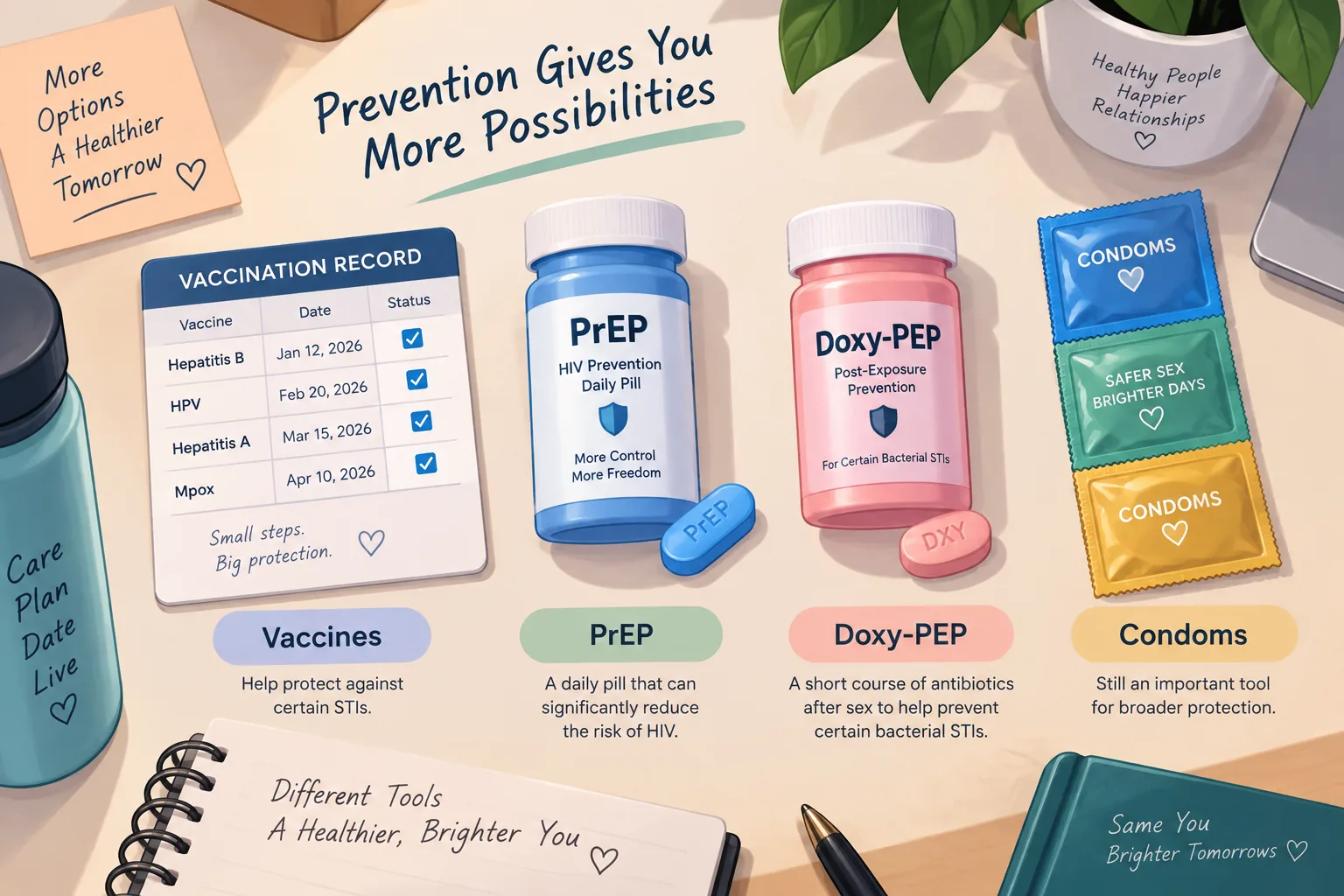
Condoms remain an important STI prevention tool, but they are not the only layer of protection available. Modern sexual health can combine vaccines, HIV PrEP, Doxy-PEP, testing, and appropriate barrier methods to address different types of STI risk.
This approach is called combination STI prevention: instead of relying on one tool to solve every problem, you build several complementary layers based on your health, partners, and dating patterns.
That matters because different STIs behave differently. Condoms can reduce the risk of many infections but cannot completely cover skin that remains exposed. Vaccines can prevent certain infections before exposure occurs. PrEP specifically prevents HIV, while Doxy-PEP can reduce the risk of certain bacterial STIs for people who meet current clinical recommendations.
The goal is not to eliminate every sexual-health risk. It is to make that risk more manageable through tools you can choose deliberately.
The Shift to Combination STI Prevention: Why Condoms Aren't the Only Tool
Condoms work by creating a physical barrier that reduces contact with infectious fluids and affected tissue. Used correctly and consistently, they can substantially lower the risk of many STIs.
But condoms do not cover every part of the genital, anal, or surrounding skin. HPV, for example, can infect areas that are not covered by a condom, so condoms reduce but do not eliminate HPV transmission. The same principle applies to some infections that can spread through skin-to-skin contact.
This is where combination prevention becomes useful.
Instead of asking:
"Should I rely on condoms or not?"
A more useful question is:
"Which prevention tools address the specific risks I actually have?"
A person who dates occasionally may need a different prevention setup from someone in an open relationship. Someone living with HIV may need a different strategy from an HIV-negative person using PrEP. Someone who has recently had a bacterial STI may be a candidate for Doxy-PEP, while another person may not.
The Anatomy of a Biomedical Toolkit
A modern STI prevention toolkit can be viewed as several layers:
Layer 1 — Vaccines: Build protection against specific vaccine-preventable infections before exposure.
Layer 2 — HIV PrEP: Reduce the risk of acquiring HIV through sex or injection-drug exposure with antiretroviral medication.
Layer 3 — Doxy-PEP: For certain people at increased bacterial STI risk, use prescribed doxycycline after sex to reduce the likelihood of syphilis, chlamydia, and, to a lesser extent, gonorrhea.
These tools are complementary rather than interchangeable. A vaccine does not replace PrEP. PrEP does not prevent chlamydia. Doxy-PEP does not prevent HIV. And none of them replaces STI screening or appropriate clinical care.
Layer 1: Vaccines — The Long-Term Immunological Shield
Vaccination is the most straightforward prevention layer because it establishes protection before a sexual exposure occurs.
For STI-related sexual health, the most relevant vaccines include HPV and hepatitis B, with mpox vaccination relevant for people whose sexual networks or circumstances put them at increased risk.
HPV Vaccine (Gardasil 9): It's Not Just for Teens
Adults who are already sexually active can still benefit from HPV vaccination, but expectations matter.
CDC recommends routine HPV vaccination through age 26 for people who were not adequately vaccinated earlier. For adults ages 27–45 who were not adequately vaccinated, vaccination is based on shared clinical decision-making, rather than being routinely recommended for everyone.
Being sexually active does not automatically make HPV vaccination pointless.
Most sexually active adults have already encountered one or more HPV types, but that does not necessarily mean they have been exposed to all of the HPV types covered by the vaccine. HPV vaccination prevents new infections; it does not treat an HPV infection that already exists.
That distinction is important.
Someone who has previously had HPV may still have potential benefit from vaccination against HPV types they have not yet encountered. The potential benefit is generally greater for people who may have new sexual partners in the future than for someone in a long-term mutually monogamous relationship.
So "I've already had sex" is not, by itself, a reason to assume the vaccine has no value.
Hepatitis B, Mpox, and Meningococcal Vaccines
Hepatitis B vaccination is another important foundation of sexual-health prevention. CDC recommends hepatitis B vaccination for all adults ages 19–59 who have not previously been vaccinated, and for adults 60 and older who have relevant risk factors or who otherwise seek protection. Sexual exposure is one of the recognized risk factors.
Hepatitis B is particularly worth checking when building a long-term prevention plan because vaccination protects against an infection that can become chronic and cause serious liver disease.
Mpox vaccination may also be relevant for people whose sexual networks or activities place them at increased risk. CDC currently recommends a two-dose JYNNEOS series for defined populations at increased risk, including certain people with multiple partners, recent STIs, sex in commercial venues, or sex associated with large public events in settings where mpox transmission is occurring.
Meningococcal B vaccines require more caution in this context. Some research has explored cross-protection against Neisseria gonorrhoeae, but MenB vaccination is not a standard gonorrhea-prevention strategy and should not be presented as a substitute for STI prevention or screening. Current CDC meningococcal recommendations focus on preventing meningococcal disease, not treating MenB vaccination as a gonorrhea vaccine.
The practical lesson is simple: use vaccines for the infections they are actually designed and recommended to prevent, rather than treating every vaccine-related finding as a broad STI shield.
Layer 2: HIV PrEP — Continuous Pre-Exposure Prophylaxis
PrEP is one of the strongest examples of how modern biomedical prevention can separate HIV prevention from other STI risks.
PrEP is medication taken by people who do not have HIV to reduce their risk of acquiring HIV. CDC currently recognizes three FDA-approved PrEP medications in the United States: daily oral F/TDF, daily oral F/TAF, and long-acting injectable cabotegravir.
When taken as prescribed, oral and injectable PrEP reduce sexual HIV acquisition risk by about 99%.
PrEP does not prevent chlamydia, gonorrhea, syphilis, HPV, or herpes, so it works best as one layer within a broader prevention strategy.
Daily Oral PrEP vs. On-Demand 2-1-1 PrEP
The most familiar approach is daily oral PrEP.
In the United States, the two daily oral options are:
- F/TDF — emtricitabine/tenofovir disoproxil fumarate, sold as Truvada or generic equivalents.
- F/TAF — emtricitabine/tenofovir alafenamide, sold as Descovy.
F/TDF can be used for HIV prevention across sexual and injection-drug exposure routes. F/TAF is approved for sexual HIV prevention, but it has not been studied for people who could acquire HIV through receptive vaginal sex.
2-1-1 PrEP is different. It is an off-label, event-driven F/TDF regimen studied in adult gay and bisexual men. It is not FDA-approved and CDC does not recommend it as a general PrEP strategy. Under current CDC guidance, clinicians may prescribe it off-label to appropriate adult gay and bisexual men who want non-daily PrEP, have infrequent sex, and can anticipate sex sufficiently to take the initial dose at least two hours beforehand.
The 2-1-1 schedule is:
2 pills 2–24 hours before sex → 1 pill 24 hours later → 1 pill 48 hours after the first dose.
It is not a universal "take PrEP only when you date" method, and it should not be generalized to people or exposure routes for which it has not been studied. It is also not recommended for people with active hepatitis B because intermittent F/TDF use can cause problems when the medication is stopped.
Long-Acting Injectable PrEP (Apretude)
For people who do not want to take a pill every day, cabotegravir (Apretude) provides a long-acting injectable option.
The current U.S. schedule begins with one injection, a second injection one month later, and injections every two months thereafter. The regimen is intended for people who do not have HIV and want prevention of sexual HIV transmission.
One of its practical advantages is convenience: the prevention medication does not require remembering a daily pill.
It can also suit people who prefer greater medication privacy or who have difficulty maintaining daily adherence.
But injectable PrEP is not "set and forget." Keeping scheduled injections and HIV testing appointments matters because delayed injections can reduce protection. HIV testing is required before initiation and throughout treatment because undiagnosed HIV while receiving cabotegravir can create a risk of drug resistance.
Layer 3: Doxy-PEP — The Game-Changer for Bacterial STIs
Doxy-PEP stands for doxycycline post-exposure prophylaxis.
Unlike HIV PrEP, which is taken before exposure to prevent HIV, Doxy-PEP is taken after sex to reduce the chance of certain bacterial STIs.
Current CDC guidance recommends discussing Doxy-PEP with gay and bisexual men and transgender women who have had syphilis, chlamydia, or gonorrhea during the previous 12 months. When prescribed, the recommended dose is 200 mg as soon as possible within 72 hours after sex, with no more than 200 mg in a 24-hour period.
What Is Doxy-PEP and How Does It Work?
Doxycycline is an antibiotic that interferes with bacterial protein production.
When used as Doxy-PEP, it is taken after sex with the goal of stopping susceptible bacteria before an infection becomes established.
Clinical trials found substantial reductions in syphilis and chlamydia, with a smaller but meaningful reduction in gonorrhea in studied populations. CDC's evidence review found reductions of more than 70% for syphilis and chlamydia and approximately 50% for gonorrhea across major studies.
The timing matters.
The current protocol is not "take doxycycline sometime later this week." It is:
200 mg as soon as possible after sex, within 72 hours, and no more than 200 mg per 24 hours.
Doxy-PEP is also not a universal STI medication. It does not prevent HIV, HPV, herpes, or viral hepatitis.
And because it is an antibiotic, it should be used as a prescribed prevention strategy rather than self-directed or borrowed medication.
Who Should Use Doxy-PEP and What About Antibiotic Resistance?
Current CDC recommendations are deliberately narrower than the phrase "Doxy-PEP is for anyone who has sex."
The strongest recommendation is for gay and bisexual men and transgender women with a bacterial STI diagnosed during the previous 12 months, using shared decision-making with a healthcare provider. Evidence is currently insufficient for CDC to make a general recommendation for cisgender women, cisgender heterosexual men, transgender men, and other populations not represented adequately in the evidence base.
That does not mean other populations can never discuss Doxy-PEP with a clinician. It means the evidence and recommendation status are different, so the decision should be individualized rather than presented as a universal protocol.
Antibiotic resistance is one of the most important reasons for this caution.
Doxycycline exposure can select for resistant organisms, and researchers are continuing to monitor antimicrobial resistance and changes in the microbiome as Doxy-PEP becomes more widely used. CDC therefore recommends that Doxy-PEP be integrated with regular STI testing, clinical follow-up, vaccination, HIV prevention, and periodic reassessment of whether continued Doxy-PEP is appropriate.
In other words, Doxy-PEP is a targeted prevention tool — not an excuse to replace sexual-health screening with antibiotics.
Building Your Personal STI Protection Matrix
There is no single prevention stack that fits everyone.
Your strategy should reflect the infections that are relevant to you, the type of sex you have, how frequently you date, whether you have new or multiple partners, vaccination status, HIV risk, and any recent STI history.
A useful starting framework looks like this:
| Dating Scenario | Biomedical Layer | Barrier / Behavioral Layer |
|---|---|---|
| Casual or frequent dating | Check HPV and Hep B vaccination; consider HIV PrEP if HIV exposure is relevant; discuss Doxy-PEP with a clinician if you meet current criteria | Condoms or other barriers can add protection, especially when partner status and exposure sites are uncertain |
| Infrequent, predictable sexual activity | Daily PrEP may be appropriate for some people; eligible adult gay and bisexual men may discuss off-label 2-1-1 F/TDF with a clinician | Use barriers according to the specific exposure |
| Long-term mutually monogamous relationship | Confirm vaccination status and consider testing before reducing barriers | Prevention decisions can be based on mutual agreements, testing, exclusivity, and comfort |
| Open relationship / multiple partners | Vaccines + HIV PrEP when indicated; Doxy-PEP may be appropriate for people meeting current recommendations | Combine screening, partner communication, barriers, and site-specific testing |
| Living with an STI | Prevention should be tailored to the infection; vaccination and HIV PrEP may still be relevant | Follow treatment/suppression plans, discuss transmission risk, and agree on barriers with partners |
| Partner with HIV | HIV prevention depends on the partner's treatment and viral suppression status; PrEP may provide an additional option when indicated | Discuss viral load, testing, and barriers based on the couple's preferences and clinical context |
This matrix is a planning framework, not a prescription.
For example, someone living with HIV does not automatically need HIV PrEP, because PrEP is designed for people without HIV. Likewise, someone using HIV PrEP does not automatically need Doxy-PEP.
The point of combination prevention is precisely that each tool has a different job.
How to Talk to Your Dates About Your Biomedical Prevention Setup
Biomedical prevention should not have to sound like a medical disclosure meeting.
The most useful conversations are usually short, factual, and reciprocal.
Rather than presenting your prevention choices as proof that your partner should trust you, present them as information that allows both people to make informed decisions.
Script Template: Normalizing Biomedical Protection
A simple version could be:
"I take my sexual health pretty seriously. I get tested regularly, and I use PrEP as part of my HIV prevention. I also talk with my clinician about other prevention options. I just wanted us to be on the same page."
When Doxy-PEP is relevant:
"I use Doxy-PEP as part of my STI prevention plan because my clinician and I decided it makes sense for me. It doesn't cover everything, so I still test regularly and use other prevention methods depending on the situation."
When discussing vaccines:
"I've kept up with the vaccines that are relevant to sexual health, including HPV and hepatitis B. I think it's easier when both people know what prevention they're comfortable with."
The important part is that biomedical protection should not be presented as a guarantee of zero risk.
PrEP does not prevent every STI. Doxy-PEP does not prevent HIV. Vaccines only protect against specific infections. Regular testing still matters.
A confident conversation therefore sounds less like:
"I'm protected, so we're completely safe."
and more like:
"Here's what I do to reduce risk. What are you comfortable with?"
That shift makes the conversation mutual rather than defensive.
Taking Control: Safety as a Spectrum, Not a Barrier
Safer dating is not a single barrier.
It is a risk-reduction strategy built from several tools that solve different problems.
Vaccination can establish long-term protection against specific infections. HIV PrEP can dramatically reduce HIV risk when used correctly. Doxy-PEP can reduce certain bacterial STI risks for people who are appropriate candidates. Condoms and other barriers still provide valuable protection. Testing identifies infections that prevention tools cannot completely prevent.
The modern approach is therefore not:
Condoms versus biomedical prevention.
It is:
Condoms + vaccines + PrEP + appropriate Doxy-PEP + testing + communication.
Not everyone needs every layer.
A person in a mutually monogamous relationship may build a very different prevention plan from someone dating multiple partners. A person at meaningful risk for HIV may benefit from PrEP even if they rarely use Doxy-PEP. Someone who already has complete HPV and hepatitis B vaccination may not need to think about those tools again.
The point is personalization.
Sexual health becomes much easier to manage when you stop treating safety as an all-or-nothing choice and start treating it as a set of adjustable prevention layers.
You do not have to choose between caring about your health and having an enjoyable intimate life.
You can use the tools that fit your circumstances, understand what each one can and cannot do, communicate openly with partners, and update your strategy when your relationships or risks change.
Safer dating is not about eliminating intimacy. It is about having more informed choices about how you protect it.