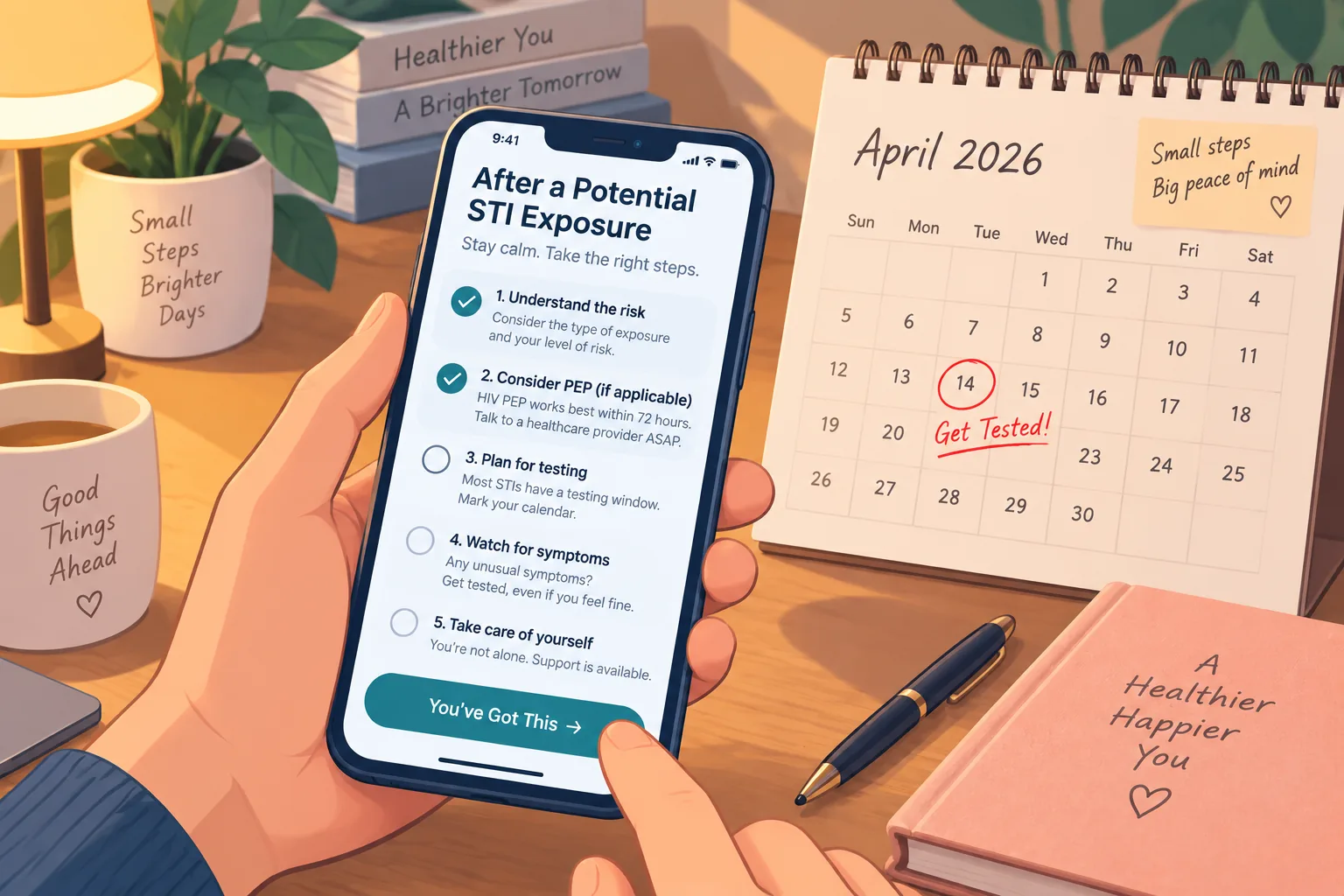
A potential STI exposure does not mean you are infected, but the first few hours can matter. If HIV exposure is possible and it has been less than 72 hours, seek PEP evaluation as soon as possible rather than waiting for symptoms or an STI test result. PEP works best when started early and must be started no later than 72 hours after exposure.
Your next steps are simple: clean the exposed area gently, avoid internal washing or harsh disinfectants, assess whether HIV PEP may be appropriate, and make a testing plan based on the window periods of different infections.
First 2 Hours: Immediate Steps and Critical Mistakes to Avoid
The first priority after a potential STI exposure is to avoid actions that can irritate exposed tissue while arranging appropriate medical care.
You do not need to perform an aggressive "disinfection" routine, and you cannot wash an STI out of the body after exposure. Genital washing and douching do not prevent HIV or other STIs, and douching may increase the risk of bacterial vaginosis and some infections.
Do: Gently Clean the Area with Mild Soap and Water
Gently wash the external skin with mild soap and water, then pat the area dry.
Keep the cleaning external. Do not attempt to flush the vagina or rectum, and do not scrub irritated skin. The goal is ordinary hygiene, not sterilization.
If semen, genital fluids, or other bodily fluids remain on the external skin, gentle cleaning can remove those fluids from the surface, but it does not reverse an exposure that has already occurred.
If the exposure involved the mouth, eyes, genitals, rectum, broken skin, or a needlestick, the appropriate medical response depends on the specific exposure. Do not delay PEP evaluation while trying to determine the risk yourself.
Don't: Douche, Scrub, or Use Harsh Antiseptics
Do not douche, flush the rectum, vigorously scrub genital tissue, or apply alcohol, hydrogen peroxide, bleach, or other harsh antiseptics to mucous membranes.
These measures have not been shown to prevent HIV or other STIs after sexual exposure, and aggressive washing can irritate or damage tissue.
Also avoid inserting unfamiliar creams, disinfectants, or medications into the vagina or rectum unless a healthcare professional specifically recommends them.
The most important thing you can do during the first two hours is not to "clean harder." It is to determine whether you need time-sensitive medical care.
The 72-Hour Clock: Do You Need PEP?
If HIV exposure is reasonably possible and the exposure occurred within the previous 72 hours, seek PEP evaluation immediately.
PEP, or post-exposure prophylaxis, is a short course of HIV medicines taken after a possible exposure to prevent HIV infection. CDC guidance treats a potential HIV exposure as a medical emergency when PEP may be indicated. PEP should be started as soon as possible, ideally within 24 hours, and no later than 72 hours after exposure.
What Is PEP and How Does It Work?
PEP is a 28-day course of antiretroviral medication prescribed after a potential HIV exposure.
The medication works by interfering with HIV replication before an infection becomes established. It is highly effective when started promptly and taken as prescribed, but it is intended for emergency situations rather than routine HIV prevention.
Do not wait for an HIV test to "prove" that you need PEP. CDC guidance states that when PEP is indicated, the first dose should not be delayed while waiting for laboratory results.
A baseline HIV test is still important because it establishes your status before or around the time PEP is started, but a negative test performed immediately after the exposure cannot rule out HIV acquired from that same recent exposure.
Assessing Your Exposure Risk
PEP is considered when a potentially infectious body fluid from a person with HIV can reach a mucous membrane, non-intact skin, or the bloodstream and the exposure occurred within 72 hours.
Examples that deserve urgent evaluation include:
- Condom failure during vaginal or anal sex when the partner has HIV and is not known to be virally suppressed.
- Vaginal or anal sex without a barrier when the partner has HIV and their viral suppression status is unknown or not sustained.
- Sexual exposure involving a partner known to have HIV when the viral load is detectable or unknown.
- Sharing injection equipment when HIV exposure is possible.
- Sexual assault involving a possible HIV exposure.
CDC recommends individualized assessment when the source's HIV status is unknown. The type of sexual activity, exposure site, presence of blood or genital fluids, source information, and timing all affect the decision.
One important distinction is U=U. A person with HIV who is taking treatment and maintains an undetectable viral load does not transmit HIV through sex. If a partner has documented sustained viral suppression, this substantially changes the HIV risk assessment.
You should not try to make the final PEP decision solely from a generalized online risk chart. When the exposure is recent enough for PEP to be possible, professional assessment is more valuable than waiting for certainty.
Where to Get PEP Immediately
PEP can be obtained through healthcare services that evaluate urgent HIV exposures. Depending on your location, options may include:
- Hospital emergency departments
- Urgent care centers
- Sexual health or STI clinics
- HIV-focused or LGBTQ+ health centers
- Telehealth services that provide urgent HIV prevention care
- Public health or community health services
CDC states that any licensed prescriber can prescribe PEP, so you do not necessarily need to wait for an infectious-disease specialist.
When you contact a service, say clearly:
"I had a possible HIV exposure and it occurred less than 72 hours ago. I need an evaluation for PEP."
That wording helps communicate that the request is time-sensitive.
Do not delay care because you are waiting for a partner to confirm their HIV status. If the exposure is potentially eligible for PEP, a clinician can assess the available information while treatment is considered.
The practical rule is simple: within 72 hours, seek PEP evaluation now rather than waiting for symptoms or test results.
Why Testing the Next Day Doesn't Work: Understanding Window Periods
A test performed immediately after a new exposure can be useful as a baseline, but it generally cannot tell you whether you acquired an infection from an exposure that happened only hours earlier.
That is because different infections become detectable at different times, and different tests look for different biological markers.
The Science of the "Window Period"
A window period is the time between an exposure and the point when a particular test can reliably detect an infection.
A test taken too early may be negative because there is not yet enough detectable pathogen, antigen, antibody, or genetic material in the sample.
This creates an important distinction:
A negative test the next day may tell you what your status was before the recent exposure, but it usually cannot rule out an infection acquired from that exposure.
The exact window depends on the infection and test method. For example, CDC states that a laboratory-based HIV antigen/antibody test using blood from a vein can usually detect HIV 18–45 days after exposure, while a NAT can detect HIV earlier, generally 10–33 days after exposure.
STI Testing Window Periods Timeline Chart
| Infection | Common test | When testing becomes useful after a recent exposure | Important note |
|---|---|---|---|
| Chlamydia | NAAT | Initial testing may be performed, but if negative and no presumptive treatment was given, repeat testing at about 1–2 weeks may detect an infection missed earlier | Test the actual exposed site, such as urine/genitals, throat, or rectum, when appropriate |
| Gonorrhea | NAAT | Initial testing may be performed, with repeat testing at about 1–2 weeks when an early result may be too soon | Site-specific testing matters |
| HIV | Laboratory 4th-generation Ag/Ab blood test | Usually 18–45 days | A negative early result may require follow-up; people taking PEP follow a different testing schedule |
| HIV | NAT | Usually 10–33 days | Used selectively, particularly when very recent infection is a concern |
| Syphilis | Serologic blood tests | Follow-up testing is commonly considered at 4–6 weeks and 3 months when recent infection cannot be excluded | Clinical circumstances and source information affect the schedule |
| HSV-1/HSV-2 | Type-specific antibody test | If recent HSV-2 acquisition is suspected, repeat testing at 12 weeks is recommended | If lesions appear, lesion-based testing can be more informative than waiting for antibodies |
| Hepatitis C | HCV RNA/NAT or antibody | RNA can become detectable earlier; antibody often takes 8–11 weeks | Follow-up timing depends on the exposure and test used |
| Hepatitis B | HBV serology | Timing is individualized according to vaccination and exposure status | Post-exposure vaccination or immune globulin may be indicated in some situations |
CDC recommends repeating chlamydia and gonorrhea NAATs 1–2 weeks after a recent exposure when initial testing is negative and presumptive treatment was not provided. CDC also recommends repeat syphilis testing at 4–6 weeks and 3 months in relevant recent-exposure situations.
For HIV, CDC's standard laboratory window-period information gives 18–45 days for a laboratory antigen/antibody test and 10–33 days for a NAT. However, the schedule changes when PEP has been taken because antiretroviral medications can delay detection. Current CDC PEP guidance recommends follow-up HIV testing at 4–6 weeks and a final test at 12 weeks after exposure, using laboratory-based Ag/Ab testing together with diagnostic NAT.
For HSV, CDC recommends repeat type-specific antibody testing 12 weeks after a suspected recent acquisition because early antibody testing can produce false-negative results. If genital or oral lesions appear, seek clinical evaluation rather than relying only on a blood test.
Hepatitis testing also varies by infection and test. For hepatitis C, CDC notes that HCV RNA can become detectable approximately 1–2 weeks after exposure, while HCV antibodies usually take 8–11 weeks to become detectable.
The key takeaway is that there is no single universal STI testing day. The correct schedule depends on the infection, the body site exposed, the test used, whether treatment or PEP was started, and the clinical circumstances.
What to Do While Waiting for Your Test Results
Waiting for a testing window can feel harder than taking the test itself, especially when you are repeatedly searching symptoms and trying to predict an outcome that cannot yet be known.
The best approach is to replace uncertainty with a specific follow-up schedule.
Protecting Yourself and Others During the Waiting Period
Until you have completed the evaluation recommended for your exposure, avoid assuming that you are negative simply because you feel well or because an early test was negative.
Many STIs can be asymptomatic, and an early negative test may not exclude a newly acquired infection.
A practical approach is to:
- Follow the testing schedule provided by your clinician.
- Avoid sex when you have symptoms or until a clinician advises that sexual activity is appropriate.
- If you do have sex while waiting, use condoms or other appropriate barriers consistently.
- Tell a healthcare professional about any new symptoms rather than waiting for the planned test date.
- Follow PEP instructions exactly if PEP is prescribed.
- Attend the recommended follow-up appointments.
For people taking PEP, follow-up is especially important because PEP can affect the timing and interpretation of HIV testing. CDC's 2025 guidance recommends clinical follow-up and laboratory testing at defined intervals, including final HIV testing at 12 weeks after exposure.
Managing "Phantom Symptoms" and Health Anxiety
After a frightening sexual-health event, it is common to become hyper-alert to every sensation in your body.
A headache, muscle tension, skin sensation, fatigue, stomach discomfort, or another nonspecific symptom does not by itself establish an STI diagnosis. Many ordinary physical sensations have multiple possible explanations, and anxiety can make normal sensations feel unusually significant.
The safest response is not to repeatedly inspect your body or search symptoms for hours. Instead, use an objective checklist:
What happened → when it happened → what exposure sites were involved → whether PEP is indicated → when each test should be performed → what symptoms require medical evaluation.
That turns an uncontrollable question — "Am I infected?" — into a series of answerable questions.
Seek medical care sooner if you develop concerning symptoms such as genital or oral sores, unusual discharge, painful urination, significant rash, fever, severe pelvic or testicular pain, rectal pain, or other symptoms that worry you.
Symptoms do not replace testing, and the absence of symptoms does not prove that an STI was not acquired.
Taking Control: Responsible Healthcare Is True Empowerment
A potential STI exposure is a health event to manage, not a reason for shame.
A condom can break. A partner's status can change or be unknown. A person can discover new information about a previous partner after sex. These situations do not require self-judgment; they require a sensible response.
The most important distinction is between panic and urgency.
Panic says:
"I need an answer right now."
Medical urgency says:
"I need to take the right action now, even though the final answer may take time."
That difference matters.
If HIV exposure is possible, the most time-sensitive decision is whether PEP should be started within 72 hours. The next decision is establishing an appropriate testing schedule rather than relying on an immediately performed test that may be too early.
You do not need to know everything tonight.
You need to know what happens next.
Clean gently. Do not douche or use harsh disinfectants. Seek PEP evaluation promptly when HIV exposure is possible and the 72-hour window has not passed. Arrange the right tests at the right time. Follow through with the recommended follow-up.
That is what taking control looks like after a potential STI exposure.
Emergency Timeline at a Glance
0-2 Hours
Gently clean exposed external skin. Do not douche, scrub aggressively, or use harsh antiseptics. Start evaluating whether medical care is needed.
Within 24 Hours
If HIV exposure is possible, seek PEP evaluation immediately. PEP is most effective when started as soon as possible.
24-72 Hours
PEP may still be indicated depending on the exposure. Do not wait until the last day if you can obtain care sooner. PEP should not be started later than 72 hours after exposure.
Around 1-2 Weeks
Follow-up NAAT testing for chlamydia and gonorrhea may be appropriate after a very recent exposure when initial testing was negative.
4-6 Weeks
Follow-up testing may be appropriate for HIV and syphilis, depending on the exposure and whether PEP was used.
Around 12 Weeks
Final HIV follow-up testing is recommended after PEP in the current CDC protocol, and 12-week repeat serology is recommended when recent HSV-2 acquisition is suspected.
The goal is not to eliminate uncertainty instantly. It is to make the right decision at each point on the timeline.