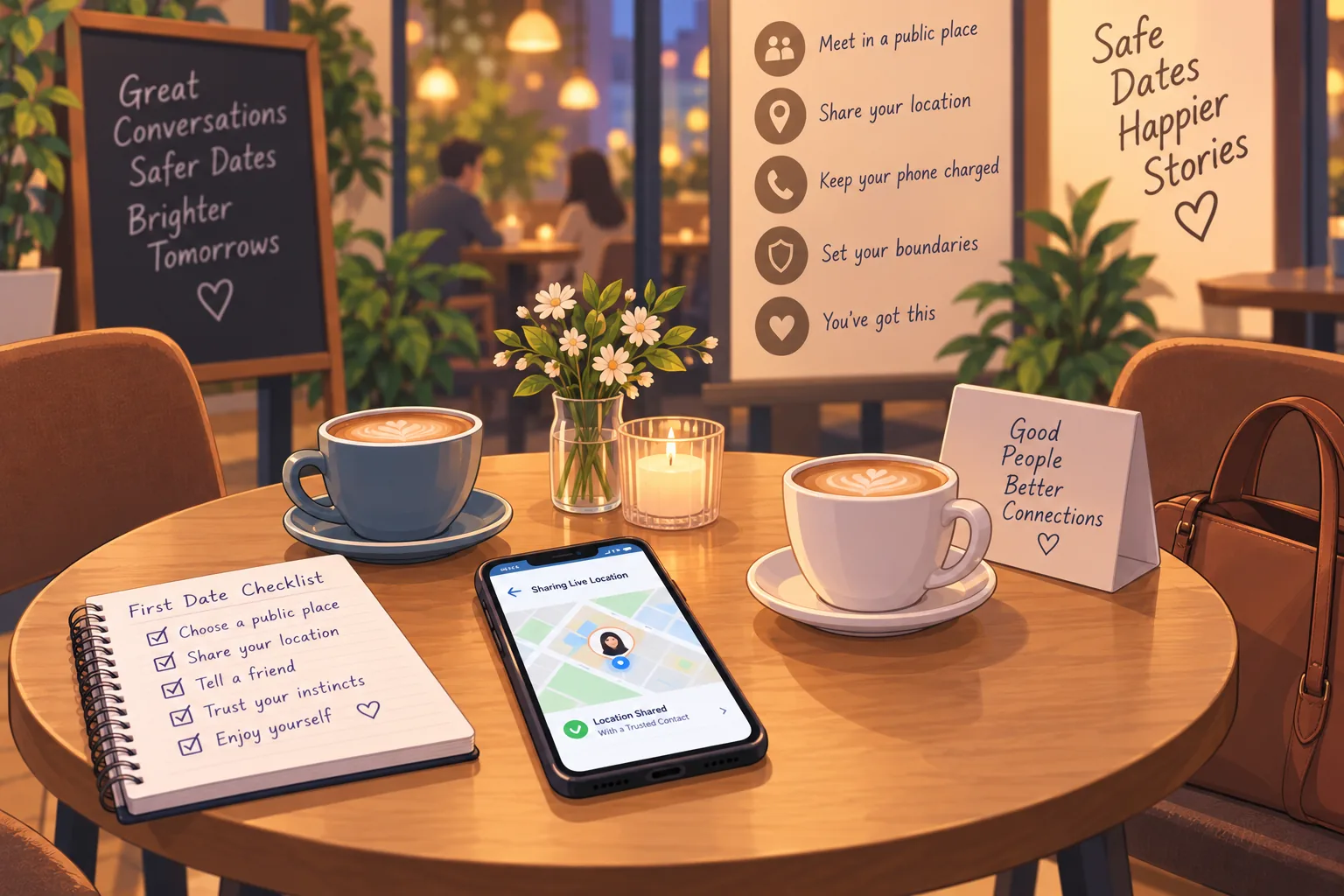
Moving from an online conversation to a first in-person date does not require giving up your privacy or handing control of the situation to someone you have just met.
For people dating with an STI, there can be an additional layer to ordinary first-date planning: a medical disclosure may already be part of the relationship, and that information is sensitive even when the date itself is going well.
The safest approach is not to become suspicious of everyone.
It is to control the variables you can control:
Choose when you meet.
Choose where you meet.
Control your transportation.
Limit unnecessary personal information.
Tell someone you trust where you are.
Set boundaries before you need them.
Leave when you need to leave.
Your STI status does not make these precautions necessary because there is something wrong with you.
They are ordinary digital and personal-safety practices for meeting someone new.
Reclaiming Control: Why First Date Safety Is About Agency, Not Stigma
A first date is not a test of whether you are brave enough to ignore your discomfort.
It is an opportunity to find out whether the person you met online feels safe, respectful, and compatible in real life.
That distinction matters.
Some people dating with an STI may worry that setting boundaries will make them look "difficult," especially after experiencing rejection around disclosure. They may feel pressure to be especially accommodating because they are relieved that someone accepted their diagnosis.
You do not need to compensate for your STI status by lowering your safety standards.
A person who respects you should also respect:
- your choice of meeting place;
- your transportation;
- your privacy;
- your pace;
- your physical boundaries;
- your right to leave.
RAINN similarly recommends meeting in public, telling someone you trust about your plans, controlling your own transportation, and leaving if you feel uncomfortable. (rainn.org)
The Dual-Layer Risk: Physical Safety Meets Privacy Protection
Every first date with a new person involves some ordinary uncertainty.
For someone dating with an STI, another concern may be present:
"What if this person now knows something private about my health?"
That makes privacy planning particularly useful.
Before meeting, consider two separate questions:
Physical safety: Can I meet this person somewhere public and leave independently?
Information safety: How much of my real identity does this person actually need to know today?
Those questions are related, but they are not the same.
You may decide that someone knows your first name but not your workplace.
They may know your city but not your neighborhood.
They may know you live with HSV but not have access to your medical records.
That is not inconsistency.
It is controlled disclosure.
The Golden Rule of Timing: When Are You Truly Ready to Meet Offline?
There is no universal rule saying you must talk online for three days, two weeks, or one month before meeting.
Time alone does not create trust.
A better readiness check is behavioral.
Before meeting, ask:
Has the person respected reasonable boundaries?
Have their basic stories remained consistent?
Have you had enough conversation to know what you are comfortable with?
Have you had an opportunity to speak by voice or video if that matters to you?
Are they comfortable meeting somewhere public?
Do they accept that you will arrive and leave independently?
Do you feel free to say "not yet" without being pressured?
One of the strongest indicators is how someone responds to ordinary boundaries.
If you say:
"I'd rather meet at the café near the station."
and they respond:
"Sure, that's fine."
that tells you something.
If they repeatedly insist on picking you up, changing the venue, or taking you somewhere private, that also tells you something.
Tinder and Bumble both recommend taking time before moving offline, meeting publicly, keeping control of transportation, and letting someone you trust know about the meeting. (tinder.com, bumble.com)
Step 1: The Privacy Firewall Before You Meet
The first-date privacy goal is simple:
Do not give a new acquaintance more access to your offline life than the date requires.
You do not need to arrive anonymously.
You simply need to avoid creating unnecessary connections between your dating profile and your home, workplace, or personal network.
Phone Numbers and Messaging: Keep a Privacy Buffer
If you have been communicating entirely inside a dating app, there is no requirement to give someone your primary phone number immediately.
A secondary number or VoIP service can create a useful layer of separation when available in your location.
The purpose is not to become invisible.
It is to avoid immediately connecting a new person to accounts or records associated with your primary number.
Before switching channels, ask:
Does this number reveal my full name?
Can it easily be connected to my public social accounts?
Would I be comfortable with this person having the number after only one meeting?
Tinder itself advises users not to give a phone number or other personal information until they feel comfortable and recommends taking time when moving conversations off the app. (tinder.com)
A secondary number can help with compartmentalization, but it is not a guarantee of anonymity. Treat it as a privacy buffer, not a disguise.
Social Footprint Scrubbing: Preventing Doxxing and Reverse Image Searches
Before meeting, review what your profile has already revealed.
Search your own name, username, and profile photos.
Ask:
Does this photo also appear on LinkedIn?
Does my dating bio reveal my employer?
Does my Instagram username match my dating username?
Could someone identify my neighborhood from my photos?
Does a photo show my workplace, school, gym, apartment building, vehicle, or usual hangout?
The goal is to reduce unnecessary linkability.
A photo showing a person sitting in a café may seem harmless.
A photo showing the same person sitting beneath a company sign, wearing an employee badge, with a LinkedIn username elsewhere online can tell a stranger much more.
A useful rule is:
Before the first date, remove information that identifies your routine rather than information that expresses your personality.
Location Anonymity: Protecting Your Home and Workplace Address
Do not make your home the pickup point for a first date.
Do not offer your exact workplace address simply because it is "on the way."
Do not give someone a detailed description of your apartment complex, building entrance, or usual route home.
Most importantly, keep control of transportation.
Tinder, Bumble, and RAINN all recommend arranging your own transportation and avoiding situations where a new date controls how you get home. (tinder.com, bumble.com, rainn.org)
Instead of:
"I'll send you my address and you can pick me up."
use:
"Let's meet there. I'll make my own way over."
That one decision preserves an important piece of autonomy.
Step 2: Choosing the Right Venue — The High-Control Environment
A good first-date location does not have to be luxurious.
It should give you options.
Think of your first date as a high-control environment when it has four characteristics:
Public.
Easy to enter and leave.
Easy to communicate in.
Low commitment.
The Anatomy of a High-Control Date Venue
A practical first-date venue should have:
People around. Not necessarily a crowded nightclub, but enough ordinary activity that you are not isolated.
Clear exits. You should be able to leave without asking the other person for transportation.
Reliable transportation. Rideshare, public transit, parking, or another independent route should be available.
Moderate noise. You should actually be able to talk.
A natural endpoint. A coffee or one-drink meeting is easier to end than a four-hour activity that has already been prepaid.
RAINN recommends meeting in well-lit, populated public places and avoiding private or isolated locations for early dates. (rainn.org)
Safe vs. High-Risk Date Environments
| Dimension | Higher-Control First Date | Lower-Control First Date |
|---|---|---|
| Venue | Café, casual restaurant, museum, public event, busy bar | Someone's home, hotel room, private rental |
| Access | Easy to enter and leave independently | Requires the other person to let you in or drive you |
| Duration | Flexible, roughly 45–90 minutes to start | Several hours with a fixed commitment |
| Transportation | You arrive and leave independently | Your date picks you up or drives you home |
| Visibility | Other people nearby | Secluded, isolated, or private |
| Communication | Quiet enough to talk | Either too chaotic to communicate or too isolated |
| Exit options | Multiple ways to leave | Few or no independent exit options |
There is nothing inherently dangerous about a longer dinner or a private venue later in a relationship.
The point is sequencing.
Your first meeting does not need maximum intimacy. It needs maximum optionality.
Timing Matters: Daytime Coffee vs. Nighttime Drinks
A daytime date is often easier to control because public places tend to have more visible activity and transportation options.
A simple coffee meeting also carries low social commitment:
"Let's grab coffee for an hour."
If the chemistry is excellent, you can extend the date.
If it is not, you already have a natural endpoint.
Evening dates can be completely reasonable, especially in established public venues. The issue is not that nighttime is automatically unsafe.
The issue is whether the location, transportation, alcohol consumption, and environment leave you with enough control.
Tinder and RAINN both emphasize public locations, independent transportation, and having an exit plan. (tinder.com, rainn.org)
Step 3: The Safety Buddy Protocol — Your Silent Backstage Pass
A Safety Buddy is not a private security team.
It is simply one person who knows enough about your plans to notice when something is unexpectedly wrong.
Briefing Your Safety Buddy: What Information to Share
Before the date, send:
Who: the person's name or dating-app identity, if known.
Where: venue name and address.
When: arrival time and expected end time.
How: your transportation plan.
What: a simple statement such as "first time meeting this person in person."
How to reach you: your phone number if they do not already have it.
You can also share your live location during the date using a built-in location-sharing function if that is comfortable for you.
RAINN specifically recommends telling a trusted person who you are meeting, where you are going, and when you expect to return, and suggests location sharing as an additional option. (rainn.org)
You do not need to send your friend the person's entire medical history, private messages, or STI information.
The goal is simply:
Someone you trust should know where you are.
The Check-In Code: Systematizing Status Updates
A simple check-in system can prevent you from having to make a dramatic phone call in front of your date.
For example:
Before the date:
"I'm meeting Alex at Café X at 7:00."
Normal check-in:
Text "coffee is good" around 7:30.
Need-help signal:
Use a pre-agreed word or emoji.
Expected end:
"I'm leaving around 9."
RAINN specifically recommends using a code word or emoji with a trusted friend if you need help ending a date early. (rainn.org)
The system should be simple enough that you will actually use it.
Do not create a complicated emergency code that you will forget.
What Should Your Safety Buddy Do if You Miss the Check-In?
Agree on this before the date.
For example:
First missed check-in: send a normal message or call.
Second missed check-in: try again and check whether your location is moving normally if you voluntarily shared it.
If there is credible concern: contact you directly and, if necessary, escalate to local emergency services.
A missed text does not automatically mean something bad happened. Phones die. Conversations run late.
The purpose of the system is to create a reasonable escalation path, not to create panic after 31 minutes of silence.
If you believe you are in immediate danger, do not wait for the Safety Buddy protocol to solve it. Contact local emergency services.
Step 4: Maintaining Onsite Boundaries and Handling Surprise Questions
The first date is not an obligation to disclose everything you have ever experienced.
It is also not the place to negotiate your medical privacy under pressure.
If you have already discussed your STI status online, the in-person date can still focus primarily on getting to know each other.
If you have not disclosed a health condition and the relationship is moving toward sexual activity, you can decide how and when to have that conversation in a setting where you feel safe and have enough privacy.
The goal is not secrecy.
It is appropriate timing and informed consent.
Managing Personal Boundaries and Pacing Disclosure
A useful first-date boundary is:
"Today is for getting to know each other."
You can talk about relationships, interests, work, family, sex, or health if you genuinely want to.
But you are not required to answer every question immediately.
A person who respects you will allow:
"I'd rather talk about that later."
to remain a complete sentence.
What to Do If a Match Asks About Your STI in Public
Imagine you are in a café and your date suddenly says loudly:
"So what exactly is your herpes situation?"
You do not need to answer in front of everyone.
Try:
"I'm comfortable talking about sexual health, but I'd rather have that conversation somewhere private. Let's keep today focused on getting to know each other."
Or:
"That's something I'm happy to discuss, just not in the middle of a public café. We can talk about it privately when it feels appropriate."
If you have not previously disclosed and sexual activity is not being considered tonight:
"That's personal health information, and I'd rather not get into medical details on a first meeting."
A good partner may accept the boundary.
If someone becomes angry because you want a private conversation about private medical information, that reaction itself provides useful information about compatibility and respect.
If the Conversation Becomes Pressuring
Try:
"I'm not comfortable continuing this conversation right now."
or:
"I said I'd rather discuss that privately. Let's change the subject."
You do not need to explain your diagnosis, medication, laboratory history, or sexual history to satisfy an increasingly intrusive line of questioning.
When Physical Boundaries Are Tested
The same principle applies to physical contact.
You can say:
"I'm really enjoying the conversation, but I like taking physical things slowly on a first date."
Or:
"I'm not comfortable with that."
Or simply:
"Please don't do that."
You do not need a medical reason.
Your comfort is enough.
RAINN emphasizes that if a person is crossing boundaries, pressuring you, or making you uncomfortable, it is okay to leave. (rainn.org)
Step 5: The Emergency Exit Plan — How to Leave Elegantly
A first date does not have to end with a courtroom-quality explanation.
You can leave because:
you are uncomfortable.
the chemistry is wrong.
the person crossed a boundary.
you changed your mind.
you simply want to go home.
You do not owe a new date a detailed defense.
Identifying Onsite Red Flags: When to Abort
Pay particular attention if someone:
- ignores a clear "no";
- repeatedly pressures you to change venues;
- tries to take control of your transportation;
- insists on going somewhere private;
- becomes angry when you establish boundaries;
- demands sensitive personal information;
- humiliates you about your STI status;
- behaves aggressively toward you or others;
- attempts unwanted physical contact;
- prevents you from leaving or follows you when you try to leave.
These behaviors matter more than whether the person simply seems awkward.
A person can have terrible first-date manners without being dangerous.
But boundary violation combined with pressure or control is a much more serious signal.
Word-for-Word Exit Scripts: Low-Drama Departures
Option A: Soft Exit
Useful when the date simply is not working:
"I have an early morning tomorrow, so I'm going to head out around now. Thanks for meeting me. It was nice to meet you."
This works particularly well when you established a time boundary before the date.
Option B: Direct Exit
Useful when you are uncomfortable but do not feel physically threatened:
"I've appreciated meeting you, but I don't think this is the right match for me. I'm going to head home now. Take care."
You do not need to debate whether the other person agrees.
Option C: Immediate Safety Exit
When you need to leave quickly:
"I need to go now. Take care."
Then leave.
You do not need to invent a complicated excuse if you are genuinely uncomfortable.
If the situation feels unsafe, move toward staff, security, other people, or a populated area rather than continuing a private conversation about why you are leaving.
Bumble advises that if you feel uncomfortable, you can leave and enlist a bartender or server for discreet assistance if necessary. (bumble.com)
When You Need the Safety Buddy to Call
If you have agreed on a code signal, your buddy can call with a pre-arranged reason for you to leave.
For example, after receiving the signal:
"Hey, I'm sorry — something came up that I need to handle. I have to head out."
You do not need to keep improvising.
The point of a prearranged signal is to make leaving easier when social pressure makes spontaneous boundary-setting difficult.
If you believe the situation is dangerous, skip the social excuse and seek immediate help.
Before You Leave Home: The First-Date Safety Checklist
A two-minute check before leaving can eliminate many avoidable problems.
Privacy
[ ] My date does not know my exact home address.
[ ] I have not shared unnecessary workplace or routine information.
[ ] My phone number is one I am comfortable giving.
[ ] My social profiles do not reveal more personal information than I intend.
Meeting
[ ] We are meeting in a public place.
[ ] I can leave independently.
[ ] My transportation is under my control.
[ ] My phone is charged.
Safety Buddy
[ ] Someone I trust knows where I am.
[ ] They know who I am meeting.
[ ] They know approximately when I expect to return.
[ ] We have a simple check-in plan.
Boundaries
[ ] I know what I am comfortable discussing.
[ ] I know what physical contact I am comfortable with.
[ ] I am prepared to say "no," "not yet," or "I'd rather discuss that privately."
Exit
[ ] I know how I will leave.
[ ] I do not need my date's car to get home.
[ ] I have enough money or payment access to leave independently.
[ ] I know where I can go if the date suddenly becomes uncomfortable.
That is enough.
You do not need a 47-point emergency manual in your pocket.
After the Date: Close the Safety Loop
When you arrive home, close the loop with your Safety Buddy.
A simple:
"Home safe 👍"
is enough.
If the person behaved well, you can simply continue dating.
If something bothered you, write down what happened while it is still fresh.
You do not need to convince yourself that it was "serious enough" to matter.
You can also unmatch or block someone after the date if you do not want further contact. Tinder and other major dating platforms provide unmatch and reporting functions for users who want to end contact or report inappropriate behavior. (tinder.com)
A First Date Is a Test of Compatibility, Not Your Ability to Endure Discomfort
One of the most useful mindset shifts is this:
The goal of a first date is not to make the other person like you.
It is to determine whether the two of you are comfortable around each other.
That means you are both being evaluated.
Does this person respect boundaries?
Do they listen?
Do they react normally when you say no?
Can they discuss sensitive subjects without embarrassing you?
Do they accept your need for privacy?
Do they allow you to control your own transportation?
Do you feel more relaxed as the date continues?
Those observations are more useful than trying to perform the "perfect" first date.
Your Safety Is Non-Negotiable
Meeting someone from a dating app in person should not require you to become paranoid.
It requires you to remain in control.
For someone dating with an STI, that control can include one additional layer: protecting sensitive health information until you are comfortable with the person and the context.
You do not need to hide forever.
You do not need to disclose everything immediately.
You do not need to prove that you are worthy of being treated well.
You simply need to decide:
What information is appropriate now?
What setting gives me the most control?
How will I get home?
Who knows where I am?
What will I do if I become uncomfortable?
That is not insecurity.
It is preparation.
The person you are meeting may turn out to be wonderful.
They may not.
Either way, you deserve to retain control of your own information, transportation, time, body, and exit.
A good first date does not require you to surrender those things.
In fact, a respectful person will probably make it easier for you to keep them.
So meet when you are ready.
Choose a place where you have options.
Tell someone you trust.
Keep your privacy boundaries intact.
And remember:
You never have to stay in a situation simply because you were excited to arrive.
Your safety is not an obstacle to connection.
It is the foundation that lets you enjoy connection with confidence.