No. A "full STI panel" does not necessarily test for every sexually transmitted infection, and the phrase "10-panel" does not have one universal medical definition. Different clinics and commercial laboratories may include different tests.
A negative report therefore means the infections that were actually tested for were not detected at that time. It does not automatically mean that every possible STI has been ruled out.
This matters when you are preparing to have sex with a new partner, reviewing an "all negative" report, or wondering why an infection such as herpes or HPV was diagnosed despite having regular STI testing.
The safest way to read an STI report is not to ask, "Did I get a full panel?"
Ask instead:
What exactly was tested, from which body sites, and which infections were not tested?
The "Full Panel" Myth: Why "Clear" Doesn't Always Mean Everything
The first thing to understand is that "full STI panel" is often a commercial description, not a standardized clinical package.
A clinic may advertise a 7-panel, 8-panel, 10-panel, or another combination of tests. Another clinic may use a completely different set of tests under a similar name.
CDC guidance also does not recommend that every sexually active person receive the same list of STI tests at every visit. Appropriate testing depends on factors such as age, sexual practices, symptoms, pregnancy, number of partners, HIV status, recent exposures, and the anatomical sites involved. (cdc.gov)
That means a "negative full panel" can be medically useful while still having important boundaries.
Standard 10-Panel vs. the Unchecked Blind Spots
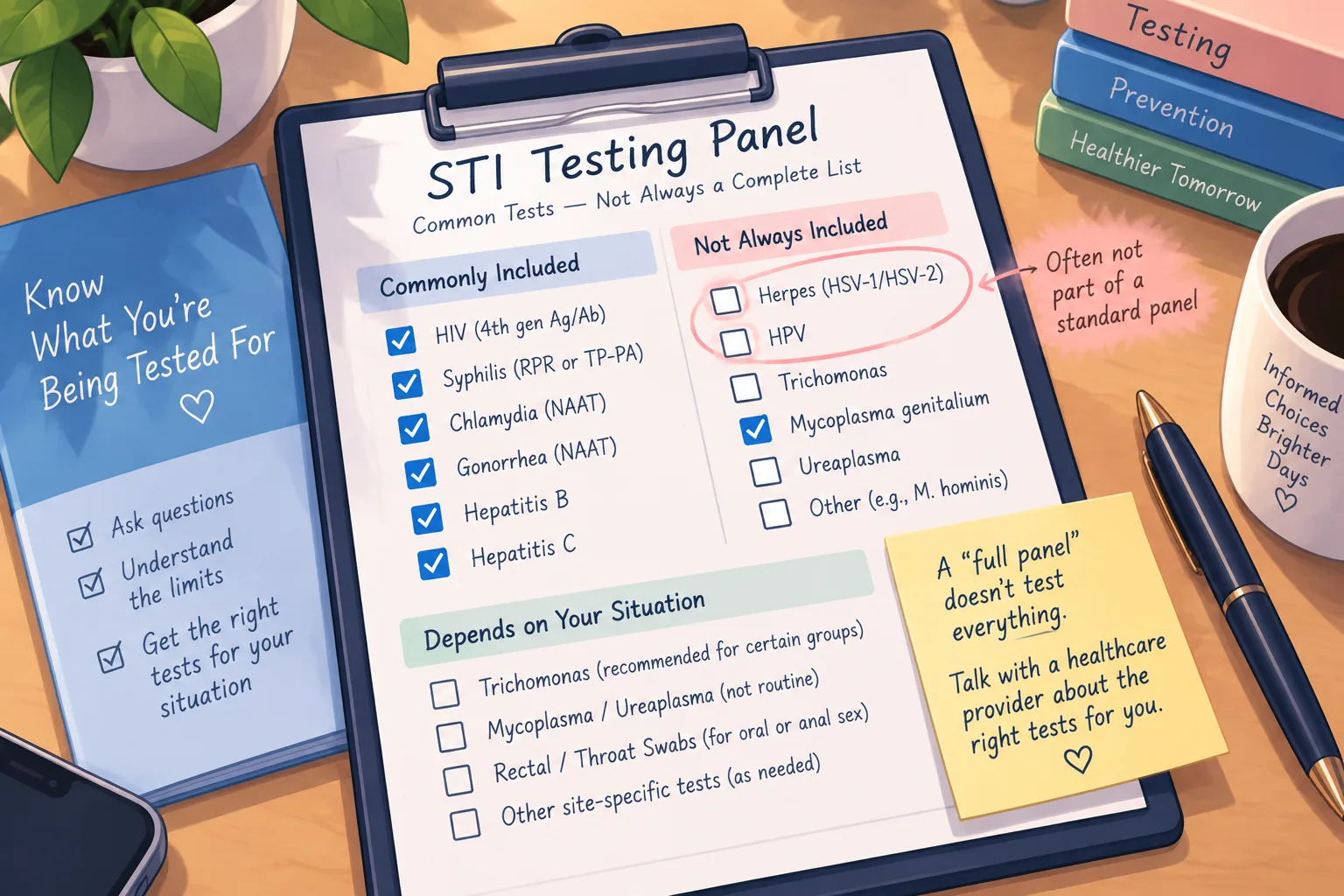
There is no single CDC-defined "standard 10-panel STI test." Commercial 10-panel packages vary, so the table below should be viewed as a guide to what commonly appears in multi-test screening packages rather than a universal checklist.
| Test category | Often included in multi-test STI packages | Often separate, conditional, or not included |
|---|---|---|
| Bacterial | Chlamydia, Gonorrhea, Syphilis | Mycoplasma genitalium |
| Viral | HIV, Hepatitis B and/or Hepatitis C | HSV-1/HSV-2 serology, HPV testing |
| Parasitic | Trichomoniasis in some packages | Often requires a separate test or is recommended only for certain people |
| Anatomic-site testing | Often urine or genital specimens | Rectal or throat testing may require separate specimens depending on sexual exposure |
| Symptom-based testing | Varies | Some infections are evaluated clinically rather than through routine screening |
The biggest takeaway is that "not listed" and "negative" are not the same thing.
If HSV testing is absent from the report, you do not have an HSV-negative result.
If HPV testing was not performed, you do not have an HPV-negative result.
And if only a urine specimen was tested, that does not automatically mean your throat and rectum were tested.
CDC specifically recommends site-specific testing based on sexual exposure for populations such as sexually active MSM, including testing at the urethral, rectal, and pharyngeal sites as appropriate. (cdc.gov)
The 4 Major Blind Spots of Standard STI Testing
Some of the biggest sources of confusion involve HSV, HPV, Mycoplasma genitalium, and Trichomonas.
But these infections are not simply "forgotten" by medicine.
In many cases, they are not included because routine screening for everyone is not clinically recommended or because the available tests answer a different question.
1. Herpes (HSV-1 and HSV-2)
Herpes is one of the most common infections people expect to see on a "full STI panel," yet herpes blood testing is not routinely recommended for the general asymptomatic population.
That is not because herpes is unimportant.
It is because type-specific HSV blood tests have limitations, including false-positive results, and a positive antibody result does not always answer the question a person thinks they are asking. CDC therefore recommends against routine HSV-2 serologic screening in the general population. (cdc.gov)
HSV testing can nevertheless be appropriate in specific situations.
CDC identifies scenarios including recurrent or atypical genital symptoms or lesions, a clinical diagnosis without laboratory confirmation, and a patient whose partner has genital herpes as situations in which type-specific HSV-2 serology can be useful. (cdc.gov)
If genital lesions are present, testing a lesion with a virologic test such as NAAT/PCR is generally more informative than simply ordering a blood test. (cdc.gov)
There is also an important distinction between HSV-1 and HSV-2 blood tests.
A positive HSV-1 antibody does not tell you whether the infection is oral or genital, and HSV-1 serology is not a reliable way to determine the site of infection. (cdc.gov)
So when someone says:
"My full STI panel was negative, but I was later diagnosed with HSV."
the first question should be:
Was HSV actually tested?
Not:
How could the test have missed herpes?
2. Human Papillomavirus (HPV)
HPV is another major source of misunderstanding because people often expect a simple "HPV test" to work like a blood test for HIV.
It does not.
There is no general test that tells a person whether they have an overall "HPV status." HPV tests used in clinical practice are primarily designed to detect certain oncogenic HPV types in the context of cervical cancer screening and follow-up. They are not general STI screening tests. (cdc.gov)
CDC specifically states that HPV tests should not be used:
- as a general STI test;
- to screen men;
- to diagnose genital warts;
- or for routine HPV screening outside recommended cervical cancer screening contexts. (cdc.gov)
This explains why a person can have a completely negative conventional STI panel without ever receiving an HPV result.
For people with a cervix, HPV testing may be part of cervical cancer screening depending on age and the screening strategy being used. But Pap testing and HPV testing should not be interpreted as comprehensive STI screening. (cdc.gov)
HPV vaccination is another separate prevention issue. Vaccination can prevent new infection with HPV types covered by the vaccine, but it does not test for or eliminate an existing HPV infection. (cdc.gov)
3. Mycoplasma genitalium (M. genitalium)
M. genitalium is a sexually transmitted bacterium that requires a specific molecular test.
It is not recommended as a routine screening test for asymptomatic people. CDC recommends testing particularly in situations such as recurrent or persistent urethritis and cervicitis, and testing should also be considered in certain cases of pelvic inflammatory disease. (cdc.gov)
That distinction is important because "not included in a routine panel" does not necessarily mean "the healthcare system forgot about it."
The reason is clinical utility.
Broadly testing every asymptomatic person can expose people to unnecessary diagnoses, antibiotic treatment, side effects, and resistance concerns without a clear benefit.
When testing is appropriate, CDC identifies NAAT as the relevant diagnostic method. FDA-cleared assays can use specimens such as urine and genital swabs, depending on the test and anatomical site. (cdc.gov)
4. Trichomoniasis
Trichomoniasis is caused by the parasite Trichomonas vaginalis and is one of the more common curable STIs.
But again, routine testing does not mean "everyone gets tested at every STI visit."
CDC recommends diagnostic testing for women seeking care for vaginal discharge and says screening can be considered for asymptomatic women in certain high-prevalence or higher-risk settings. Annual screening is recommended for sexually active women with HIV. (cdc.gov)
The testing method also varies by setting and assay.
So if Trichomonas is not shown on your commercial panel, the appropriate response is not automatically:
"The test was incomplete."
The more useful question is:
"Given my symptoms, anatomy, exposure history, and risk factors, is Trichomonas testing indicated for me?"
That is the basic difference between screening everything and testing intelligently.
How to Advocate for Yourself at the Clinic: What to Ask For
The most effective form of medical advocacy is not asking a clinician to perform every conceivable STI test.
It is giving them enough information to choose the tests that are actually relevant to you.
Before the appointment, identify:
When was the exposure?
What types of sexual contact occurred?
Which anatomical sites were involved — genital, rectal, oral/throat?
Was a condom or another barrier used?
Do you have symptoms?
Do you have a partner with a known STI?
Do you have a history of previous STIs?
These details can change what testing is appropriate.
The Add-On Checklist: What to Say to Your Provider
Instead of saying:
"I want every STI test available."
try:
"I'm getting tested after a new sexual partner. Could we review exactly which infections and anatomical sites are covered by the tests we're ordering?"
Then ask:
"Based on my exposure and symptoms, are there any additional tests you recommend?"
For a specific concern:
"My partner has genital herpes. Would type-specific HSV testing be useful in my situation?"
or:
"I've had persistent/recurrent symptoms despite initial testing. Should we consider testing for Mycoplasma genitalium?"
For people with the relevant anatomy:
"Does my routine cervical cancer screening cover what it is supposed to cover, and is there any separate STI testing I need?"
The advantage of this approach is that it puts the clinical question first.
It also prevents a common mistake: assuming that adding more tests automatically produces a more accurate picture of sexual health.
More testing is not always better testing.
The right test, at the right site, for the right reason, is more useful than a longer shopping list.
How to Talk to Your Partner About Your Test Results Without Misleading Them
A negative STI report can be reassuring without being a guarantee that every infection has been excluded.
The safest communication is specific.
Instead of:
"I'm completely clean."
say:
"My recent STI tests were negative for the infections that were included in the panel."
That language may seem less dramatic, but it is medically more accurate.
It also avoids stigmatizing terms such as "clean" and "dirty," which can make STI conversations unnecessarily judgmental.
Script: Communicating Scope and Limitations
A useful version is:
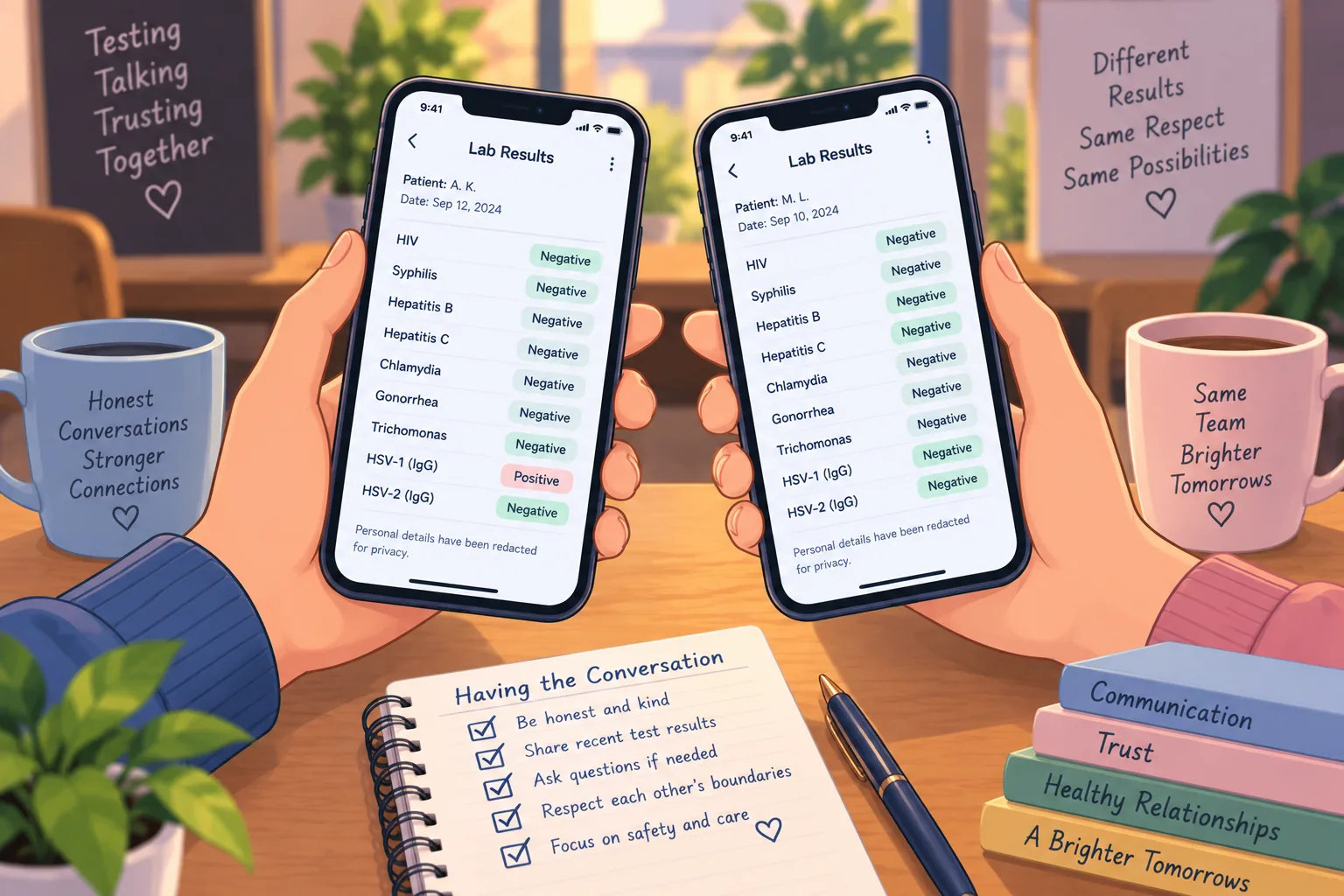
"I got my recent STI results back and everything that was tested was negative. The panel covered HIV, syphilis, chlamydia, and gonorrhea. It didn't include HSV testing, and HPV isn't screened for through a general STI panel. I wanted to be transparent about what the results do and don't tell us. Is there anything you'd want us to discuss with a clinician before we stop using barriers?"
This is much stronger than:
"My full panel was negative, so we're completely safe."
The first statement communicates:
What was tested.
What was not tested.
What remains uncertain.
What the couple can decide together.
That is informed communication rather than reassurance built on an ambiguous label.
It is also important to remember that testing is only one part of risk management.
Vaccination, condoms and other barriers, HIV PrEP when appropriate, treatment of diagnosed infections, partner notification, and testing at relevant anatomical sites can all play different roles.
What a Negative STI Test Actually Tells You
A negative result can mean different things depending on the test.
For example:
Negative chlamydia NAAT means the organism was not detected in the specimen tested.
It does not automatically mean your throat or rectum was negative if those sites were not tested.
Negative HIV test means HIV was not detected by that particular test at that point in time, but timing relative to exposure matters because tests have window periods.
Negative HSV blood test is not the same thing as saying "no herpes symptoms will ever occur," and a negative HSV test very soon after exposure may not exclude a recent infection.
No HPV result generally means there was no general HPV screening test to interpret. HPV testing is used in specific cervical cancer screening contexts rather than as a universal STI screen. (cdc.gov)
This is why reading the test name, specimen type, anatomical site, and testing date is much more informative than reading the word "negative" alone.
When "Full Screening" Should Become More Customized
A customized testing plan may be more appropriate when there is:
- a known STI-positive partner;
- a new or multiple-partner sexual network;
- symptoms;
- a recent high-risk exposure;
- recurrent genital or urinary symptoms;
- HIV or immunocompromising conditions;
- a history of previous STIs;
- pregnancy;
- exposure at sites that were not included in the original test;
- persistent symptoms despite negative initial tests.
CDC emphasizes that STI testing should be based on individual factors including sexual behavior, age, symptoms, and other risk factors rather than applying one identical testing package to everyone. (cdc.gov)
That is also why a person who has recently had a new partner should not necessarily use someone else's testing list as their own.
Your exposure determines your testing needs.
Knowledge Is Protection, Not Paranoia
A "full STI panel" is not a magic certificate saying that every possible sexually transmitted infection has been ruled out.
But that does not mean STI testing is unreliable.
It means testing is designed around clinical evidence, test limitations, symptoms, anatomy, exposure patterns, and the infections for which screening provides meaningful benefit.
HSV may not appear because routine blood screening is not recommended for the general asymptomatic population. (cdc.gov)
HPV may not appear because HPV testing is not a general STI test and is instead used primarily in cervical cancer screening and related follow-up. (cdc.gov)
M. genitalium may not appear because routine screening of asymptomatic people is not recommended. (cdc.gov)
Trichomoniasis may require testing based on symptoms, risk factors, or specific clinical circumstances rather than universal screening. (cdc.gov)
None of these facts means that a standard STI test is useless.
It means that the value of a result depends on knowing exactly what question the test was designed to answer.
So the next time someone says:
"I got a full STI panel. Everything is negative."
you do not need to become alarmed.
You also do not need to treat the sentence as proof of zero risk.
Ask three simple questions:
What was tested?
Where was it tested?
When was it tested?
Those three questions transform a vague "full panel" into actual medical information.
That is not paranoia.
It is informed sexual-health decision-making.