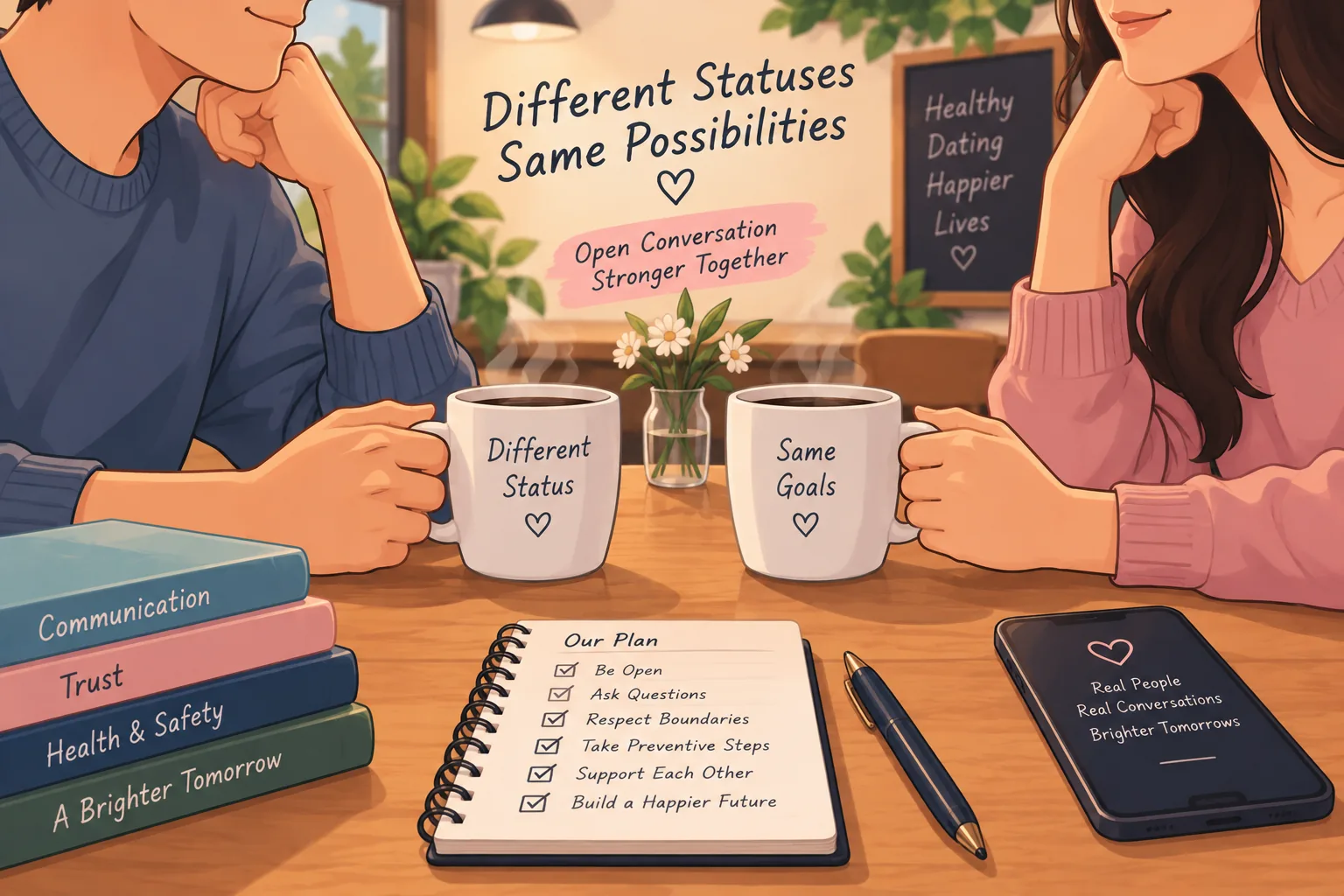
Dating someone with an STI when you do not have the same infection does not automatically mean giving up intimacy or accepting uncontrolled risk. With appropriate treatment, prevention tools, barrier methods, testing, and communication, couples can build a practical system for managing different STI statuses together.
The important shift is from "one partner is the risk and the other is the protected person" to "both partners participate in managing a shared health issue."
The term serodiscordant relationship is most commonly used for couples in which one partner has HIV and the other does not. For other STIs, mixed-status couple or couples with different STI statuses is generally more precise.
The goal is not to promise zero risk for every STI. It is to understand the specific infection, identify the prevention measures that actually work, and agree on boundaries that both people can live with.
Redefining Mixed-Status Dating: From Anxiety to Teamwork
A mixed-status relationship does not require one partner to become the permanent "risk manager" or the other to become a permanent source of reassurance.
Different STIs have different transmission patterns, medical treatments, and prevention options. HIV, HSV, HPV, chlamydia, and syphilis therefore cannot be managed with one universal rule.
What couples can share is a decision-making framework.
That framework starts with three questions:
What does the infection-specific medical evidence tell us?
What physical or behavioral measures reduce the remaining risk?
How will we communicate when circumstances change?
That makes STI prevention a cooperative process rather than a test of whether either partner is willing to sacrifice enough for the relationship.
Decoupling Guilt and Fear in Intimacy
An STI diagnosis can create a painful imbalance inside a relationship.
The partner with the infection may think:
"I don't want to be the person who gives this to someone I love."
The partner without the infection may think:
"I trust you, but I still need to protect my health."
Both concerns are legitimate.
The solution is not to eliminate either concern. It is to separate risk management from blame.
An STI can be transmitted without anyone intending to cause harm, and some infections can be present without symptoms or without the infected person knowing they have them. At the same time, the uninfected partner does not owe anyone unlimited risk tolerance simply because the relationship is serious.
Healthy mixed-status dating allows both statements to be true:
"I care about protecting you."
and
"I care about protecting myself."
Those are not competing positions.
They are the foundation of informed consent.
For couples living with HIV, the medical picture can be especially reassuring. A person with HIV who takes treatment as prescribed and maintains an undetectable viral load does not transmit HIV through sex. This is the principle known as U=U, Undetectable = Untransmittable.
U=U does not apply to other STIs, however, and HIV treatment does not protect against infections such as herpes, HPV, chlamydia, or syphilis.
The 3-Tier Safety Framework for Mixed-Status Couples
A sustainable relationship usually works better when STI prevention is divided into three layers rather than relying on one behavior.
Tier 1 is medical management.
Tier 2 is physical and behavioral risk reduction.
Tier 3 is communication and dynamic consent.
The layers reinforce one another, but none should be expected to solve every STI risk by itself.
Tier 1: The Medical Layer — Viral and Bacterial Suppression
The medical layer asks a straightforward question:
What can treatment or prevention medicine do to lower transmission risk before we make decisions about sex?
For HSV, daily suppressive antiviral therapy can reduce the frequency of recurrences and reduce the risk of HSV-2 transmission in discordant heterosexual couples. CDC recommends considering suppressive antiviral therapy as part of a broader transmission-reduction strategy alongside consistent condom use and avoidance of sexual activity during recurrences.
For HIV, effective ART can reduce viral load to an undetectable level. When that undetectable viral load is maintained, there is no sexual transmission of HIV.
For the HIV-negative partner, PrEP can provide another layer of HIV prevention when clinically appropriate. PrEP greatly reduces the chance of acquiring HIV but does not prevent other STIs.
Vaccination can also create a preventive layer before exposure. HPV vaccination prevents new infection with the HPV types covered by the vaccine, while hepatitis B vaccination protects against hepatitis B. HPV vaccination does not treat an HPV infection that already exists.
The medical layer therefore depends on the actual infection.
There is no single "STI suppression medication" that works across every diagnosis.
Tier 2: The Physical & Behavioral Layer — Barriers and Outbreak Management
The second layer manages the exposures that medical treatment cannot completely eliminate.
Condoms and other barrier methods can reduce transmission of many STIs. They are particularly useful for infections transmitted through genital fluids or contact with covered tissue.
They are not a perfect shield against every infection because some infections can spread through skin or lesions outside the area covered by the barrier. CDC notes, for example, that condoms can reduce HPV transmission but may not fully protect against HPV because HPV can infect uncovered areas.
For HSV, avoiding sex during outbreaks and prodromal symptoms is an important behavioral layer because transmission can occur when visible lesions are present and when symptoms are beginning. Suppressive therapy and consistent condom use can add further protection.
For other STIs, the appropriate behavior may be different.
If a partner has a newly diagnosed bacterial STI, the couple may need to pause sexual activity until treatment requirements have been completed and both partners have been evaluated or treated as appropriate. For chlamydia, CDC recommends avoiding sexual intercourse until the relevant treatment period has been completed and all sex partners have been treated to reduce reinfection.
The point is not to create a permanent list of prohibitions.
It is to identify when a temporary change in behavior meaningfully reduces risk.
Tier 3: The Communication Layer — Dynamic Consent
The third layer is often overlooked because it is not a medication or physical barrier.
It is the couple's ability to communicate when the medical or behavioral situation changes.
Dynamic consent means that agreeing to a type of intimacy once does not mean automatically agreeing to it under every future circumstance.
For example:
- A new outbreak may change what forms of sexual contact feel reasonable.
- A missed treatment schedule may lead to a temporary change in the couple's prevention plan.
- A new STI diagnosis may require testing and treatment before sex resumes.
- A change in relationship structure may alter both partners' exposure patterns.
- A partner who becomes uncomfortable with a particular risk is allowed to pause and reassess.
This does not mean asking for permission before every physical interaction.
It means making relevant health information available when it could reasonably affect the other person's decision.
Good communication makes prevention predictable instead of reactive.
General Risk Mitigation Matrix Across Common Conditions
The framework becomes more useful when it is applied to individual infections rather than treated as one universal STI protocol.
| STI / Condition | Medical Layer | Barrier & Behavioral Layer | Key Risk-Management Reality |
|---|---|---|---|
| HSV-2 / Genital Herpes | Suppressive antiviral therapy can reduce recurrences and transmission risk | Condoms/barriers can add protection; avoid sexual contact during outbreaks or prodrome | Risk can be substantially reduced, but no standard prevention strategy guarantees zero transmission |
| HIV | Effective ART with sustained undetectable viral load provides U=U; HIV-negative partners may also consider PrEP | Condoms can protect against other STIs; additional HIV prevention may be chosen based on circumstances | Sustained undetectable viral load means no sexual transmission of HIV; ART does not prevent other STIs |
| HPV | HPV vaccination can prevent new infection with vaccine-covered types | Condoms reduce but do not eliminate risk because uncovered skin can transmit HPV | Vaccination does not clear an existing infection and does not guarantee that transmission cannot occur |
| Chlamydia | Appropriate antibiotic treatment is the key medical intervention | Avoid sex until treatment requirements are met and partners have been treated | Treatment cures the current infection but does not create permanent immunity; reinfection is common, so partner treatment and later retesting matter |
| Syphilis | Appropriate medical treatment and follow-up are essential | Pause sexual contact when lesions or infectious exposure are suspected and follow clinical advice | Treatment is effective, but a previous infection does not make someone immune to future infection |
| Gonorrhea | Prompt evaluation and recommended antibiotic treatment | Avoid sex until the recommended treatment and partner-management period is complete | Reinfection can occur; ongoing screening may still be necessary depending on exposure |
A More Useful Way to Think About "Risk"
It is tempting to ask:
"What is the percentage risk if we follow all the rules?"
For many STIs, that number cannot be translated into a single reliable figure for an individual couple.
Risk changes according to:
- the infection and strain;
- whether symptoms or lesions are present;
- the infected partner's treatment status;
- whether treatment is being taken consistently;
- the type and location of sexual contact;
- barrier use;
- vaccination status;
- whether both partners have been tested;
- whether another STI is present.
That is why a framework is more useful than a simplistic "low / medium / high" label.
For HIV, there is an unusually strong evidence-based endpoint: maintained viral suppression means no sexual transmission.
For HSV, HPV, and bacterial STIs, couples should instead think in terms of risk reduction and management, not guaranteed elimination.
That distinction protects both partners from false reassurance.
The "No-Blame" Protocol: What to Do During Accidental Exposures or Outbreaks
Even a well-managed relationship can have an unexpected event.
A condom may break. An HSV prodrome may begin unexpectedly. A partner may later discover that they had an STI before symptoms appeared. A treatment schedule may be interrupted.
The couple's response matters as much as the original incident.
The goal is to separate the medical event from the relationship conflict.
Immediate Physical Action Steps
When an unexpected exposure occurs, use a simple sequence:
1. Pause.
Temporarily stop the relevant sexual activity rather than continuing because "it probably isn't a big deal."
2. Inform each other clearly.
State what happened without assigning blame.
"The condom broke. I think we should stop for now and figure out what we need to do."
or:
"I'm noticing symptoms that could be an HSV prodrome, so I don't want to take the chance tonight."
3. Identify the actual exposure.
Determine what contact occurred, when it happened, which body sites were involved, and whether blood, semen, genital fluids, lesions, or broken skin were involved.
4. Identify time-sensitive prevention.
If HIV exposure may have occurred within the previous 72 hours, the HIV-negative partner should seek urgent medical evaluation for PEP rather than waiting for symptoms or a test. CDC describes PEP as an emergency prevention option that must be started within 72 hours and works better the sooner it is started.
Doxy-PEP is a different tool. It is intended for selected people at increased bacterial STI risk and should be used according to a clinician's assessment rather than treated as a universal emergency medication. Current CDC guidance recommends discussing doxy-PEP with gay and bisexual men and transgender women who had syphilis, chlamydia, or gonorrhea during the previous 12 months.
5. Make a follow-up plan.
Depending on the exposure, that may include STI testing, HIV testing, clinical examination, vaccination, or treatment.
The couple does not need to solve every question in the first ten minutes.
They need to identify the decisions that are genuinely time-sensitive.
Maintaining Emotional Safety: De-escalating Blame
An accident should trigger a health protocol, not a courtroom.
Avoid questions such as:
"How could you do this to me?"
"Didn't you promise you were safe?"
"Did you give this to me?"
Those questions can be understandable in a moment of fear, but they often move the conversation away from the immediate medical problem.
A more constructive approach is:
"We don't know everything yet. Let's deal with the medical side first."
Then:
"Once we know what happened, we can talk about whether anything in our prevention plan needs to change."
This does not mean ignoring accountability.
If a partner knowingly concealed an infection, deliberately ignored a mutually agreed safety boundary, or repeatedly refused to follow an agreed prevention plan, those relationship issues still matter.
But they are separate from the immediate question of medical care.
First manage the exposure. Then discuss the relationship.
That separation can prevent one stressful health event from becoming a permanent trust injury.
Scripts for Routine Health Check-Ins
Routine health conversations become easier when they happen before there is a crisis.
The goal is not to create a formal "STI meeting."
A 30-second check-in can be enough.
Scenario: Pre-Intimacy Check-In Script
A natural version might be:
"Hey, just checking in before tonight. I've been feeling fine and I've been consistent with my medication. How are you feeling about our setup?"
Or:
"Everything on my side is the same. Are you still comfortable with the boundaries we've been using?"
This gives the other partner an opportunity to say:
"Actually, I'd like to use condoms tonight."
without turning that decision into an accusation.
Another useful version is:
"Do you want to stick with our usual prevention plan tonight, or change anything?"
The strength of this kind of language is that it makes health decisions routine rather than dramatic.
Scenario: Symptom Warning Script
For an HSV-related concern, a partner might say:
"I'm noticing some tingling that could be a prodrome, so I'd rather pause genital contact tonight and switch to something else."
That message does three things:
It identifies the change.
It explains why the plan is changing.
It keeps intimacy possible without pretending there is no risk.
For a newly diagnosed bacterial STI, the conversation could be:
"I got a result back that needs treatment. I don't want us to have sex again until we've both followed the treatment plan. Let's figure out what we need to do together."
This avoids framing treatment as punishment.
Build a Routine, Not a Surveillance System
Healthy couples do not need to constantly monitor each other's bodies.
A sustainable check-in system can be triggered by specific events:
- a new diagnosis;
- new symptoms or an outbreak;
- a meaningful change in treatment;
- a new sexual partner;
- a change in relationship agreements;
- a scheduled STI screening;
- a change in either person's comfort level.
The objective is shared awareness, not surveillance.
Your partner should not have to prove their innocence every time you have sex.
Likewise, the person with an STI should not have to repeatedly prove that they deserve intimacy.
The prevention plan should carry some of that weight.
Shared Safety Is the Highest Form of Intimacy
A relationship across different STI statuses does not have to be defined by the infection.
The diagnosis is one variable in the relationship. It may require treatment, prevention, communication, and occasional adjustments, but it does not determine whether two people can build trust or enjoy intimacy.
The most sustainable model is collaborative:
Medical management reduces biological risk.
Physical and behavioral choices reduce exposure.
Communication makes sure both partners can make informed decisions as circumstances change.
For HIV, U=U provides a particularly powerful example of how medical treatment can transform a condition once associated with fear into a manageable part of a person's health. A person who maintains an undetectable viral load does not sexually transmit HIV.
For HSV, suppressive treatment, barriers, and avoiding sex during outbreaks can reduce transmission risk.
For HPV, vaccination can prevent new infections with vaccine-covered types, while condoms can reduce but not completely eliminate transmission.
For bacterial STIs, appropriate diagnosis, treatment, partner management, and follow-up are essential because successful treatment does not prevent future reinfection.
None of these approaches asks one partner to surrender their health boundaries for the sake of love.
And none requires the other partner to live permanently under a cloud of guilt.
The better model is simple:
We know what we are managing.
We know what tools we have.
We know what we will do when circumstances change.
That is what makes mixed-status intimacy sustainable.
Safety is not one person's sacrifice.
It is a shared system that allows both people to participate in intimacy with informed consent, clearer expectations, and less fear.