Protecting your STI status on a dating app does not mean hiding your identity from people you may eventually become intimate with. It means controlling when, where, and with whom sensitive health information is shared.
Your dating profile may contain enough information to connect your first name to your employer, neighborhood, social media accounts, family members, or other identifying details. Once those connections are made, an STI disclosure can become much more identifiable than you intended.
A better approach is to separate your public dating identity, private personal identity, and health information until trust has developed.
The basic principle is:
Privacy is not deception. Privacy is controlled disclosure.
This guide shows how to reduce unnecessary digital exposure before, during, and immediately after moving a conversation toward real-life intimacy.
Understanding Digital Privacy in STI Dating
STI information is health information. It can affect relationships, employment, social circles, and how a person feels about being identified publicly.
That makes digital privacy especially important for people dating with HSV, HIV, HPV, or another STI.
But privacy does not mean refusing to disclose relevant health information to a sexual partner.
Those are two different decisions:
Public disclosure: Should everyone viewing my dating profile know my medical status?
Private disclosure: When should a particular person know information that is relevant to sexual consent and safer sex?
This article focuses on the first problem: protecting your medical information and personal identity while you are still deciding whom to trust.
Privacy Is Not Deception: Reframing Your Medical Rights
A dating profile is not a medical chart.
You do not need to put an STI diagnosis, treatment history, medical provider, or laboratory report into a public profile simply because you want to be honest with future partners.
At the same time, protecting your profile from strangers does not remove the need for honest communication with people who may become sexual partners. Disclosure decisions should be made before relevant sexual activity and should take the specific infection, circumstances, and applicable local requirements into account.
Think of the information as separate layers:
Public: interests, personality, general location, dating goals.
Private: first name, occupation details, social media, phone number, exact neighborhood.
Sensitive: STI status, medical history, treatment information, test reports.
Highly identifying: home address, workplace address, government ID, insurance information, account credentials.
You control how quickly someone moves from one layer to the next.
That is not deception.
It is ordinary privacy management.
The Primary Digital Risks: Doxxing, Outing, and Unwanted Screenshots
There are three recurring privacy problems to think about.
Doxxing happens when information from different places is combined to identify or locate someone. A dating photo might connect to an Instagram account, which reveals a workplace, which reveals a neighborhood.
Outing occurs when sensitive information about someone's health or identity is exposed to people who were not supposed to receive it.
Screenshot or message misuse occurs when something shared privately is copied, stored, forwarded, or posted without permission.
No dating app can eliminate these risks completely.
A platform can provide privacy tools, but once another person can see your photo or message, you cannot guarantee what they will do with it.
The safest strategy is therefore not "find the app that makes screenshots impossible."
It is:
Share less identifying information until the relationship has earned more access.
Public Bio vs. Private Disclosure: Should You Put Your STI Status in Your Profile?
There is no single privacy strategy that suits everyone.
Some people prefer public disclosure because it immediately filters out potential partners who are uncomfortable dating someone with an STI.
Others prefer to keep their profile medically neutral and discuss their status privately with people who have become genuine dating prospects.
Radical Transparency: Who It Works For and the Trade-Offs
Putting something such as:
"Living with HSV-2"
or:
"U=U"
directly into a public profile can have a legitimate advantage.
It makes your position clear before anyone matches with you.
That can reduce the emotional burden of bringing up the subject repeatedly and may attract people who already understand the relevant health information.
But public disclosure comes with a major privacy trade-off.
Once the information is attached to a searchable profile, you lose much of your control over who sees it.
A local coworker, former partner, classmate, relative, or acquaintance may encounter the profile without ever becoming someone you would have chosen to tell.
A public disclosure strategy therefore means accepting:
greater transparency + less control over audience.
There is nothing inherently wrong with choosing it.
It simply should be an informed decision.
Strategic Privacy: Why Holding Back Is a Valid Digital Hygiene Choice
A privacy-first strategy keeps medical details out of the public profile and introduces them later to people with whom a genuine connection has developed.
The sequence might look like:
Public profile → conversation → basic trust → identity verification → health conversation → decision about intimacy
This gives you more control over the audience for your medical information.
It also reduces the amount of sensitive data stored in screenshots, profile caches, search results, and other digital traces before you know whether the person is trustworthy.
The key distinction is:
Private does not mean secret forever.
You can protect your health information while still planning honest disclosure at the appropriate stage.
Profile De-Identification: Building Your Online Anonymity Shield
The strongest privacy strategy is not a single setting.
It is reducing the number of links between your dating profile and your offline identity.
A useful rule is:
One profile should not automatically reveal the next profile.
Photo Privacy Protocols: Reduce Reverse-Search and Recognition Risk
Assume that any public dating photo can be copied.
Do not build your privacy strategy around the hope that someone cannot download, screenshot, or search an image.
Before uploading a photo, ask:
Has this image appeared on my Instagram, LinkedIn, Facebook, professional website, or other public profile?
Using the exact same photo across platforms makes cross-platform matching much easier.
A safer approach is to use photos that are:
- recent;
- authentic;
- not already associated with your full name;
- free of unnecessary workplace or school clues;
- free of visible addresses, documents, badges, license plates, or unique location markers.
Be particularly careful with backgrounds.
A photo may unintentionally reveal:
a company logo
a school building
a recognizable apartment complex
a street sign
a family home
a distinctive car
a gym or workplace
The face is not always the identifying information.
Sometimes the background does the work.
You can also run a reverse-image search against your own proposed profile photo before using it. The purpose is not to defeat a particular search engine; it is to find out whether the image is already publicly associated with your real identity.
Facial recognition tools can also create matching risks, so do not assume that cropping or slightly editing a photo makes it anonymous.
Avoid Reusing Photos Across Identities
Using different photos on dating platforms does not make you impossible to identify, but it reduces one very simple path to cross-platform matching.
For example:
Dating app photo → reverse-image search → LinkedIn profile → employer → full name
is an extremely efficient identity chain.
Using a photo that already appears on your professional LinkedIn profile makes that chain much easier.
The goal is to make the chain harder, not to make yourself unrecognizable.
Text & Bio Anonymity: Mask Workplaces, Schools, and Micro-Locations
Profile text can identify you just as easily as a photograph.
Compare:
"Senior SEO Manager at [Company Name], UCLA Class of 2019, living in Silver Lake."
with:
"I work in digital marketing and live in Los Angeles."
The second version still tells someone enough to understand your lifestyle without providing several unique identifiers.
Be cautious with combinations.
Any individual detail may seem harmless:
job + school + neighborhood + age + hobby + employer event
But together they can narrow the identity dramatically.
Avoid publishing:
- exact workplace;
- exact job title when highly distinctive;
- graduation year;
- exact neighborhood when unnecessary;
- apartment or building name;
- regular commuting route;
- highly specific workplace schedule.
You can become more specific as trust develops.
Total Account Isolation: Decoupling Social Accounts and Email
Before connecting Instagram, Spotify, LinkedIn, or another public account, ask:
"What does this connection reveal that I did not intend to reveal?"
A linked Instagram may expose:
- your full name;
- family;
- workplace;
- friends;
- home area;
- old photos;
- travel history;
- personal relationships.
A linked Spotify profile may reveal your identity through a reused username, while a LinkedIn connection can immediately expose your employer and professional history.
Using a separate email address for dating can reduce accidental cross-linking with your primary accounts.
But separation is only useful when the secondary account is actually separate.
Do not reuse the same username everywhere and assume a different email address has solved the problem.
Think in terms of linkability, not simply account count.
Optimizing App Privacy Settings: Mainstream vs. Niche Dating Platforms
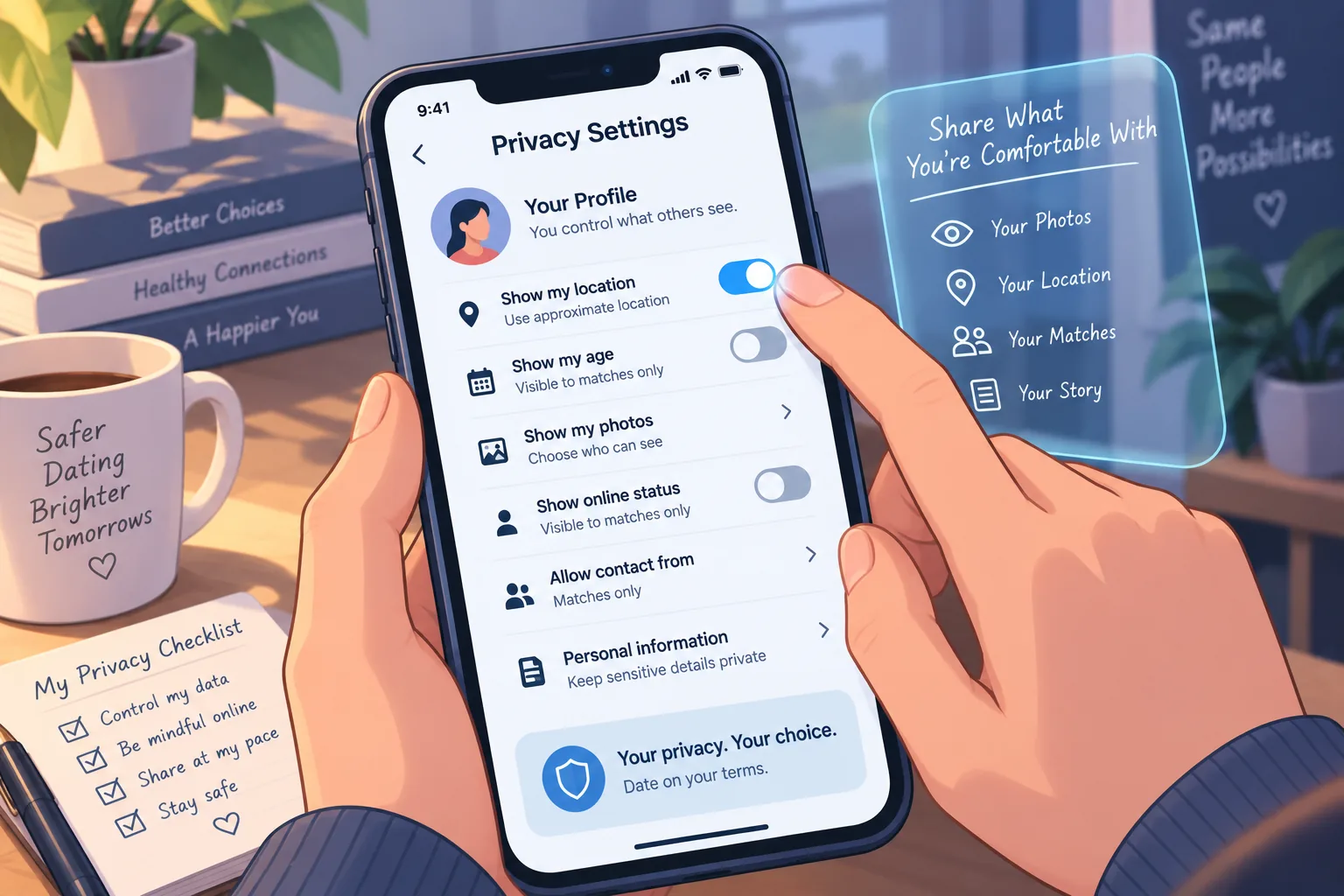
Privacy features vary by platform, subscription, country, and app version. The safest practice is to check the current privacy and safety settings inside the app and on the platform's official help pages before relying on a specific feature.
Mainstream Apps: Use Privacy Controls, but Do Not Treat Them as Invisible Mode
On Tinder, the current subscription feature set includes Incognito, which allows a user to hide their profile until they Like someone. Tinder also offers Block Contacts, which can use selected contact information to try to prevent you and those contacts from seeing each other. Tinder notes that contact blocking depends on matching contact information and therefore is not a guarantee that a particular person can never see your profile.
That creates two useful layers:
Incognito: reduce broad profile exposure.
Block Contacts: reduce exposure to known people whose matching contact information is available.
But neither should be interpreted as absolute anonymity.
A blocked contact may have different information associated with their Tinder account, and users can change phone numbers or email addresses.
On Hinge, Pause prevents your profile from being shown to new users while allowing conversations with existing matches to continue. Hinge also allows users to hide Last Active status.
This can be useful when you want to stop increasing your exposure without deleting your existing conversations.
The practical lesson across mainstream apps is:
Use visibility controls before you need them.
Do not wait until after a sensitive conversation has started to review who can see your profile.
Location Privacy
Dating apps need some form of location information to provide local matches, but that does not mean you should voluntarily publish your exact home location.
Avoid putting:
- home address;
- apartment number;
- exact workplace address;
- usual daily schedule
in your profile.
Also check your phone's location permissions and review whether the app has access to location only while in use, where that option is available.
A city-level dating location can provide useful matching without giving another user an exact map to your front door.
Niche STI Platforms: Privacy Features Can Be Stronger, but Sensitive Data Concentration Is Higher
STI-focused platforms can offer privacy features designed specifically for people who do not want their health status visible on mainstream dating services.
PositiveSingles currently describes features including Quick Exit, profile/privacy controls, private albums, profile hiding, and controls over which members can access photos. It also states that search engines and non-logged-in users are blocked from seeing member profiles.
PositiveSingles also allows private-photo access to be revoked.
MPWH likewise offers private albums and privacy controls. Its current help information says users can hide profiles through Privacy settings, and private albums can be shared selectively and later unshared.
Those features can be useful for people whose primary concern is being unexpectedly identified through a mainstream dating audience.
But there is another side of the equation:
A specialized STI dating platform necessarily contains highly sensitive information.
The platform may know that your account belongs to a person interested in STI-specific dating, and your profile may contain additional health-related information.
PositiveSingles itself states that no system can be completely secure and advises members to be careful about how they handle and disclose personal information.
So the decision is not:
"Which platform is perfectly private?"
It is:
"Which platform gives me the privacy controls I need, and what information am I comfortable giving that platform?"
Mainstream vs. Niche: A Practical Privacy Comparison
| Privacy consideration | Mainstream dating app | STI-focused dating platform |
|---|---|---|
| Audience size | Larger and more diverse | More concentrated around STI-specific dating |
| STI status visibility | Usually not inherently part of the public profile | May be more closely associated with the purpose of the platform |
| Private photos | Depends on platform and current plan | Private album features may be available |
| Profile hiding | Depends on platform and plan | Some platforms offer profile/privacy controls |
| Quick Exit | Not universal | PositiveSingles currently advertises Quick Exit |
| Risk of being recognized by mainstream contacts | Potentially higher because of broader social overlap | Potentially lower for some users, but not zero |
| Sensitive-data concentration | Health status may be less explicit | STI-related data may be more directly associated with the account |
| Best approach | Minimize identifying information and use visibility controls | Use privacy features while still minimizing personal identity information |
The correct choice is therefore personal.
Do not equate niche with anonymous or mainstream with unsafe.
The Tiered Disclosure Protocol: Building Trust Without Leaving Unnecessary Digital Footprints
Trust should increase gradually.
A person you have just matched with does not need the same amount of information as someone you have verified through several conversations and are preparing to meet.
The simplest model is:
Tier 1 → Public Profile
Tier 2 → In-App Conversation
Tier 3 → Verified Private Channel / Pre-Meeting
Step-by-Step: The 3-Tier Information Release Model
Tier 1: Public Profile
Keep your public profile focused on:
- interests;
- personality;
- general location;
- dating goals;
- non-identifying lifestyle information.
Avoid public disclosure of:
- STI diagnosis;
- treatment history;
- full legal name;
- employer;
- home address;
- personal phone number;
- linked social accounts.
This does not mean your profile must be fake.
It means your profile should contain less unnecessary identifying information.
Tier 2: In-App Private Chat
Once the person seems respectful, you can gradually share more.
A first name is usually enough.
A rough profession may be enough.
A city may be enough.
You can use an in-app voice or video call as one part of identity verification before giving someone your personal contact information.
However, remember that a video call does not guarantee identity. A recording can also be made without your knowledge depending on the device and jurisdiction.
Treat voice and video as additional evidence of authenticity, not proof that the person is automatically safe.
Tier 3: Private Channel / Pre-Meeting
Once the person has demonstrated basic respect and consistency, you can consider moving to another communication channel.
This is also the stage when a health conversation may become appropriate if sexual activity is becoming a realistic possibility.
The key principle is:
Health disclosure should happen early enough for informed sexual consent, but it does not need to happen publicly to everyone on the internet.
Keep medical communication focused.
Someone may need to know your STI status and relevant prevention or treatment information.
They do not automatically need:
- your medical records;
- your doctor;
- your insurance company;
- your prescription history;
- your patient portal password;
- unrelated diagnoses.
Protecting Your Real Phone Number
Using a separate number can create a useful privacy buffer when moving off-app.
Services such as Google Voice and other secondary-number providers may allow you to communicate without immediately giving a new acquaintance your primary number.
But a secondary number is not automatically anonymous.
Depending on the service and what information you use to create the account, a phone number can still be associated with identity information.
Therefore:
Secondary number = compartmentalization
not:
Secondary number = invisibility
Keep your primary number private until you are comfortable with the person and the relationship.
Managing Screenshot Vulnerabilities in In-App Messaging
There is no reliable way to prevent another person from copying information they can already see.
Even disappearing messages, screenshots warnings, voice notes, or video calls should not be treated as a guarantee against recording.
Instead, use a simple rule:
Do not send something digitally that would create a serious problem if the recipient saved it.
This is particularly important for:
- STI disclosures;
- medical documents;
- explicit images;
- home addresses;
- workplace details;
- identifying family information.
When health information needs to be discussed, keep the language factual and limited.
For example:
"I have genital HSV-2, and I manage it with suppressive treatment. Before we have sex, I want to make sure you understand the transmission risk and what prevention steps we can use."
That is enough to begin an informed conversation.
You do not need to send a photograph of your medical chart.
Before You Share a Sensitive Screenshot
Ask yourself:
Does this contain my full name?
Does it show my address?
Does it show insurance information?
Does it reveal an unrelated diagnosis?
Does it include my medical provider's contact information?
Does it contain more information than the other person actually needs?
Crop or redact unnecessary information before sharing.
Do not edit the actual medical result itself.
The objective is privacy minimization, not changing the evidence.
Pre-Meeting Privacy Audit: A 5-Point Safety Checklist
Before moving from an app to a personal phone number, social media, or an in-person meeting, take two minutes to review your digital footprint.
The 5-Point Privacy Audit Checklist
1. Photo Check
Have you checked whether the exact dating photos are already connected to your public social accounts?
Look at what the background reveals, not just your face.
2. Phone Number Isolation
Are you still using a number you are comfortable sharing?
A secondary number can reduce unnecessary exposure of your primary number, but remember that no phone-number service guarantees anonymity.
3. Social Media Separation
Have you accidentally connected Instagram, LinkedIn, Facebook, Spotify, or another public profile?
If the answer is yes, review exactly what that account reveals before continuing.
4. Identity and Trust Check
Have you had enough interaction to establish that this is a real person?
An in-app voice or video conversation can provide additional confidence, but it is not a guarantee. Pay attention to consistency across conversations and to whether the person respects boundaries.
5. Disclosure Control
Are you choosing the timing of your STI disclosure yourself?
Have you disclosed because the person is becoming a relevant sexual partner, or because they pressured you?
Have you avoided sending unnecessary medical records?
This is the most important question:
Am I sharing information because it is necessary for informed consent, or because I am afraid that saying no will make someone reject me?
Pressure is not trust.
What to Do When Someone Pushes for Too Much Information
Privacy boundaries work both ways.
A respectful date might say:
"That's okay. You don't have to share that yet."
A less respectful person may demand:
"Send me your medical records."
or:
"Give me your real name and workplace so I know you're not hiding anything."
You are allowed to slow down.
You can say:
"I'm happy to talk openly about sexual health before we're intimate, but I'm not comfortable sharing unrelated personal information this early."
Or:
"I can tell you what you need to know for sexual-health decisions. I don't share my full medical records or private accounts with someone I've just met."
That is a reasonable boundary.
You do not have to prove trustworthiness by surrendering privacy.
A Safer Way to Think About STI Disclosure Online
There is no need to treat disclosure as a single dramatic event.
A healthier approach is relevant information at the relevant time.
Early in dating:
"I prefer to discuss sexual health before becoming intimate."
As intimacy becomes realistic:
"There is something about my sexual health that I want you to know before we have sex."
During disclosure:
"Here's what the condition is, how I manage it, and what prevention options we can use."
After disclosure:
"What questions do you have?"
This creates room for informed consent without putting a medical label on your public identity.
Digital Privacy Is About Controlling the Link Between Identities
Your goal is not to disappear.
It is to prevent unnecessary links between:
Dating Profile → Real Name → Social Media → Employer → Home → Medical Information
The fewer automatic connections you create, the more control you retain.
A privacy-conscious profile can still be warm, authentic, attractive, and personal.
You can talk about:
- your hobbies;
- your sense of humor;
- what you're looking for;
- the kind of dates you enjoy;
- your interests;
- the kind of relationship you want.
You simply do not need to make your medical history part of the public search index.
Reclaiming Control of Your Digital Dating Experience
Protecting your STI status online is not a sign that you are ashamed of yourself.
It is a recognition that medical information is sensitive information.
You do not need to publish your diagnosis to thousands of strangers just to prove that you are honest.
You also do not need to give a future sexual partner less information than they need to make an informed decision.
Those two principles can coexist.
Use the profile to show your personality.
Use private conversations to build trust.
Use platform privacy controls to reduce unnecessary visibility.
Use separate channels when you need additional compartmentalization.
Share health information when it becomes relevant to sexual consent.
And remember that once information is sent digitally, you cannot completely control where it goes next.
The strongest privacy strategy is therefore not a perfect app setting.
It is controlled information release.
Before you post, ask:
Does this identify me more than necessary?
Before you link an account:
What else does this reveal?
Before you send a message:
Would I be comfortable if it were saved?
Before you disclose your STI status:
Am I sharing this because it is appropriate and necessary, or because I am being pressured?
That mindset creates a healthier digital boundary between your dating life and the rest of your identity.
Privacy is not hiding from intimacy.
It is deciding who gets access to you, and when.