The Shrinking Grid
I had been dating men long enough to know the implicit mechanics of the grid. Photos mattered. Age mattered. Body types and positions mattered. It never took long to figure out who was looking for a real connection, who wanted a casual drink, and who just wanted someone over before the night ended.
I knew how fast things moved on the apps—a quick trade of photos, a location drop, or a sudden, silent fade. The pool wasn't massive to begin with, but it was familiar. I knew where I stood, or at least I thought I did.
Then came my STI diagnosis.
Nothing about my desires actually changed. I was still attracted to men, still wanted to go on dates, and still held on to the possibility of falling in love. But suddenly, every new interaction was haunted by a quiet, persistent second-guessing: When do I tell him? Before coffee? After a good first date? Right before his clothes come off? And what happens to his face when I do?
The raw number of gay men in my city hadn't physically shrunk overnight, but the usable pool felt completely depleted. Before the diagnosis, my primary question was simply whether I liked a guy. Afterward, the question flipped entirely: Would he still want to know me once he found out what I carried?
It was a subtle shift in phrasing, but it completely changed the terms of engagement.
The Displacement Dilemma
After a while, a strange kind of displacement set in.
On standard gay apps, I was just another face on the grid—until the STI came up. The second I disclosed, friction entered the room. The tone would shift, replies would slow, or the chat would simply dissolve.
Seeking refuge, I turned to online STI forums and support spaces, hoping for a sense of kinship. But those spaces presented a different kind of gap. Scrolling through threads, I'd pass endless posts from straight couples or suburbanites managing conditions entirely different from mine. Nobody in those groups needed me to justify my medical history, which was a relief, but almost nobody shared the specific mechanics of my life as a gay man.
I kept finding pieces of my experience scattered across different corners of the internet, but never the whole picture in one place.
Too clinical for Grindr. Too queer for the general STI groups. Too cautious for a late-night hookup. Too complicated for a quick drink.
Eventually, I stopped asking where men like me were supposed to date. I started asking a much quieter, heavier question: Where do we actually fit?
The Two Coming-Outs
I thought I already understood the mechanics of a heavy confession.
I knew what it felt like to tell someone I was gay and then sit back to swallow the reaction. I had lived through the awkward pauses, the intrusive questions, and the tense days waiting for people to digest the news. I had survived all of it, so when I got my diagnosis, I naively assumed I was uniquely equipped for disclosure.
I was wrong.
Coming out as gay had been about claiming something fundamental about my identity. Disclosing an STI felt entirely different; it was a single medical fact about my body, yet I knew it had the power to rewrite every other impression a man had just formed about me.
"I have HSV."
I'd type it out or say it aloud, and then the suffocating waiting period would begin—the sudden drop in the room's air pressure, the three dots pulsing silently on a screen, the agonizing seconds where you watch a person's face reconfigure itself in real time.
Except this time, I wasn't waiting to see if he accepted my identity. I was watching for something far more visceral: Was he calculating his risk? Was he disgusted? Would he still let me touch him tonight?
In those early disclosures, I tried to sound breezy and clinical, as if I were offering a weather update. But it was a hollow performance. Every time the words left my mouth, the same power dynamic took hold: I had handed a guy an immediate veto over my body, and I was forced to sit silently while he decided what I was worth.
Fragmented Identity
I started noticing how effortlessly people could strip away my complexity until only one label remained.
With certain men, being gay was never a question—it was just the background radiation of our lives. We talked about work, bad dates, and niche pop culture. Nobody treated my sexuality as a separate category to be audited.
Then I'd disclose my STI, and the transformation was often instantaneous. The banter-filled tone would vanish, replaced by a cautious, clinical register. A man who had been flirting twenty minutes earlier would suddenly sound like an intake nurse, far more interested in my medical timeline than my personality.
Other times, the reaction was wrapped in a performative kindness: "You're still a great guy." It was meant to soften the blow, but it carried an insulting undertone—as if my diagnosis had demoted my worth, and he was being generous just by acknowledging my humanity.
I was still the exact same gay man I had been an hour prior—with the same dry humor, career ambitions, and desire for physical connection. Yet the moment those three letters entered the room, everything else about me became invisible.
I didn't want a space that validated my STI while knowing nothing about gay culture, nor did I want a gay dating scene where an STI turned me into a separate species. I wanted to be seen as a whole human being.
Exhausted by this constant fragmentation, I turned to a platform where I assumed I wouldn't have to justify either side of who I was.
The Illusion of Frictionless Spaces
When I registered for a dedicated STI dating platform, my initial reaction was an almost overwhelming wave of relief.
The dark, looming cloud of disclosure was completely gone; it was built directly into the infrastructure of the app. Everyone on the platform had already accepted the terms of engagement. I didn't have to spend three days calculating the right moment to drop the news, nor did I have to brace myself for a sudden, silent block.
For a brief, hopeful moment, I thought I had bypassed the hardest part of queer dating.
Then reality settled in.
I set my location filters, refreshed the feed, and hit the bottom of the stack within ten minutes. The usable pool of active gay men in my metro area was painfully small. A few lived hours away across state lines; others had completely blank bios or sparse profiles.
An uncomfortable realization washed over me: I had dangerously confused being understood with being compatible.
Having the same medical history didn't mean we shared the same taste in art, relationship goals, or physical spark. The platform had successfully removed the fear of rejection, but in doing so, it had also stripped away the scale, diversity, and spontaneous chemistry of a real dating market.
It hadn't solved my dating life; it had simply traded a massive, high-friction pool for a tiny, low-friction one.
Returning to the Mainstream
Driven by the desire for real options, I reinstalled the standard gay dating apps.
The contrast was immediate and jarring. Opening the grid felt like walking out of a cramped backroom into a bustling city street. There were endless profiles, fresh faces, real physical attraction, and men living just three blocks away. For about a week, the sheer density of options was intoxicating.
Then, the honeymoon phase evaporated.
On the STI platform, my diagnosis was part of the room's atmosphere; here, it was an invisible baggage I carried alone into every new conversation. Every time a genuine connection began to flicker, the familiar clock started ticking: When do I tell him? I caught myself enjoying a conversation for ten minutes, only to be hit by a sudden, sickening wave of anticipatory dread.
I started meeting men again. Some I told over text; their replies slowed down and eventually vanished. Other times, I sat in a dimly lit bar across from a man I genuinely liked, feeling an invisible wall rising between us because I knew the confession was coming.
The mainstream apps forced me to confront a fundamental truth: the low-friction space was barren, and the fertile pool required armor. I couldn't eliminate the threat of rejection; I could only decide who was worth the risk.
From Fear of Rejection to Fear of Recognition
Rejoining mainstream gay apps resolved the pool-size crisis, only to trigger an entirely different kind of paranoia: recognition.
In a dense urban queer scene, anonymity is an illusion. The ecosystem is deceptively tight; men overlap across platforms, circles intersect, and digital footprints leak.
I began noticing how remarkably little data it takes to triangulate a human life—a familiar wrist tattoo in a crop-free photo, a distinct living room bookshelf, or a specific neighborhood drop combined with an age and an industry. On Grindr, I was just a torso photo keeping my health status guarded. On the STI platform, I was transparent about my diagnosis.
The haunting possibility took root in my mind: What if the two worlds collide?
Every time I swiped past a profile, my brain ran a desperate recognition algorithm: Do I know this guy? Did we cross paths at a party last month? What if he screenshots my profile and drops it into a group chat?
I became hyper-vigilant, scrubbing recognizable artwork from my photo backgrounds and keeping my location settings coarse. The threat didn't even need to be real to be completely paralyzing. I was no longer looking at a handsome man's profile and wondering about romantic chemistry; I was calculating digital security risks.
I had initially turned to specialized platforms assuming that honesty would bring safety. Instead, I discovered that in a hyper-connected world, vulnerability always carries a digital paper trail.
Seeking Sanctuary, Not Just Matches
At some point during the endless cycle of swiping, disclosing, and bracing for impact, my primary query fundamentally shifted. I stopped opening every digital space asking: Could I meet a boyfriend here?
I started looking for sanctuary instead.
I drifted into online spaces where gay men discussed health diagnoses with unvarnished honesty—private subreddits and quiet message boards completely untethered from the hookup economy.
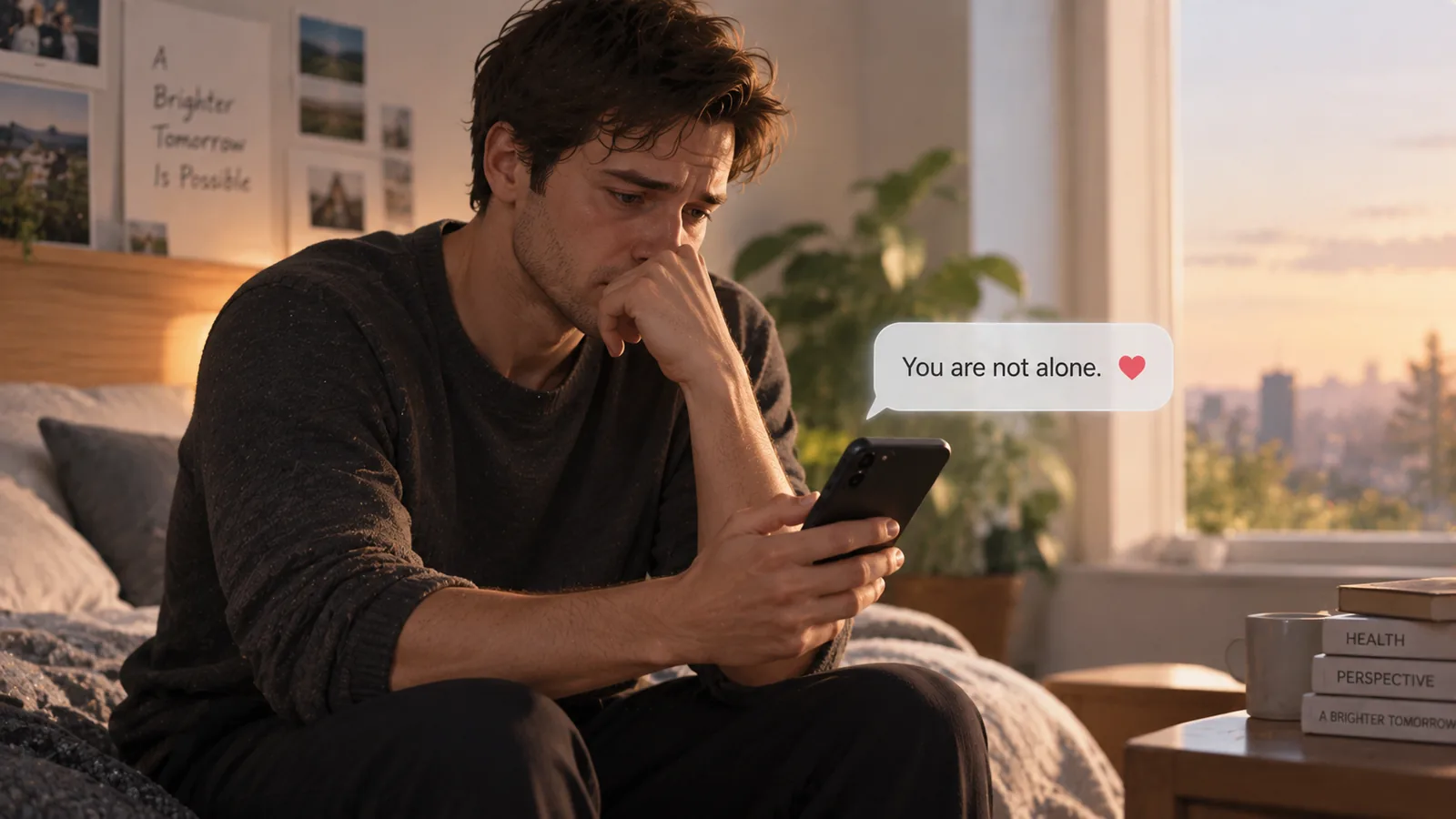
Late one night, I replied to an anonymous post from a guy terrified of feeling like damaged goods. I typed out a simple sentence: "I know that exact hollow feeling in your stomach. It gets quieter over time."
Ten minutes later, he replied: "Thank you. I really needed to hear I wasn't the only one tonight."
We never exchanged photos or met up, yet that brief interaction felt infinitely more grounding than a dozen matches on Grindr. For the first time in years, I wasn't being evaluated on my aesthetics, proximity, or medical safety. I could just exist.
I suddenly realized how much exhausting energy I had wasted trying to force every digital square foot into a romantic sorting mechanism. Not every space needed to be a dating pool; some places were meant to be lifeboats.
A Room Full of Folding Chairs
That realization eventually led me out of the digital world and into my first in-person support group.
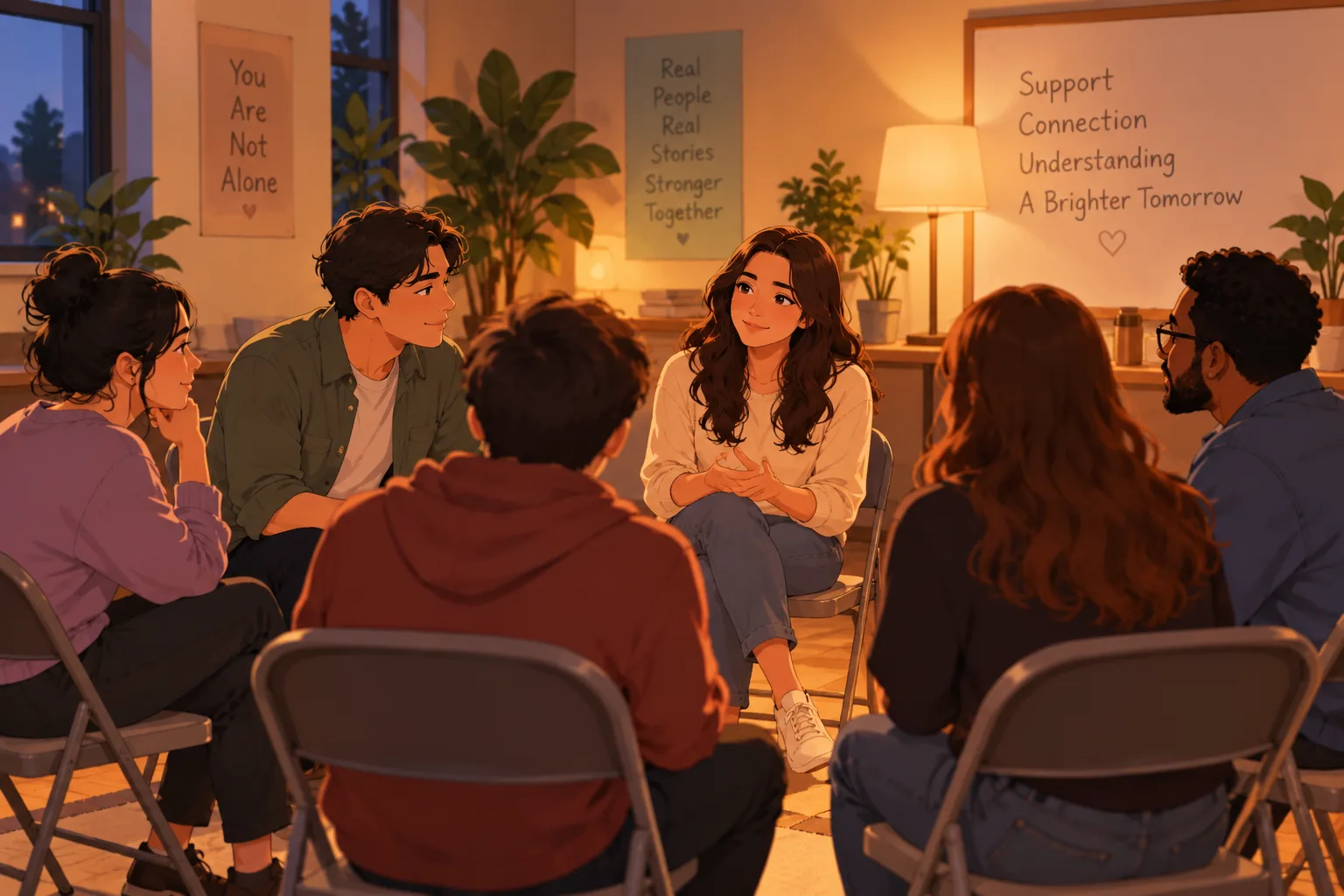
The meeting was held in a basement room of a local community center. I almost walked away at the threshold, bracing myself for a solemn room full of gloom.
Instead, I walked in to find eight or nine men laughing over cheap drip coffee. One guy was animatedly recounting a disastrous Hinge date; another was showing photos of his dog; someone else mentioned he had been happily married for seven years.
When the conversation eventually turned toward dating and disclosure, men spoke openly about the sting of rejection and the clumsy wording of text messages. Nobody offered platitudes or grand speeches. They just talked, laughed, and passed around paper cups.
Sitting in that circle, an embarrassing realization hit me: I had spent years attempting to compress human connection into a hyper-specific filter algorithm. I was searching for men who were simultaneously gay, STI-positive, local, emotionally mature, and physically my type. I was demanding that a dating app solve my identity, my safety, and my romance all at once.
The men in that room weren't an algorithmic sub-category. They were just human beings with complex, messy, ordinary lives.
For two hours, I stopped assessing the room for romantic potential. For the first time since my diagnosis, I stopped viewing myself as a walking medical status trying to locate his designated sanctuary. I was just a man in a folding chair, listening to other men talk.
Flipping the Script: From Acceptance to Agency
For a long time, I operated under the fantasy that the perfect dating ecosystem existed—a magical sanctuary that could offer massive scale, local proximity, deep attraction, and effortless understanding all at once.
I eventually realized that such a frictionless universe does not exist.
Mainstream apps offered scale, but required high-friction disclosure. STI platforms provided transparency, but suffered from tiny pools. Online forums offered emotional safety, but lacked physical chemistry. Support groups provided grounded human warmth, but weren't dating markets.
None of them solved everything, and that was okay. The moment I stopped expecting one single platform to carry the full weight of my existence, the anxiety dissolved.
The most profound shift, however, didn't happen in my swiping strategy; it happened in my internal posture.
For years after my diagnosis, I had approached every prospective date with one desperate, submissive question: Will he accept me?
That mindset had placed me in a perpetual audition, spending whole evenings managing a stranger's comfort before I had even decided if I enjoyed his company.
Eventually, I flipped the script. I forced myself to start asking simpler, far more important questions: Do I actually enjoy talking to him? Does he make me laugh? Do I even want to kiss him?
Those questions didn't make rejection disappear, but they completely changed what rejection meant. I didn't need every man in my city to accept my medical history; I only needed to find the few who were compatible with the life I was actively building.
My dating pool may be smaller than it was before my diagnosis, but I have made peace with that math. What I refuse to accept, ever again, is the idea that a small pool makes me a lesser choice.
I stopped looking for a dating world that would grant me permission. I started looking for men I actually wanted to take the risk of knowing.