One Night Four Years Ago Changed My Life Forever
Four years ago, I was 37 years old and living in Jackson, Mississippi. I worked as a federal government employee, had a stable job, and lived what I would describe as a fairly ordinary life. I was never someone who dated around or slept with a lot of people. If anything, I was pretty traditional and had always taken relationships seriously.
For years, I had been waiting for the kind of love I could actually build a life around. I just hadn't found it.
But loneliness has a way of making you do things you normally wouldn't.
One weekend night, I went to a bar in Jackson. I wasn't looking for anything serious. I just wanted to have a few drinks, get out of the house, and maybe forget for a while how lonely I had been feeling.
That's where I met her.
She looked like an ordinary woman—almost like the kind of girl you might imagine living next door. There was nothing about her appearance that made me suspicious or gave me any reason to think there was anything seriously wrong.
Looking back, I realize how easily we make assumptions based on appearances. I had no reason to believe she was sick, and I certainly didn't think I had anything to worry about.
We talked. We drank. We got along.
One thing led to another, and eventually I brought her back to my place.
That night, we had unprotected sex.
The next morning, I woke up and realized she was still there.
I remember feeling relieved, even happy.
For the first time in a long time, I allowed myself to wonder whether this might actually become something. Maybe this wasn't just another meaningless encounter. Maybe, after waiting all these years, I had finally met someone.
I was 37 years old. I had spent years waiting for love.
And that morning, lying there beside her, I thought maybe my wait was finally over. I allowed myself to imagine breakfast together, a lazy Sunday, and maybe calling her later in the week. I thought my love story might finally be starting, completely unaware that my worst nightmare had already begun.
She Asked Me to Get Breakfast. When I Came Home, My House Had Been Robbed
The morning started in a way that made me believe even more strongly that something might come out of that night.
She was still in my bed when I woke up.
We talked for a while, and everything seemed normal. There was no reason for me to think that anything was wrong.
Then she told me she had a headache.
She asked me if I could go out and get her some painkillers. Then she asked if I could bring back some breakfast for us while I was out.
It seemed completely harmless.
I didn't hesitate for even a second.
I wasn't suspicious of her. I wasn't thinking about my belongings or whether I should lock something up. In my mind, she was simply a woman I had spent the night with, someone I was beginning to like, someone who might possibly become more important in my life.
So I left.
I bought the medicine she had asked for and picked up breakfast on my way home.
I remember walking through my front door with the bags in my hands, probably still thinking about what the rest of the day might look like.
Then I noticed something was wrong.
She was gone.
At first, I thought she had simply left.
Then I looked around.
Something felt different.
I checked my things.
My valuables were missing.
My electronics were gone. Other things I had worked years to buy were gone too. She had taken practically everything valuable she could carry.
For a few seconds, I just stood there trying to make sense of what I was seeing.
I couldn't believe it.
The woman who had been lying next to me that morning had waited until I left the house and then taken everything she could.
But strangely, my first reaction wasn't anger.
I didn't immediately think, She's a thief.
I kept trying to find another explanation.
Maybe something had happened.
Maybe she had been desperate.
Maybe there was some reason she had done this.
I wanted there to be a reason because admitting the truth meant admitting that I had completely misjudged the person I had trusted only hours earlier.
I even tried to find her.
I looked for ways to contact her. I searched for information that might lead me to her. Part of me was still hoping that I could find her, hear her explanation, and somehow make sense of what had happened.
I didn't want to believe that someone I had just shared such an intimate moment with could deliberately betray me like that.
So I waited.
One day passed.
Then another.
It wasn't until the third day that I finally accepted that she wasn't coming back and that I had to report what happened.
I called the police.
The police eventually began investigating, and within about two days, they managed to locate and apprehend her.
Then I received a call asking me to come to the station to identify her and verify the recovered property.
I thought that would be the end of the story. I thought I would identify the woman who had robbed me, get my belongings back if I was lucky, and somehow move on with my life.
And even as I walked through the doors of that police station, I still didn't want to admit to myself just how thoroughly she had deceived me.
The Other Thing the Police Told Me Made My World Collapse
I went to the police station expecting to identify the woman who had robbed me.
Instead, the officer took me into a private room and told me something I never could have imagined.
She was living with HIV.
For a moment, I honestly didn't understand what he was saying. The words sounded completely disconnected from reality.
Then he told me more. She was heavily involved with drugs and prostitution, and she had been seeing multiple men across the city.
Everything around me seemed to go quiet.
I suddenly remembered that night.
The bar.
The drinks.
Bringing her home.
Waking up next to her the next morning.
And then the one thing I had tried not to think about came rushing back into my mind with suffocating clarity.
We had had unprotected sex.
It had been less than 48 hours since she left my apartment.
My mind went completely blank.
My world collapsed.
I had gone into that police station thinking I was dealing with a stolen laptop, missing belongings, and a woman who had betrayed my trust.
I walked out wondering whether she had handed me a terminal sentence that would change the rest of my life.
I didn't know what to do. My hands were shaking so hard I could barely unlock my car door.
I started searching for information everywhere I could. I called doctors. I drove to an urgent clinic. I tried to understand what options I might still have. I just wanted someone to tell me there was something—anything—I could do.
That same afternoon, the doctor performed a baseline HIV test.
The result was negative.
For a brief moment, I felt a tiny sliver of relief. It at least gave me a baseline showing that I had not tested positive prior to this exposure.
But I knew that didn't answer the question that was terrifying me.
Had I been infected that night?
The doctor explained that there was an emergency treatment called PEP (Post-Exposure Prophylaxis) that could be used after a potential HIV exposure.
"You're right at the edge of the 72-hour window," the doctor told me carefully. "It's not guaranteed, but every hour counts."
I knew the odds might still be stacked against me.
But I couldn't just do nothing.
I wasn't ready to accept the possibility that my life was over without even trying to stop it.
So I decided to start the 28-day regimen immediately.
For the next four weeks, I took the medication exactly as prescribed, counting down every single pill, desperately trying to convince myself that maybe, somehow, I would get lucky.
When you are terrified of losing your entire future, you don't think in terms of cold statistics.
You think about hope.
Even if it's only the smallest, most fragile amount of hope.
I was holding on to that with everything I had.
28 Days of PEP and the Longest Wait of My Life
The next 28 days were some of the hardest days I had ever lived through.
Every day, I took my medication and tried to go about my normal life.
But nothing felt normal anymore.
I went to work. I talked to colleagues. I answered emails. I went through the motions of my everyday routine like an actor on a stage.
But in the back of my mind, there was always the exact same question looping endlessly:
Did I get infected?
I couldn't turn it off.
Every strange feeling in my throat made me wonder whether it was an early symptom. Every time my phone rang with lab updates, I felt a sickening rush of adrenaline. Every appointment felt like I was walking toward a courtroom verdict.
During that period and the months that followed, I had to go back for follow-up testing again and again, following medical protocol.
The test right after finishing the 28 days of PEP was negative.
I felt relieved.
The second test at six weeks was negative.
I felt even better.
The third test at three months was negative.
For the first time, I started allowing myself to truly believe that maybe I had gotten lucky.
By that point, the suffocating fear that had been sitting on my chest for months had begun to loosen its grip.
Maybe the PEP had worked.
Maybe the exposure hadn't resulted in transmission.
Maybe this terrible chapter was finally coming to an end and I could chalk it up to a horrifying near-miss.
I started thinking about my life again.
For a few weeks, I allowed myself to imagine that I could put the whole thing behind me, close the drawer on that terrible weekend, and move forward.
But because PEP can delay the body's antibody response, I still had one final confirmatory test scheduled at six months.
The fifth test.
I remember how nervous I was when I went in, even though I kept telling myself it was just a formality.
Even after four negative results, part of me was still afraid to celebrate too early.
Still, nothing in the world could have prepared me for what I saw when the doctor walked back into the room.
The result was positive.
I stared at the paper.
I read it again.
And again.
I kept hoping I had misunderstood the medical jargon, or that it was a typo on the printout.
But I hadn't.
After months of negative tests, after 28 grueling days of medication, after slowly convincing myself that I had escaped, I was suddenly looking at the exact result I had spent half a year praying never to see.
I broke down completely.
There are moments in life when your mind simply refuses to accept what is happening in front of your eyes.
This was one of them.
I sat in my car in the clinic parking lot and cried until my stomach hurt. I thought about everything I had assumed my future would contain.
Marriage.
Children.
Love.
A normal, quiet life.
All of those things suddenly felt impossibly far away, like objects sinking to the bottom of an ocean.
For months, I had been living between fear and hope.
The negative results had slowly given me pieces of my life back.
Then that fifth test took every single piece away in an instant.
I had started this journey desperately hoping that I had somehow avoided HIV.
Now I had to face the cold, undeniable truth that I had not.
And that was the moment I realized my life was never going to be the same again.
I Finally Knew That I Really Had HIV
The positive test was eventually confirmed through secondary western blot and viral load testing.
There was no misunderstanding. No mistake in the laboratory. No possibility that I could simply wait a few more days and watch the result magically disappear.
I had HIV.
The four negative tests before it suddenly felt almost cruel, like a sick trick played by time itself.
At the time, I didn't understand why the earlier results had been negative. I only knew that I had tested negative several times, started to believe I was safe, and then received a positive result anyway.
It was only later, as I learned more about HIV testing and how PEP can extend the window period, that I began to understand the science behind what had happened.
But knowing the medical mechanics later didn't make the moment of diagnosis any easier to swallow.
That day, I wasn't thinking about medical terminology or testing windows.
I was thinking about my life.
I thought about the woman I had met in that bar. I thought about the night I had trusted her. I thought about the morning when I had actually believed something good might come from that encounter.
I was angry.
I was devastated.
And for a long time, I blamed her entirely for everything that had happened to me.
She was eventually charged with multiple offenses related to the theft and her criminal conduct surrounding HIV transmission, and she was sent to prison.
But strangely, hearing that news didn't make me feel better.
My stolen belongings could be replaced eventually.
She could be prosecuted.
She could spend years behind bars paying for her crimes.
None of that could undo what was now circulating in my bloodstream.
I still had to wake up every morning knowing that I was living with HIV.
And that is when the story stopped being about her.
It became about me.
About what I was going to do with the life I still had left.
At that point, I didn't know the answer.
In fact, for a long time, I wasn't even sure I wanted to find one.
I had spent months desperately trying to prevent HIV from becoming part of my life.
Now that it had, I had to figure out how to live with it.
And in those first months, I honestly believed HIV hadn't just changed my health.
I believed it had completely taken away my future.
Love. Marriage. Children.
Things that had once seemed like ordinary, natural parts of an adult life suddenly felt like they belonged exclusively to other people.
I had no idea then that the darkest part of my story wasn't the diagnosis itself.
It was what I was about to start believing about myself because of it.
I Hated Her, I Hated HIV, and I Hated the Life That Had Suddenly Been Taken Away From Me
After my diagnosis, anger became the easiest emotion for me to understand and hold onto.
I hated that woman.
I hated what she had done to me. I hated that I had trusted her. I hated myself for bringing her home that night. And more than anything, I hated the fact that one single night I could never take back had changed the rest of my existence.
Then I started hating HIV itself.
Every time I took my daily medication, I was reminded of it.
Every time I went to the clinic for bloodwork, I was reminded of it.
Every time I thought about where I would be in five or ten years, HIV was standing in the doorway.
Eventually, I even started hating my own life for what it had become.
I became a very different person.
I was constantly terrified that someone would find out.
At work, I became hyper-cautious about what I said. Around friends, I kept my distance and held back. I stopped sharing parts of my day that I once would have talked about without thinking twice.
I became sensitive to everything around me.
If someone mentioned HIV or AIDS in a casual conversation or on the news, my stomach would knot up and I'd wonder if they somehow knew.
If someone made a crude joke about sexually transmitted infections, I felt uncomfortable and exposed, even when the joke had nothing to do with me.
I was always afraid that somehow, through some microscopic slip-up, people would discover my secret.
So I withdrew completely.
I talked less.
I went out less.
I stopped getting close to people.
The more I tried to protect myself from being judged or exposed, the more isolated I became in my own home.
Dating was even harder.
It wasn't that I suddenly stopped wanting love or companionship.
If anything, I wanted it more than ever because the loneliness was deafening.
But wanting someone and believing that you were still worthy of someone were two completely different things.
If I saw a woman I found attractive or met someone nice, I would immediately jump ahead in my mind to the conversation that would eventually have to happen.
What happens when I tell her?
Will she be terrified of me?
Will she think I tricked her?
Will she tell her friends, my neighbors, or people in Jackson?
Will she just turn around and walk away?
Eventually, I stopped allowing myself to get close enough for those questions to ever matter.
It seemed infinitely easier never to start anything than to face that brutal rejection later.
Before HIV, I had imagined my future in fairly ordinary terms.
I wanted to fall in love.
I wanted to get married.
Maybe someday, I wanted to have children and teach them how to play ball.
After my diagnosis, those dreams suddenly seemed almost ridiculous—like a child wishing for a castle.
Love, marriage, and children became completely unimaginable to me.
It wasn't because a doctor had told me I could never have those things.
It was because I had convinced myself that nobody in their right mind would ever want to share them with an HIV-positive man.
That distinction took me years to truly understand.
HIV had changed my health status.
But the stigma I had constructed inside my own head was changing the way I saw my own humanity.
And for a long time, that self-inflicted shame was the part that hurt the most.
I Started Fighting HIV, Not Because I Wanted a Better Life, But Because I Was Afraid to Die
After my diagnosis, my entire existence began revolving around HIV management.
Medication schedules.
Doctor's appointments.
Blood draws.
Lab reports.
Viral load counts.
CD4 ratios.
Side effects monitoring.
Every part of my daily routine seemed to have a direct connection to the disease I had spent months trying to avoid.
I learned how to take my medication with precision. I kept meticulous records of my appointments. I paid attention to every minor twitch or change in my body.
But I want to be entirely honest about something.
I wasn't doing all of this because I had suddenly found a heroic new appreciation for life.
I wasn't waking up every morning thinking, I'm going to beat this and live my best life.
I was simply scared out of my mind.
I was terrified of dying.
That was the sole reason I followed my treatment plan so religiously.
That was the reason I sat in those cold waiting rooms every few months.
That was the reason I kept getting tested.
It wasn't because I had regained my confidence in living. It was simply because I was terrified of what death would look like.
I had spent my entire life assuming I would have plenty of time.
Time to fall in love.
Time to get married.
Time to raise children.
Time to build a career and retire quietly.
Time to grow old.
Suddenly, I wasn't sure if I had five years or fifty.
I would lie awake at night staring at the ceiling, thinking about it.
What would happen to my body?
Would the medication stop working one day?
Would my health suddenly take a catastrophic turn?
Would I live long enough to see any version of the future I had taken for granted?
Sometimes I would catch myself thinking about having a family, and then I'd immediately shut the thought down.
Why plan for a future when I wasn't even sure if I had one?
I didn't have the courage to dream anymore.
I was simply trying to survive the day.
And because I was so afraid, I started reading every medical paper, journal, and article I could find about HIV.
At first, I was looking for reassurance or trying to calculate my own expiration date.
I wanted to know how serious my condition was, what could happen to my organs, and how much time I had left.
But the more I read, the more my initial assumptions were challenged.
I started learning about modern antiretroviral therapy in detail.
About viral suppression.
About what it actually meant when treatment brought the virus down below detectable levels.
About transmission studies.
About mixed-status relationships.
About people who had been living with HIV for thirty years, working full-time jobs, falling in love, getting married, and raising completely healthy, uninfected children.
I didn't realize it at the time, but something deep inside me was beginning to shift.
The daily medication was keeping my physical body alive.
But the knowledge I was slowly accumulating was doing something else entirely.
It was systematically dismantling the monster I had spent so long fearing in the dark.
And eventually, I came to a startling realization: I had spent most of my life being terrified of HIV without ever actually understanding a single scientific fact about it.
That realization would become the turning point of my entire journey.
Treatment Forced Me to Finally Learn About HIV—and I Realized How Little I Had Ever Understood
The more medical facts I learned about HIV, the more uncomfortable I became with a truth I hadn't expected to face.
I realized just how profoundly ignorant I had been about the disease before I was diagnosed.
I had always known that HIV was dangerous, of course. I had grown up hearing the somber warnings, seeing the old public service announcements, and knowing it was something society viewed with horror.
But knowing a disease is dangerous is not the same thing as understanding the reality of living with it in the modern era.
Before my diagnosis, I had never once stopped to ask myself what actually happened after someone tested positive today.
Could they still work a regular job without being a danger to anyone?
Could modern treatment keep the virus under complete control?
What did "viral load" even mean in practical terms?
Could someone with HIV safely love someone who was HIV-negative?
Could they get married?
Could they have children without passing the virus on?
I had never given those questions a second thought.
Like most people who have never been forced to deal with it, I had simply carried around a vague, outdated image of HIV in my head—a terrifying death sentence wrapped in shame and risk.
Then I became the person in that image.
And suddenly, my survival depended on learning what was actually true versus what was just absorbed cultural stigma.
I learned about modern HIV treatments and how taking one or two pills a day can suppress the virus so effectively that it can no longer damage the immune system.
I learned about viral load testing and the threshold of detectability.
And most importantly, I learned about U=U—Undetectable equals Untransmittable.
I read the clinical trials and official statements from global health authorities confirming that a person living with HIV who maintains an undetectable viral load through continuous treatment cannot sexually transmit the virus to others.
Read that again. Zero risk.
That single medical fact completely transformed my understanding of my own body and my future.
For the first time in four years, I started asking questions that I had long assumed had only one depressing answer.
Could someone with HIV fall in love with someone who was HIV-negative without endangering them?
Yes.
Could they build a normal life together?
Yes.
Could they get married?
Yes.
Could they have children naturally without passing HIV to their partner or their baby?
Yes. With proper medical care and viral suppression, the risk of transmission to a child is effectively zero.
The more I learned, the more my old, shame-filled view of HIV crumbled into dust.
And I had to confront a very uncomfortable truth about myself.
I realized that before I got sick, I had been just as uninformed, just as judgmental, and just as fearful as everyone else. I had never truly understood HIV or the human beings living with it.
Not really.
And then a second thought followed closely behind: If I didn't know any of this until I was forced to learn it for my own survival, why would I expect anyone else in the general public to know it?
Most people who don't have HIV are just like the old me.
They know it's a scary word.
They know it's associated with danger.
They may have heard vague things about transmission from decades ago.
But how many everyday people have ever taken ten minutes to read modern medical guidelines? How many know what U=U means? How many realize that an HIV-positive person today can have a career, fall in love, get married, have healthy kids, and live well into their eighties?
Virtually no one.
Because until it touches your life, you have no reason to look.
That was when the core question in my mind shifted permanently.
For the first few years after my diagnosis, I had spent every night asking:
"Why me? Why did this happen to me?"
Now, equipped with real knowledge, I was starting to ask a much bigger question:
"Why are we as a society still so terrified of something that medicine has already conquered?"
And that question would end up changing far more than just my medical outlook.
It would completely change the way I viewed the world—and the people who would eventually attack me.
Four Years Later, I Finally Believed I Could Have a Normal Life Again
It took four full years to reach that mental space.
I didn't wake up one morning and magically lose all my fear. It was a slow, agonizingly gradual process of unlearning shame.
I kept taking my medication every single day without fail.
I kept going to my quarterly medical checkups.
I kept tracking my lab work.
And year after year, my viral load remained solidly undetectable.
My physical health was stable. My career was stable.
More importantly, my understanding of my own condition had matured completely.
The virus that had once represented an imminent death sentence in my mind had become a manageable chronic condition—no different in practical daily management than diabetes or high blood pressure.
I was still living with HIV, but I was no longer letting HIV live my life for me.
That distinction changed everything.
I began to realize that beneath the medical label, I was still the exact same man I had been four years ago.
I still had my career as a federal employee.
I still had my values, my humor, and my work ethic.
I still had goals I wanted to achieve.
I still wanted to fall in love.
And maybe, just maybe, I didn't have to surrender the things I had assumed were stripped away forever.
A real relationship.
A marriage.
A family.
Children of my own.
For four long years, I had treated those normal human desires as off-limits fantasies because I was HIV-positive.
Now, grounded in medical facts, I finally understood that my diagnosis had never actually taken those things away from me.
My own internal shame had.
I had spent years believing that no woman would ever want me if she knew my status. I had convinced myself that the safest, most responsible thing to do was to stay isolated, keep my head down, and never give anyone the chance to reject me.
But I was getting profoundly tired of living like a ghost in my own life.
I didn't want the rest of my years to be defined by a mistake made on one lonely night.
I wanted to be a man again—a whole person, not just a walking diagnosis.
I wanted to meet someone, fall in love, share coffee in the morning, and see where life could take us together.
For the first time since walking out of that police station, I started thinking seriously about putting myself back out there.
It still terrified me. I wasn't naive.
I knew that most people didn't understand HIV science.
I knew many women would say no immediately.
I knew disclosing my status would always be an uncomfortable, vulnerable moment.
But I also possessed something I didn't have four years earlier: confidence built on truth.
I wasn't asking for pity.
I wasn't asking anyone to endanger themselves for me, because with U=U, there was no danger to begin with.
I simply wanted the chance to be seen as a person first.
That realization was the floor beneath my feet.
And eventually, after years of hesitation, internal debates, and talking myself out of it a thousand times, I decided to take a step I hadn't dared to consider since the day I tested positive.
I was going to put myself out into the world.
I was going to be completely honest about who I was and what I was looking for.
And I was going to see if there was anyone out there willing to meet the real me—not just my medical file.
After Years of Hesitation, I Finally Posted on Instagram Looking for a Partner
Even with four years of viral suppression and medical knowledge behind me, the act of actually stepping back into the dating world was petrifying.
Reading medical studies in the quiet of your living room is one thing.
Exposing your deepest secret to real human beings is something else entirely.
In the days leading up to it, I asked myself every painful question imaginable.
What if people mock me?
What if someone I work with sees it?
What if people in Jackson start talking behind my back?
What if this ruins my career or my standing as a federal employee?
What if the rejection is so overwhelming that it pushes me back into the dark?
Those thoughts spun in my head night after night.
I could have taken the easy way out.
I could have stayed quiet and lived a comfortable, isolated life.
I could have searched secretly on specialized, private forums meant exclusively for HIV-positive individuals. I could have hidden my status until months into dating someone, living in terror of the day I'd have to confess.
But I didn't want to live behind a curtain anymore.
I was 37 years old when I was diagnosed, and now I was 41.
I had already spent four valuable years in total solitude.
Four years of being afraid to hold someone's hand.
Four years of convincing myself that I was damaged goods.
I refused to spend the next four years doing the exact same thing.
So one evening, after staring at my phone for nearly an hour, I opened Instagram.
I decided not to use a fake photo or a pseudonymous handle. I didn't try to soften the reality or beat around the bush.
If I was going to do this, I wanted absolute honesty from the very first second.
I typed out a short, direct text post:
"Jackson, Mississippi. 37-year-old male living with HIV, federal government employee with a stable income, looking for a female partner in a similar situation or someone who understands. I have been U=U (undetectable and untransmittable) for several years, can father healthy children, and am looking for a serious relationship leading to marriage."
I sat there staring at the screen.
My thumb hovered over the 'Share' button for what felt like an eternity.
My heart was beating so hard I could feel it in my throat.
I knew that once I pressed that button, there was no pulling it back.
My face, my location, my profession, and the medical secret I had guarded with my life for four years would be out in the public square forever.
And yet, I also knew that if I let fear win again, I was choosing to remain invisible for the rest of my life.
I closed my eyes and tapped Post.
For the first few minutes, nothing happened. The screen was quiet.
Then the first notification pinged.
Then another.
Then a steady stream.
At first, naive as I was, I thought people were simply reading it with curiosity.
Maybe another person living with HIV in Mississippi would see it and feel less alone.
Maybe a woman would appreciate the complete lack of games or deception.
I had prepared myself for polite rejections or quiet unfollows. I knew I wasn't everyone's cup of tea.
What I had not prepared for—what no human being can truly prepare for—was the wall of raw, unfiltered malice that immediately flooded my account.
Within an hour, I realized I hadn't just put up a dating post.
I had accidentally thrown open a door into the dark, ugly underbelly of public ignorance.
I had spent four years learning how to live with the virus in my blood.
I thought I was strong enough to handle whatever people threw at me.
I was wrong.
I was about to learn that the hardest part of living with HIV in the 21st century wasn't the disease itself.
It was the terrifying cruelty of people who knew absolutely nothing about it.
After the First Cruel Comment, I Realized How Little I Had Understood the Cruelty of the World
At first, I kept refreshing my notifications because my nerves were shot.
I knew people might have questions about U=U. I expected a few awkward stares. I had mentally prepared myself for someone saying, "Sorry, not for me."
But the very first public comment didn't address dating at all.
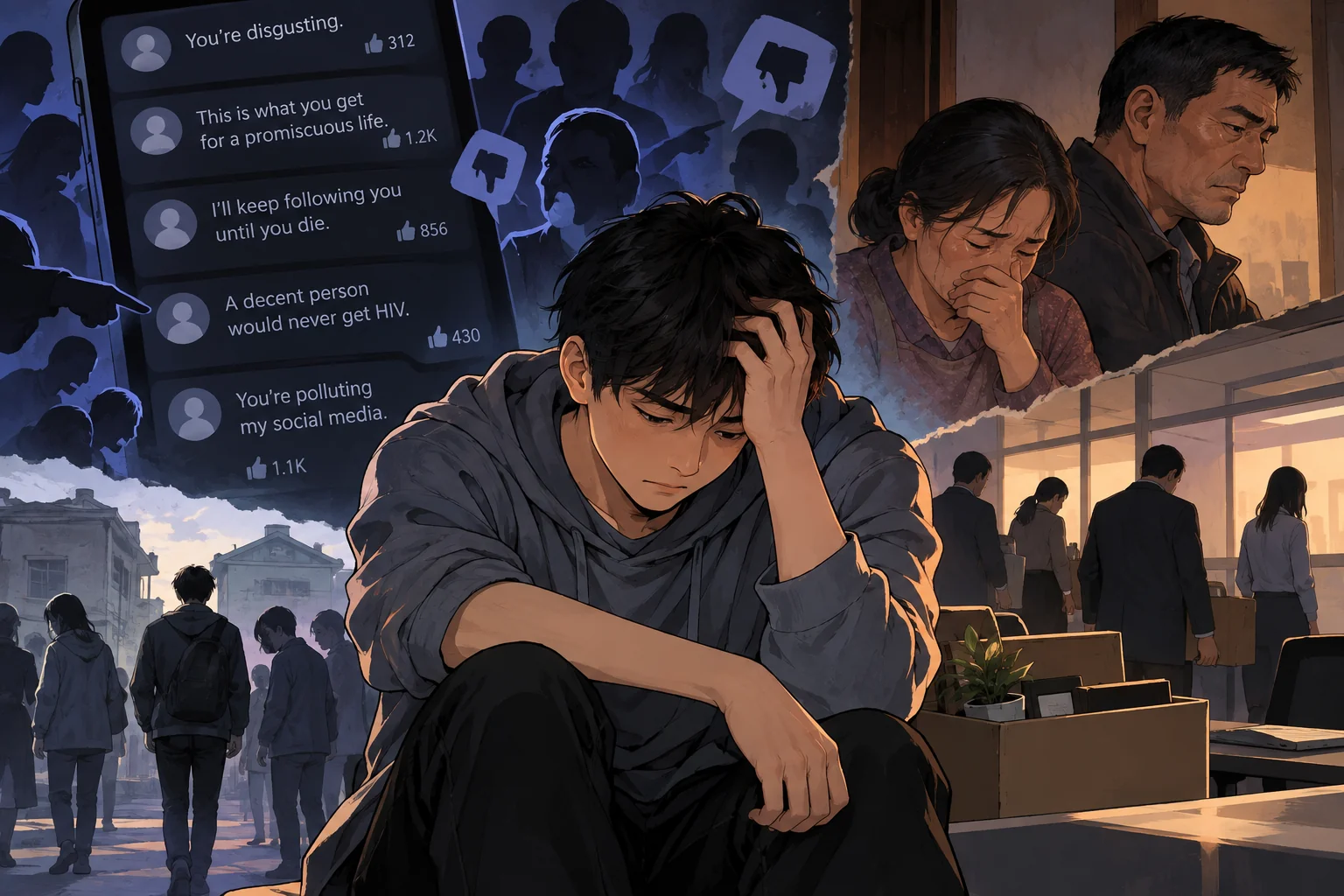
Someone wrote:
"Somebody get me some disinfectant for my phone screen right now."
I stared at the text on my screen. I didn't know whether to laugh it off or delete it.
Before I could decide, a second comment popped up underneath it:
"So let me get this straight, the guy got HIV through the air while typing this? Gross."
It was meant as a cruel joke, a casual piece of internet trolling.
I tried to swallow the lump in my throat. It's just the internet, I told myself. Don't take it personally.
Then a third comment appeared, hitting much closer to home:
"It's honestly terrifying that an HIV patient is allowed to work as a federal government employee. Who approved his security clearance?"
That one sliced right through me.
They weren't mocking my dating life anymore. They were publicly questioning my integrity, my career, and my right to hold a job I had worked hard for over a decade.
Then the comment section turned its attention to the part of my post that meant the most to me—my dream of having a family.
Someone commented:
"Find another HIV guy and live together. Just don't bring kids into this. They'll inherit your disease, you selfish idiot."
Another wrote:
"I guarantee you no healthy, normal girl is ever going to take a chance on a biohazard like you."
And then:
"This guy actually thinks he deserves a normal girl. The audacity of people on the internet never ceases to amaze me."
I couldn't stop scrolling. I knew I should have closed the app, put the phone face down, and walked away.
But it was like watching a car crash in slow motion—you can't pull your eyes away.
The comments weren't just rejecting me as a romantic partner anymore. They were systematically stripping away my humanity, categorizing me as something subhuman.
In their eyes, I wasn't a man looking for love.
I was "an HIV patient trying to trick a normal person."
That distinction hurt more than any physical pain I had ever felt.
Then someone brought my immediate environment into it:
"I live in Jackson too. After seeing this post, I'm literally considering moving out of the city tonight."
I remember staring at that comment for a long time.
For four years, I had worried in private about local stigma. Now a complete stranger in my own town was publicly declaring that simply breathing the same city air as me made them feel contaminated.
And still, the comments kept escalating in toxicity.
Someone wrote:
"Go die already, you damn degenerate."
Another comment was so vile I had to read it twice just to process the sheer hatred behind it:
"If I were your kid and found out both my parents were AIDS patients, I would literally kill you both first and then turn myself in to the police."
At that point, I wasn't even thinking about dating or finding a wife anymore.
I was sitting in my quiet living room, watching hundreds of total strangers vote on whether I had a right to exist, whether I deserved a career, and whether my life had any value whatsoever.
And then came a comment that was shorter than the rest, but somehow cut deeper than all the insults combined:
"Are you even sure you'll live long enough to see your kid finish elementary school?"
I finally put the phone down on the coffee table. My hands were freezing.
The comments had started with cheap jokes.
Then came medical ignorance.
Then personal rejection.
Then disgust.
Then pure, unadulterated hatred.
And finally, they had arrived at death wishes.
I had always known, in an abstract way, that HIV stigma existed in society.
I had experienced enough private fear to know people held prejudices.
But I had never truly understood how quickly a simple, honest post looking for companionship could unleash a lynch-mob mentality against a person simply trying to live.
I thought I was putting up a post looking for love.
Instead, I had accidentally held up a mirror to the ugliest, most ignorant corners of the human mind.
They Told Me I Didn't Deserve a "Normal" Woman—and Some Even Wanted Me Dead
I sat on my couch for hours as the notifications continued to light up the dark room.
Eventually, the initial sting of individual comments began to dull, replaced by a profound, heavy realization about the world we live in.
None of those people knew me.
They didn't know my work record. They didn't know how I treated my neighbors, how I cared for my family, or how many nights I had spent praying for a second chance at happiness.
They knew one single medical fact about my blood.
And for them, that one fact was more than enough to write off my entire existence.
According to them:
I had no right to look for a "normal" woman.
I had no right to get married.
I had no right to dream of holding my own child.
I had no right to work for the government.
And for the most extreme among them, I had no right to continue breathing.
That was the part that baffled me to my core.
I hadn't forced myself on anyone.
I hadn't lied about my condition—in fact, I had done the exact opposite by putting it in bold text for the entire world to see.
I hadn't demanded that anyone accept me.
I had simply stated, with complete honesty: This is who I am, this is my medical reality, and if you are open to it, I would love to build a life with you.
And that honest invitation was enough to make complete strangers furious.
They had taken my vulnerable search for companionship and turned it into a public spectacle about whether an HIV-positive person is even human enough to deserve love.
I picked up the phone again and scrolled further down, past the wave of vitriol.
And there, buried beneath dozens of hateful tirades, I noticed a few different kinds of comments.
A few strangers had actually stepped in.
One person wrote:
"Medical science has come a long way. HIV is fully manageable now. You are being honest and brave, man. Don't let these ignorant trolls get to you."
Another posted:
"People in this comment section clearly have no idea what U=U means. Educate yourselves before you comment on someone's life. He cannot transmit the virus if he's undetectable!"
A woman commented:
"You sound like an honest, grounded man who knows what he wants. Ignore the hatred. The right person will understand science and appreciate your honesty."
And another simply said:
"Stay strong, brother. You deserve happiness just like anyone else."
Those supportive comments didn't outnumber the hate. Not even close.
But seeing them sit there in the middle of all that darkness did something vital for me.
It proved that light still existed, even if you had to dig through a mountain of noise to find it.
Yet, as I looked at both the kindness and the hatred side by side, I realized that my emotional response was beginning to change.
I was no longer crying.
I was no longer spiraling into self-pity.
Because something much bigger was starting to dawn on me—something that would completely alter how I viewed the entire experience.
A Moment of Clarity: They Were Just Like the Old Me
That night, I didn't sleep a wink.
I sat by the window, watching the streetlights outside my house, thinking about the hundreds of messages sitting inside my phone.
I realized that the comments that had hurt me the most weren't actually the violent ones or the death threats.
The ones that truly shook me were the ones from people who genuinely believed they were stating a simple, logical fact:
"You have HIV, so you shouldn't be with a normal person."
That line kept echoing in my head.
Why did they believe that so deeply?
Why were they so convinced that an HIV-positive person living with an undetectable viral load was an inherently dangerous, broken creature who needed to be quarantined from the rest of society?
And then, in the quiet of the early morning, the answer hit me with the force of a physical blow.
They believed it because they were living in total, uneducated darkness.
They didn't know what modern medicine could do.
They didn't know what viral suppression meant.
They had never heard of U=U.
They didn't know that an undetectable person cannot pass the virus to a partner.
In their minds, HIV was still the exact same terrifying, fatal, highly contagious plague from decades ago that they had absorbed through cultural horror stories and outdated rumors.
They weren't responding to me—the 41-year-old federal employee sitting on his couch with a clean lab report.
They were responding to a ghost. A monster created by four decades of fear and lack of education.
And then came the most humbling, uncomfortable realization of my entire life:
Four years ago, before I got infected, I was exactly the same as them.
If I had seen a post like mine before that night in Jackson, how would I have reacted?
I might not have posted a death threat—I was raised better than that.
But would I have felt uncomfortable? Yes.
Would I have assumed the man was dangerous or reckless? Yes.
Would I have thought to myself, "Well, he definitely can't have a normal family anymore"? Absolutely.
I would have thought all of those things because I didn't know any better either.
I had spent four years being angry at the world for stigmatizing me, without ever acknowledging that I had harbored the exact same stigma inside myself until the disease forced me to learn the truth.
That realization changed everything inside me.
In an instant, my victimhood evaporated.
I wasn't a tragic figure being crushed by a cruel world anymore.
I was an educated observer watching a room full of blindfolded people swing wildly at something they couldn't see.
The commenters weren't inherently evil monsters.
They were just profoundly, tragically uninformed—exactly like I had been for thirty-seven years of my life.
And suddenly, I didn't feel hurt by them anymore.
I felt a strange, quiet sense of pity.
I Thought About the Woman Who Infected Me
With that realization opening up in my mind, my thoughts naturally drifted back to the one person I had hated more than anyone else on earth.
The woman from the bar four years ago.
For four long years, my narrative about her had been crystal clear, simple, and unforgiving:
She was a criminal. She was a liar. She took my belongings, gave me a life-altering condition, and ruined my future.
I had taken comfort in knowing she was behind bars, paying for her crimes against me and others.
But that night, looking at my Instagram comment section, I saw her through a completely different lens for the very first time.
I started asking myself questions I had never allowed my mind to explore before.
How did she end up in that bar that night?
What kind of life had she lived before she met me?
When she tested positive for HIV, did anyone sit her down and explain U=U, or did society just treat her like an untouchable?
Did she have access to stable healthcare, or was she driven into addiction, sex work, and petty crime because the world made her feel like her life was already over?
If someone had shown her compassion, educated her, and helped her get undetectable years before I met her, would any of this have happened?
I want to be very clear about something: I am not excusing what she did.
Stealing my property was a crime. Concealing her status and placing another person at risk was a crime. She committed those acts, and she deserved to face legal consequences for them.
I am not playing the martyr, nor am I pretending that the physical harm she caused me magically disappeared.
But for the first time, I could see the tragic chain reaction behind her actions.
She wasn't born a monster.
She was the product of a society that treats HIV as a mark of shame rather than a manageable medical condition.
When a society tells a sick person, "You are dirty, you are dangerous, and your life is over," many of those people give up on living ethically. They retreat into the shadows, into addiction, into desperation, and eventually, they end up hurting others because they feel they have nothing left to lose.
The hateful commenters on my Instagram post were actively building the exact same cage for me that society had built for her years earlier.
They wanted me to feel dirty.
They wanted me to give up on love.
They wanted me to crawl into a corner, isolate myself, and accept that my human life was effectively over.
And if I listened to them—if I allowed their ignorance to convince me that I was subhuman—I would end up broken, bitter, and destroyed just like she was.
That was the turning point.
I realized that holding onto hatred for her was keeping me chained to the very stigma that had ruined both of our lives in different ways.
Her actions were her responsibility.
But my response to this disease was entirely mine.
And I refused to let fear and shame turn me into another casualty of ignorance.
Why I Kept the Post Up: Moving Beyond Stigma
By the next morning, my phone was blowing up with messages from a few close friends who had seen the post and the nightmare unfolding in the comments.
"Delete it," one friend urged me. "Turn off your account. People are crazy, and this isn't worth your mental health or your job."
"Delete the comments at least," another said. "Block those accounts."
I looked at my Instagram post.
The comment count was in the hundreds. The vitriol was still there, sitting under my picture for anyone in Jackson—or anywhere else—to read.
I put my finger over the 'Delete Post' button.
It would have been so easy to make it all go away with one tap.
I could pretend I never posted it. I could go back to my quiet, isolated routine, keep my head down at my federal job, and never speak of HIV publicly again.
I stood there in my kitchen for a long time, holding my phone.
And then I closed the menu and put the phone back down.
I didn't delete the post.
I didn't delete a single comment.
I left every insult, every crude joke, every death threat, and every piece of medical misinformation right where it was, completely visible to the world.
I left it up because I finally understood why I had made that post in the first place.
When I typed those words out the night before, I thought I was just looking for a girlfriend.
I thought I was just trying to solve my own loneliness.
But as I looked at the wreckage in the comment section, I realized that my post had served a much higher purpose whether I had intended it to or not.
It had laid bare the exact reason why millions of people living with HIV around the world suffer in silence every single day.
The problem isn't the daily pill.
The problem isn't the quarterly blood test.
The problem is the crushing, suffocating weight of public ignorance that tells healthy, managing individuals that they don't deserve to belong to the human family.
I didn't need anyone's pity.
I didn't want a woman to date me out of charity or because she felt sorry for my diagnosis.
And I certainly wasn't demanding that every woman on Instagram fall in love with me.
People have every right to choose their partners based on whatever criteria they want—age, height, lifestyle, personality, or health preferences. Rejection is a normal, healthy part of adult dating, and I respect anyone's personal boundaries without hesitation.
If a woman reads my status and says, "I understand the science, but personally I'm just not comfortable with it," I respect her honesty completely. That is her right.
But refusing to date someone is fundamentally different from publicly humiliating them, wishing death upon them, and claiming they have no right to seek a family.
One is personal choice.
The other is bigotry born of ignorance.
And I realized that if I deleted my post out of fear, I would be agreeing with them.
I would be admitting that they were right—that an HIV-positive man should hide in the dark and be ashamed of wanting a normal human life.
I refused to give them that victory.
Raising Awareness Is the Real Story
Four years ago, on a quiet morning in Jackson, Mississippi, my entire life was ripped away from its foundation.
I went from a traditional, quiet federal employee expecting a quiet romance to a terrified man clutching a positive lab result, convinced that my life was over.
I spent years grieving for a future I assumed had been stolen from me.
I hated the woman who infected me.
I hated the virus in my body.
I hated the world that I knew would judge me if they ever found out.
It took four long years of physical medical care, mental processing, and deep education to realize that the phantom I was running from wasn't the virus itself.
Modern science has rendered the virus manageable. A single daily pill keeps my viral load at zero, my immune system strong, and my ability to pass it on completely nonexistent.
The real phantom—the monster that almost destroyed my soul—was the shame I had allowed society to plant inside my own mind.
When I posted on Instagram, I accidentally stepped directly onto the battlefield where that shame lives.
The hate I received was brutal. It was raw, unvarnished, and deeply personal.
But it was also the greatest gift I could have received at this stage of my life.
Because going through that fire cleared away the very last traces of my fear.
I realized that the people slinging insults from behind their keyboards couldn't touch the truth of who I am.
They don't control my medical reality.
They don't control my value as a human being.
They don't control my future unless I hand them the steering wheel.
I am 41 years old today.
I am a dedicated federal government employee.
I am a reliable friend, a responsible citizen, and a healthy man living with a fully managed medical condition.
I still want to fall in love.
I still want to get married.
I still hope to hold my own healthy child in my arms one day.
And I no longer feel the need to ask permission from an uneducated public to pursue those ordinary human dreams.
I didn't take down my Instagram post, and I won't be deleting it tomorrow.
If that post stays up and causes one person living with HIV to realize they aren't broken, it was worth every insult.
If it forces one uninformed person to Google "U=U" and realize that modern medicine has changed the world, it was worth every death threat.
And if it serves as a beacon for the one woman out there who values complete honesty, courage, and true scientific understanding over shallow public stigma, then my four-year journey has accomplished exactly what it was meant to do.
Four years ago, I thought my life was ending in that police station.
Today, I finally understand that it was just the painful, necessary beginning of me learning how to truly live.
I am still here. I am still healthy. And I am still looking forward to tomorrow.
That is my story.