Editor’s Note
In public discussions surrounding HIV, attention typically zeroes in on clinical breakthroughs or the tragic plight of late-stage diagnosis. Yet between those two extremes lies a vast, unexamined gray zone: the unforgiving daily mechanics of staying alive.
On paper, employment discrimination against people living with HIV is strictly prohibited. In practice, "stealth discrimination" dominates the job market. Employers rarely issue formal rejection letters citing medical status; instead, applicants are met with complete silence following routine pre-employment health screenings—a quiet barrier that leaves job seekers with virtually no legal recourse.
At the same time, the institutional legacy of the One-Child Policy leaves rural and small-town families extraordinarily vulnerable. In many agricultural regions, basic monthly elder-care stipends hover around 200 to 300 RMB (roughly $30 USD). Aging parents cannot serve as a financial safety net; on the contrary, they rely almost entirely on their sole child for basic survival.
While free Antiretroviral Therapy (ART) serves as the cornerstone of public health policy, free medication does not translate to zero cost of living. Government programs cover specific antiviral drugs, but out-of-pocket payments remain unavoidable for managing secondary complications, routine diagnostic blood work, basic nutrition, and shelter.
In Part 3, Jack withdrew from romantic illusions and social circles following a devastating emotional scam. Here, he faces a far more immediate obstacle: the cold calculus of daily survival.
This is his story.
Also in this series:
After Going Public Ⅰ: An Irrevocable Choice
Silent Exile: The Eyes That Burned
In the first few months after my status became public, I tried to preserve a sense of normal life. I genuinely believed that if I remained transparent and calm, the people around me would eventually adapt.
The shift was immediate, if quiet. At a rare family gathering, the air turned heavy. When the food arrived, older relatives casually pushed the serving utensils toward my side of the table. When I reached for a glass, the cousin sitting next to me subtly shifted away. People I had grown up with stayed focused on their phone screens, offering only polite, strained smiles whenever direct conversation became unavoidable.
There was no shouting, no overt insults. Just a heavy, physical distance that made it clear my presence had become a burden. Every interaction forced them into an uncomfortable tug-of-war between fear, etiquette, and moral obligation.
I stopped attending gatherings altogether. It was not an act of surrender, but an acceptance of reality: in that setting, no amount of goodwill could remove the label pinned to my name. Stepping back was the only quiet courtesy left to offer.
Shelter on the Margins: A Nine-Square-Meter World
To spare my parents the quiet strain of neighborhood gossip, I packed my bags and left home.
I found a nine-square-meter room on the outskirts of a nearby village. It was narrow, with peeling paint, a wooden plank bed, a second-hand wardrobe, and no private bathroom. The rent was low enough to fit my dwindling savings.
That small room became both a sanctuary and a self-imposed boundary. Inside, I did not have to monitor anyone’s facial expressions or brace for awkward pauses. My routine collapsed into the essentials: a simple meal in the morning, reading under a dim light at night, and the low rumble of long-haul trucks passing on the distant highway.
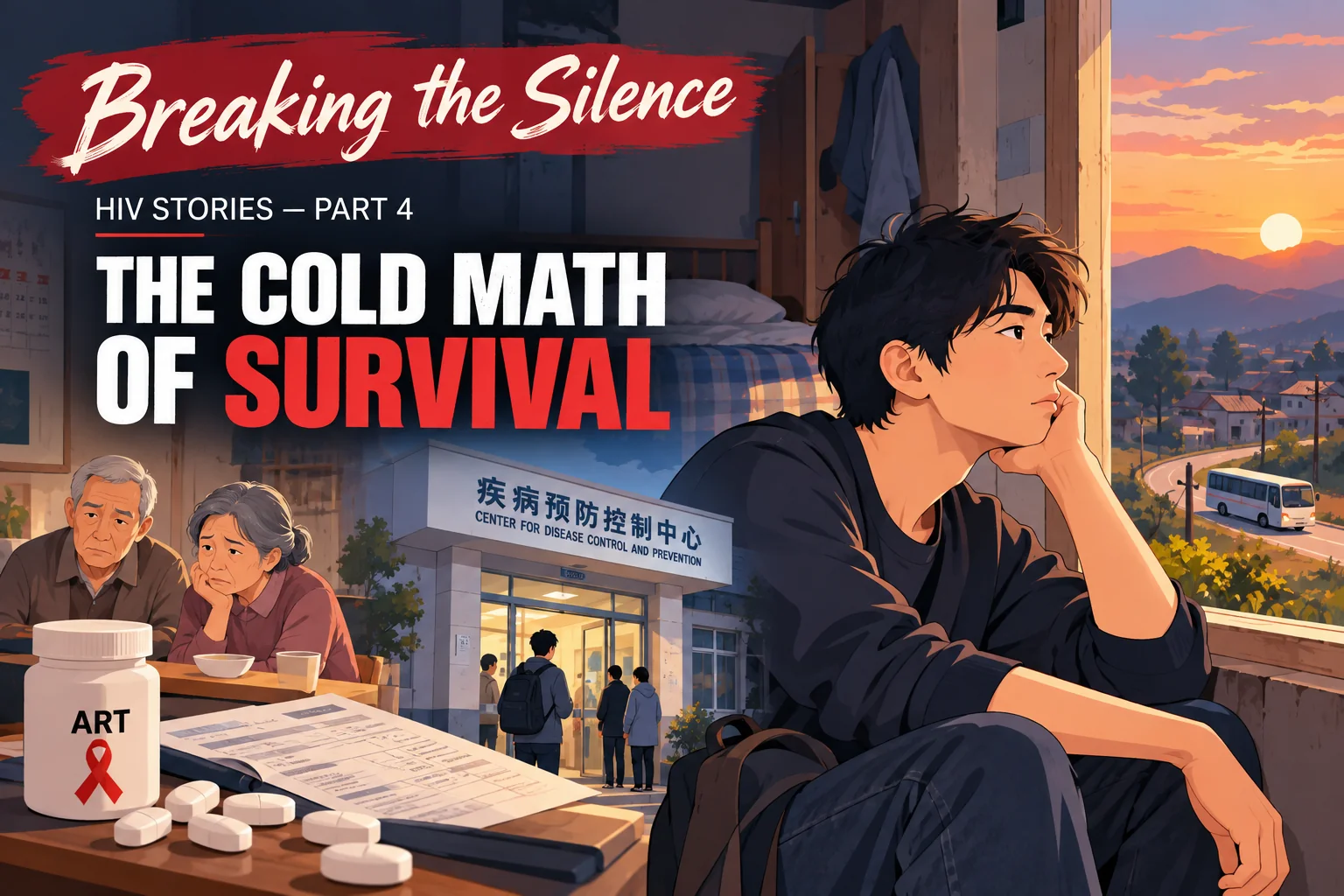
The only regular contact I maintained with the outside world occurred on my monthly pick-up day at the county Center for Disease Control and Prevention (CDC).
Once a month, I would shave, put on a clean shirt, and take the morning bus into town. Inside the bright CDC clinic, a healthcare worker would check my ID, print out the paperwork, and hand over my monthly supply of ART medication. Those thirty minutes—walking down sterile corridors, signing my name, taking the prescription—were the only times I felt connected to an organized, functioning society. It was a brief reminder that I was still accounted for.
The Cold Math of Survival: Free Medicine vs. Daily Bills
Free medication, however, does not cover daily expenses.
Long-term ART regimens can bring persistent side effects. I developed recurrent oral ulcers and severe skin rashes—minor complications from a clinical perspective, but costly ones in practice. Ointments, blood panels, and liver function monitoring all required out-of-pocket cash.
Then there was the reality back home. My father is nearly seventy, and my mother suffers from severe chronic back pain. Their combined monthly rural stipend barely reaches 300 RMB. As an only child, I was supposed to be their financial backup. Instead, I was struggling to cover my own basic groceries.
With traditional employment out of reach, I turned to the internet.
The public fallout from disclosing my status had drawn intense hostility, but it had also generated significant visibility. With no remaining safety net, I leveraged that attention to start live-streaming.
I bought a cheap microphone and mounted my phone against the wall. I avoided dramatic stories or sensational appeals, choosing instead to discuss the practical realities of living with HIV: managing medication schedules, dealing with side effects, and navigating daily routines. Over time, modest tips from viewers and small product referral commissions generated anywhere from a few hundred to a thousand yuan a month.
It was a meager income, but it covered my rent, paid for my skin treatments, and allowed me to send a couple of hundred yuan back to my mother each month.
The Digital Siege: Humiliation on the Live Screen
That modest stream of income quickly turned into a grueling test of endurance.
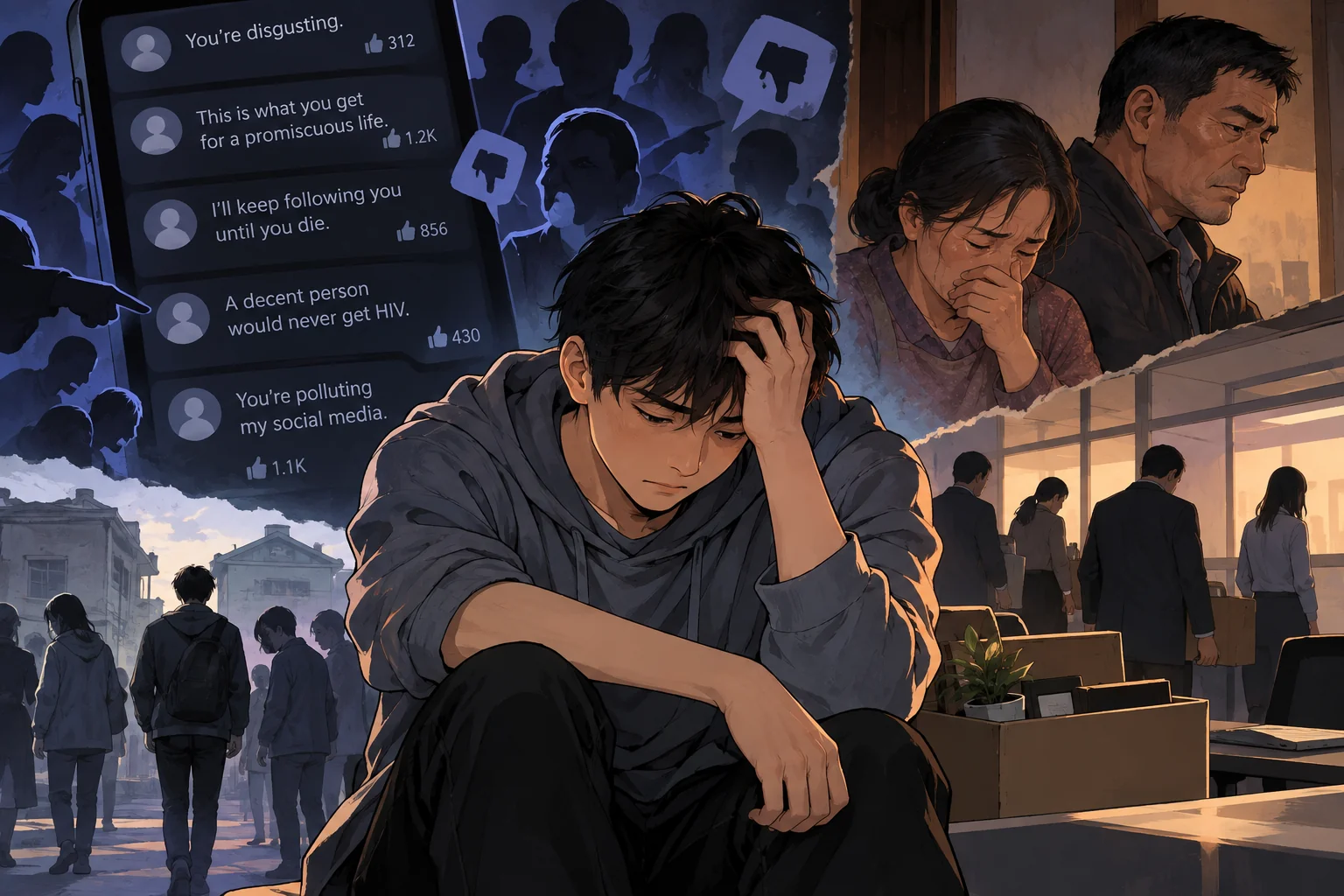
Skepticism online was pervasive. Viewers regularly accused me of faking my diagnosis, claiming I was using a serious condition as a gimmick for sympathy and clout. To maintain credibility and keep the stream running, I found myself complying with increasingly invasive demands from the chat. On camera, before thousands of strangers, I was urged to use a lancet for live rapid testing, hold up stamped CDC diagnostic forms, and repeatedly justify my presence.
Equally exhausting was the relentless wave of coordinated flagging.
Organized groups of users, operating under the premise of clearing "harmful content" from the platform, mobilized to report my channel. The moment I went live, dozens of accounts would file simultaneous complaints.
What followed was a slow, repetitive cycle of friction:
Going live $\rightarrow$ Getting automatically suspended within minutes $\rightarrow$ Submitting my government ID and official CDC diagnosis to platform support $\rightarrow$ Waiting out the manual review until reinstatement $\rightarrow$ Going live again, performing live tests to satisfy skeptical viewers $\rightarrow$ Getting hit by another mass report.
Platform safety algorithms are automated and risk-averse. When faced with high-volume reporting, the default response is suspension.
This was not a clean, permanent ban, but an ongoing process of attrition. Each successful appeal offered a brief window to generate income, only for the next wave of flags to pull the plug again. The unpredictability kept my finances unstable and my daily routine in a state of constant tension.
Regret and Persistence: The Will to Keep Breathing
In narratives about personal hardship, there is a common tendency to push toward a clean, resolute conclusion—a moment where the subject looks back and declares that every struggle was worth it.
I have no interest in framing my life that way. If I could go back, I would not choose to disclose my status publicly. I would far prefer the quiet anonymity of an ordinary job in a place where nobody knew my history, over tearing open my private life for public view only to spend my energy managing cynicism, reporting campaigns, and invasive scrutiny. Going public did not turn me into an advocate or a public figure; it simply removed my privacy.
My motives were never grand or heroic. Every attempt to speak out, every hour spent online, was driven by the immediate need to pay rent and buy medication.
Yet, regret does not pause the clock.
Outside my window, rain drips off the plastic awning. I pack away my medication bottles, prepare tomorrow’s meals, and turn off the light.
I am still here, and I am still breathing.
Survival does not require a grand narrative; it simply requires moving forward. Tomorrow morning, I will balance the bills, take my daily dose, and continue navigating whatever options remain.
Medical & Contextual Disclaimer
- Personal Narrative Context: This publication presents a first-person account reflecting individual lived experience under specific social and economic circumstances. It does not represent the universal experience of all individuals living with HIV, nor does it constitute medical or legal advice.
- Scientific Consensus on Transmission (U=U): According to global public health standards established by the World Health Organization (WHO) and UNAIDS, individuals living with HIV who achieve and maintain an undetectable viral load through consistent Antiretroviral Therapy (ART) for at least six months have zero risk of sexually transmitting the virus to others (Undetectable = Untransmittable).
- Public Health Infrastructure: Under national public health guidelines (including the National Manual on Free Antiretroviral Therapy issued by China CDC), basic ART medications are provided free of charge to eligible individuals. However, coverage for secondary complications, specialized consultations, and general cost-of-living support remains subject to local social security frameworks and personal financial capacity.