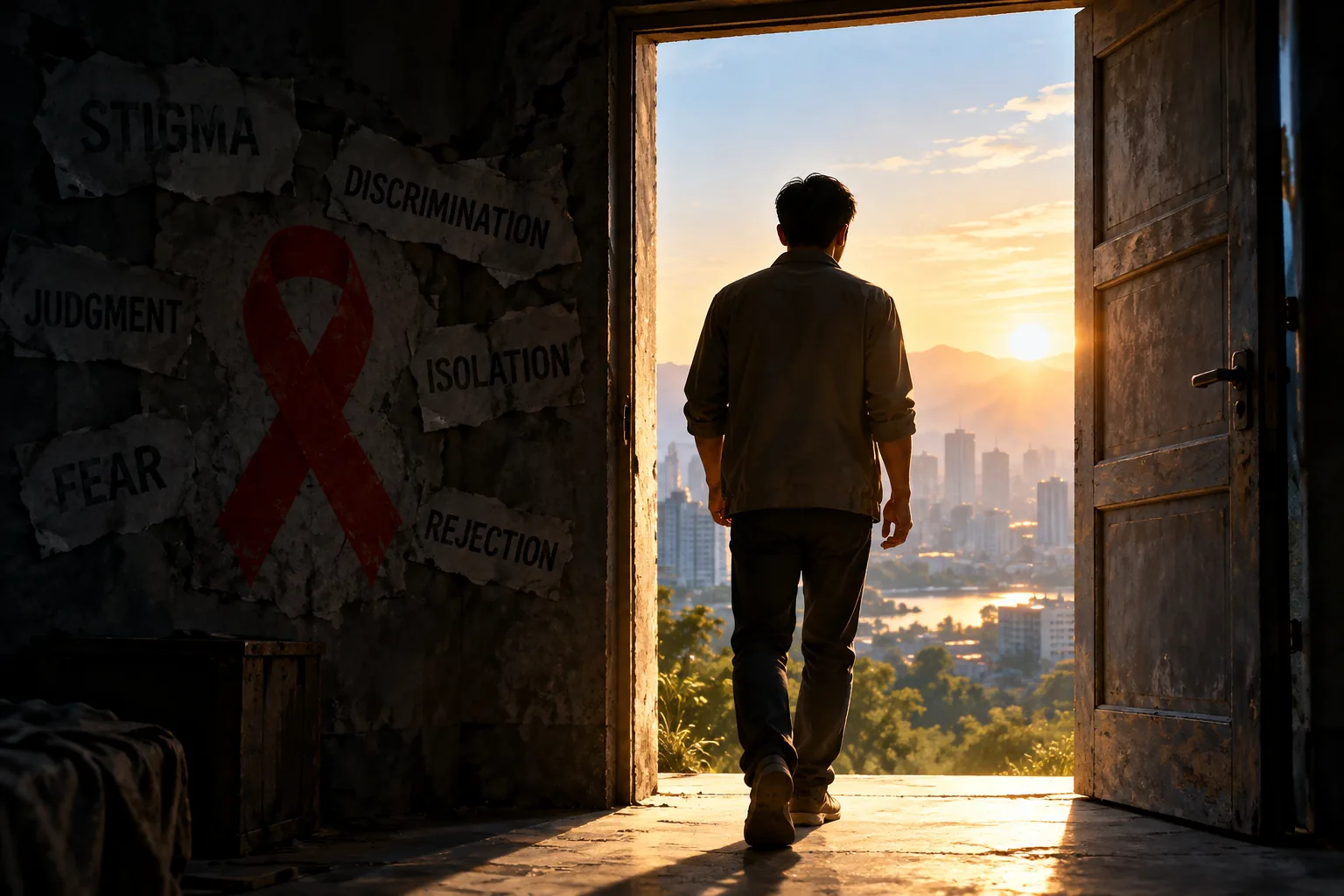
Editor’s Note
Jack Lee is not his real name.
He is a 41-year-old man from Yunnan, China, who contacted DatingBeyondStatus.com with a story that took him years to find the courage to tell.
At 36, Jack was diagnosed with HIV.
But his diagnosis is not the only reason this story matters.
The more difficult decision came years later, when Jack chose to make his HIV status public.
In many societies, telling the world that you are living with HIV is a deeply personal decision. In China, where HIV has long been associated with sexual behavior, morality, fear, and social prejudice, publicly identifying yourself as HIV-positive can carry consequences far beyond the medical condition itself. Research and public-health reporting have documented HIV-related stigma and discrimination in China, including social exclusion, concerns about employment and family relationships, and fear of being identified as living with HIV. UNAIDS has also reported that stigma can discourage people from seeking care or disclosing their status. (UNAIDS)
That is what makes Jack’s decision so difficult to understand from the outside.
He knew what society might say.
He knew people might judge him for how he acquired HIV.
He also knew that once his face and status were online, he could no longer control who saw them, who talked about him, or what assumptions people might make about his private life.
He knew that HIV status is deeply personal health information. China’s public-health system has formal requirements around the confidentiality of HIV-related information, reflecting the importance of protecting patients’ privacy. (National Health Commission of the People’s Republic of China)
And yet, after years of silence, Jack decided to do the one thing that frightened him most.
He decided to tell strangers who he really was.
He did not make that decision because he had stopped caring about stigma.
He made it because he had started to believe that silence had a cost too.
He wanted to warn other people about the risks he had taken. He wanted to challenge some of the fear and misinformation surrounding HIV. And, on a much more personal level, he wanted to know whether people could still see him as a person after knowing his status.
That mixture of courage, fear, idealism, loneliness, and self-interest is at the center of Jack’s story.
The story below is told in Jack’s first person. His name and some identifying details have been changed to protect his privacy.
This is his story.
Also in this series:
After Going Public Ⅱ: A Price Beyond Expectation
Solitude, Stigma, and the Sexual Risk I Took
My name is Jack Lee.
I am 41 years old, and I come from Yunnan, China.
Five years ago, when I was 36, I was diagnosed with HIV.
When I think about how it happened, I still wish there were a simpler explanation.
There isn’t one.
I was single. I was lonely. I was in my thirties, earning relatively little money, and I had very little social life outside of work. I wanted a relationship, but I did not know how to build one. I also wanted sex, and over time I became increasingly frustrated by the fact that I had no stable partner.
China has lived for decades with a male-skewed sex ratio, and the consequences of that demographic imbalance have been discussed in relation to marriage and relationships among unmarried men. But I don’t want to pretend that a statistic explains my choices. Numbers cannot describe what it feels like to go home every night to an empty room.
For me, the problem felt much more personal.
I was lonely.
I wanted intimacy.
And eventually, I started looking for a way to deal with that loneliness without having to confront the bigger problem underneath it.
Some of the men I worked with talked openly about paying for sex. At first, I was uncomfortable with the idea. Then I tried it.
In the beginning, I was still relatively careful. When I could afford it, I looked for women who seemed more experienced and who insisted on condoms. I thought I was being responsible because I understood that unprotected sex could transmit HIV and other infections.
But something changed over time.
The first few times I was frightened afterward. I would search online, worry about symptoms, and promise myself that I would never do it again.
Then nothing happened.
A few days passed.
I felt normal.
The fear disappeared.
Eventually, I repeated the behavior.
That was where my thinking began to change. I stopped seeing every sexual encounter as a new risk and started thinking that I had somehow learned how to manage the risk.
Then gambling made things worse.
One night, I lost money.
I still wanted sex, but I no longer had enough money for the kind of encounter I normally looked for.
I found a woman in a public park. We agreed on 20 Chinese yuan—less than three U.S. dollars.
I did not have a condom.
We did not use one.
Even now, I don’t want to pretend that I didn’t know the risk.
I did.
That is what makes the memory difficult.
I wasn’t completely ignorant. I had heard HIV prevention messages. I knew condoms mattered. I knew that unprotected sex could be dangerous.
But I had already learned the wrong lesson from my earlier experiences.
Nothing had happened before.
So some part of me believed nothing would happen this time either.
I later came to understand how dangerous that kind of thinking can be. The fact that someone feels perfectly healthy after a sexual encounter does not prove that they were not exposed to HIV or another STI.
At the time, I didn’t know that intellectually understood risk and emotionally accepted risk were two completely different things.
That night cost me 20 yuan.
For years afterward, I would think about how cheap the decision had been.
And how expensive its consequences felt.
Anxiety, Late-Night Searches, and the Fear I Couldn’t Shake
About two weeks later, I became sick.
The fever came first.
Sometimes I felt as though my entire body was burning. Then, without warning, I would feel cold and start shivering.
I was exhausted.
My throat hurt.
Then I noticed that the lymph nodes in my neck were swollen. I could feel small, tender lumps beneath the skin when I touched them.
I developed diarrhea.
Then I developed painful sores in my mouth.
The symptoms frightened me because I remembered what had happened two weeks earlier.
I picked up my phone.
I searched:
HIV early symptoms.
Then:
HIV fever swollen lymph nodes.
Then:
HIV mouth sores.
Then:
acute HIV infection.
China’s national HIV guidance describes acute HIV infection as a stage that can occur shortly after infection and may involve symptoms such as fever, sore throat, muscle or joint pain, swollen lymph nodes, headache, diarrhea, nausea, and vomiting. It also notes that many people may not experience obvious symptoms. (China CDC)
But none of that meant my symptoms proved that I had HIV.
I didn’t understand that properly at the time.
I was frightened, and fear changes the way you read information.
Every symptom seemed to confirm what I was already afraid of.
Late at night, I would sit alone in my room with only the light from my phone.
I searched the same questions again and again.
I read medical websites.
I read anonymous forum posts.
I read other people’s stories.
Eventually, I created a post of my own. I described the encounter and listed all of my symptoms.
Then I waited for strangers to answer.
What I wanted was not really a diagnosis.
I wanted reassurance.
I wanted someone to say:
“This doesn’t sound like HIV.”
“It’s probably something else.”
“You’re worrying too much.”
I knew there was another possibility.
I just couldn’t bear looking directly at it.
So I kept searching.
One article would give me a few minutes of relief. Then I would find another page that mentioned a symptom I had.
I barely slept.
Looking back, I wasn’t searching for information anymore.
I was searching for a way out.
Eventually, I knew there was only one thing that could settle the question.
I had to get tested.
The Positive Result and the Weight of Regret
I went for testing.
Then I went back for further testing.
The waiting was unbearable.
I remember sitting in the clinic and trying to behave normally. Other people around me were talking, checking their phones, filling out paperwork, going about their day.
I couldn’t think about anything except the result.
When the confirmation came, I heard the words I had been trying not to imagine.
I was HIV positive.
I remember the word positive very clearly.
I don’t remember every other sentence that was said that day.
Until that moment, HIV had always belonged to someone else.
It was something I had seen in public-health campaigns, on websites, and in other people’s stories.
Now it was attached to me.
I walked home with the result in my possession.
When I closed my apartment door, the fear I had been holding back finally came out.
I cried.
I blamed myself.
I replayed the same night again and again.
Why did I go?
Why didn’t I use a condom?
Why had I taken the same risk before?
Why did I assume that because I had been lucky before, I would be lucky again?
At one point, I slapped myself.
Then I did it again.
I knew it was pointless.
The result would not change.
I think I was angry at the version of myself who had made those decisions.
I hated the fact that I had understood enough to know there was a risk and had still convinced myself that it wouldn’t happen to me.
For years, I had thought of HIV as something terrible that happened to other people.
Now I was the person in the story.
And I had no idea what happened next.
Living With HIV, Anxiety, and the Fear of Being Discovered
The months after my diagnosis were confusing.
I started going to medical appointments. I learned about HIV treatment. I had blood tests and follow-up checks. I started paying attention to things I had never thought about before.
CD4 counts.
Viral load.
Treatment.
Side effects.
Monitoring.
I wanted to understand what was happening inside my body.
China’s national HIV treatment guidance has continued to emphasize early initiation and effective antiretroviral therapy. The 2023 edition of China’s National Free HIV Antiretroviral Treatment Manual states that people diagnosed with HIV should start treatment as soon as possible, with the manual recommending initiation within 30 days of diagnosis, and it defines a viral load below 50 copies/mL as complete viral suppression. (China National Center for AIDS/STD Control and Prevention)
Learning those facts gradually changed my fear.
But there was another fear that medicine could not solve.
I was terrified that someone would find out.
I became very careful around other people.
If I needed to take medicine, I preferred to do it privately.
I worried about labels.
I worried about medical paperwork.
I worried about messages appearing on my phone.
I worried about anyone seeing me leave a hospital or noticing that I had medication with me.
A friend might say, “You look thinner lately.”
Immediately I would wonder:
Do they know?
A colleague might ask, “Are you feeling okay?”
Again I would think:
Why are they asking?
I became very good at acting as though nothing had changed.
At work, I tried to be the same person I had always been.
With friends, I tried to laugh at the same jokes and participate in the same conversations.
But inside my head, HIV was always there.
Would my friends reject me?
Would my family look at me differently?
Would my colleagues avoid me?
What would happen to my job?
Could anyone still want to date me?
Could anyone still love me?
Those questions were not imaginary to me. They were the reason I kept my HIV status private.
China has formal protections around the confidentiality of HIV-related information, and public-health authorities have repeatedly emphasized the need to protect the privacy of people living with HIV. At the same time, UNAIDS has documented the continuing role of stigma and discrimination in shaping how people in China experience HIV in healthcare, employment, family life, and the wider community. (National Health Commission of the People’s Republic of China)
So I lived with two realities at the same time.
Legally and medically, my HIV status was personal health information.
Socially, I feared that if the information escaped, other people might turn it into a definition of who I was.
For a long time, that fear controlled my life.
Learning to Live With HIV—and Finding a Reason to Speak
Eventually, I became tired of being afraid all the time.
The change was not dramatic. It happened slowly, as I learned more about HIV and began to understand that my diagnosis did not mean my life was automatically over.
I started reading more seriously. Instead of spending night after night on anonymous forums, I looked for medical information and tried to understand what was happening to my body. I learned about CD4 counts, viral load, treatment, and what it meant to control HIV over the long term.
The more I learned, the more I felt that I had something to say.
I had already gone through the fear, the confusion, the obsessive searching, the diagnosis, and the long period of trying to rebuild my life. I had made mistakes, but I had also learned things that I wished I had understood earlier.
For the first time, I began to feel that my experience might have some value to other people.
Maybe I could tell younger men what I had learned about sexual risk.
Maybe I could tell someone recently diagnosed that HIV did not automatically mean the end of their life.
Maybe I could explain what it actually felt like to live with an HIV diagnosis, rather than letting people learn about it only through statistics and public-health slogans.
The more I thought about it, the stronger the urge became.
But there was another reason too.
Before I had HIV, most of the education and public messaging I had encountered about people living with HIV was positive.
I remember hearing that people with HIV should be respected.
That they deserved understanding.
That they should not be rejected simply because they were infected.
That HIV was a medical condition, not a reason to treat someone as a bad person.
Those messages stayed with me after my diagnosis.
And perhaps they influenced me more than I realized.
I began to believe that if I was willing to stand up and say, “I am living with HIV,” people would respond in roughly the same spirit.
I imagined that people would see my honesty as something meaningful.
I thought they might understand why I was speaking.
I thought some might even appreciate me for having the courage to do it.
Looking back, there was a certain innocence in that belief.
I had spent years afraid of being judged, yet I had somehow convinced myself that once I became honest enough, people would respond with understanding.
There was also a much more personal side of my decision that I did not like admitting at the time.
I was lonely.
I had become insecure about myself.
Years of hiding my status had made me feel as though a part of me was permanently unacceptable.
And somewhere inside, I wanted attention.
I wanted to become known.
I wanted people to listen to me.
I wanted to feel that my story mattered.
Maybe there was even a part of me that imagined I could become someone people admired for being brave enough to speak openly about HIV.
And then there was the most private hope of all.
I wanted someone to accept me.
I wanted to know whether a woman could hear that I was living with HIV and still see me as a man worth knowing.
I wanted friendship.
I wanted love.
I wanted proof that I had not become less human because of the virus.
So my reasons were never as pure as I might have wanted them to sound.
Part of me genuinely wanted to help people.
Part of me wanted to make sense of what had happened to me.
And part of me simply wanted to be seen.
At the time, I didn’t think these motives contradicted one another.
I thought I could turn my experience into something meaningful and, perhaps, finally find some of the understanding and acceptance I had been missing.
What I did not fully understand was how different public support for “people living with HIV” could be from the reaction to a real person standing in front of you and saying:
“I am HIV positive.”
That difference would become the most painful lesson of my life.
Pressing “Upload”: A Risky Step Into the Spotlight
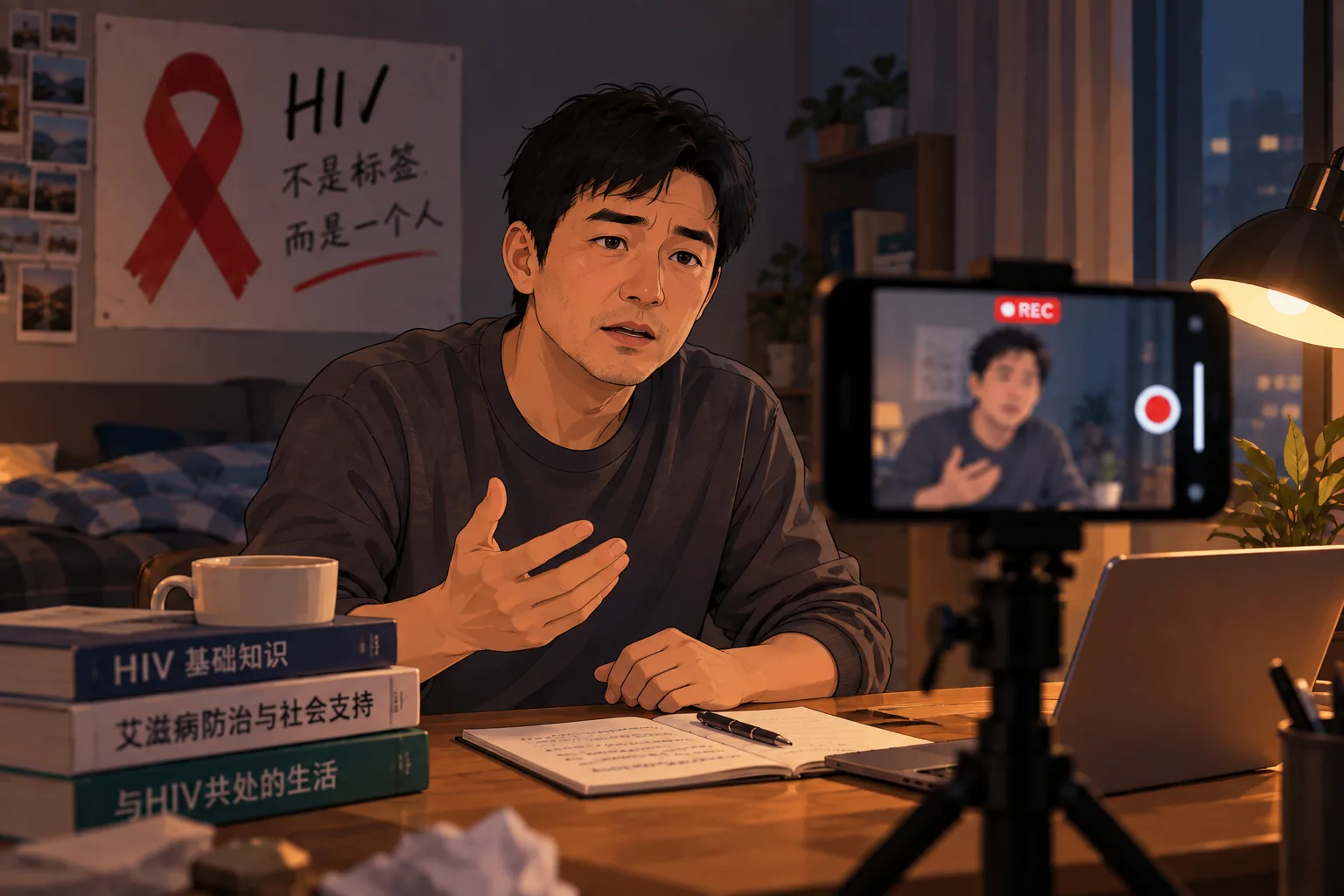
Once I decided to do it, I spent a long time preparing.
I set up my phone and started recording.
Then I stopped.
I changed what I wanted to say.
I recorded again.
Sometimes I could barely get through the opening.
The hardest sentence was still the simplest one:
“I am HIV positive.”
I had spent years making sure nobody around me heard those words.
Now I was preparing to let strangers hear them.
Before pressing Upload, I thought about everything I was about to give away.
My face.
My name, or at least enough of my identity for people to recognize me.
My HIV status.
My past.
The circumstances in which I became infected.
The mistakes I had spent years trying to keep private.
I knew that once the video was public, I would lose control over where it went.
People could save it.
Share it.
Send it to someone else.
Someone could recognize me.
Someone could connect my story to my real life.
Someone could tell my family.
Someone could tell my colleagues.
Someone could remember my face long after I regretted showing it.
I understood all of that.
And still, I believed the possible good might outweigh the risk.
I told myself that I was doing something worthwhile.
Maybe the video would help someone avoid the mistakes I had made.
Maybe it would help people understand HIV from the perspective of someone actually living with it.
Maybe someone recently diagnosed would watch it and feel less alone.
And, although I did not want to admit it too loudly, maybe people would finally notice me.
Maybe they would think I was brave.
Maybe they would respect me.
Maybe, somewhere among all those strangers, there would be someone who understood me and wanted to know me better.
I watched the finished video one last time.
My heart was beating faster than usual.
For a moment, I almost deleted it.
I stared at the screen and thought about going back to the life I had before.
A private life.
A frightened life.
But at least a life I could still control.
Then I took a breath and pressed Upload.
For the first few minutes, nothing seemed to happen.
Then the numbers began climbing.
The views came much faster than I had expected.
I kept refreshing the page.
More views.
More shares.
More people watching.
For a brief moment, I felt something close to excitement.
After years of hiding, I was suddenly visible.
I remember thinking that perhaps I had finally done something that mattered.
Then the notifications began arriving faster.
And although I had expected attention, I had not expected what came with it.
The reaction was already taking a direction I had not anticipated.
I did not yet understand how bad it would become.
I only knew that something had changed the moment I pressed that button.
I had spent years being afraid of the consequences of revealing my HIV status.
Now I had revealed it to the world.
And the world was beginning to answer.
To be continued.
Medical Context
Jack’s symptoms are part of his personal experience and should not be used to diagnose HIV. Guidance from China’s National Center for AIDS/STD Control and Prevention notes that acute HIV infection can produce symptoms such as fever, sore throat, swollen lymph nodes, headache, diarrhea, and other flu-like symptoms, often within the first several weeks after infection. However, similar symptoms can occur with many other conditions, and some people have no symptoms at all. HIV infection must be determined through appropriate testing rather than symptoms alone. (China CDC)
An HIV diagnosis also does not automatically mean that a person has AIDS. AIDS refers to the advanced stage of HIV infection, while effective antiretroviral treatment can suppress HIV and protect the immune system. China’s national treatment guidance emphasizes early treatment and ongoing viral-load monitoring for people living with HIV. (China National Center for AIDS/STD Control and Prevention)
Jack’s experience is a personal account, not medical advice. Readers who are concerned about a possible HIV exposure should seek professional testing and medical care rather than trying to diagnose themselves from symptoms.