
Condoms are highly effective against many sexually transmitted infections, but they are not a universal shield. Their protection depends on how an infection spreads and whether the potentially infectious area is actually covered by the condom.
Infections transmitted mainly through genital fluids are generally more directly blocked by a condom. Infections that can spread through contact with infected skin, mucous membranes, sores, or areas outside the condom's coverage can still be transmitted. CDC specifically notes that condoms are highly effective against HIV and certain other STIs such as gonorrhea and chlamydia, while providing less protection against HPV, genital herpes, and syphilis.
That does not mean condoms are useless for skin-to-skin STIs.
It means the prevention strategy needs to match the biology:
Barrier what you can cover. Treat what can be treated. Vaccinate where vaccines exist. Avoid contact with active lesions. And understand what risk remains.
The Condom Illusion: Why Latex Isn't a Universal Shield
One of the most common STI misconceptions is:
"I use condoms, so I can't get an STI."
The opposite misconception is almost as unhelpful:
"If condoms don't prevent every STI, there is no point using them."
Both statements miss how risk reduction actually works.
A condom creates a physical barrier over the penis and substantially reduces contact with semen, vaginal or cervical fluids, and infected tissue that falls within the area covered by the condom. Laboratory studies also show that latex provides an effective barrier to particles much smaller than many STI pathogens.
But an external condom does not cover the entire genital region.
If an infection is present on exposed skin outside the condom, direct skin contact can still create an opportunity for transmission.
Transmission at a Glance: Fluid vs. Skin-to-Skin
The table below is a practical model rather than a strict biological classification. Some infections can spread through more than one route, and the exact risk depends on the sexual activity, infected site, symptoms, and whether the exposed area is covered.
| Category | Primary transmission pathway | Examples | What a condom can do |
|---|---|---|---|
| Fluid-associated / genital-secretion transmission | Contact with infectious genital fluids or blood, depending on the infection | HIV, chlamydia, gonorrhea, hepatitis B; condoms also reduce risk of trichomoniasis | Usually provides stronger protection because the barrier blocks much of the relevant fluid and genital contact |
| Skin / mucosal-contact transmission | Direct contact with infected skin, mucosa, ulcers, lesions, or areas outside the condom | HSV-1/HSV-2, HPV, syphilis | Reduces risk when the infectious area is covered, but may not protect against contact with uncovered skin |
| Mixed or site-dependent transmission | More than one mechanism can matter | Syphilis, hepatitis B, and some other infections | Effectiveness depends heavily on the exact exposure |
CDC's clinical guidance states that consistent and correct condom use reduces the risk of several STIs, including chlamydia, gonorrhea, hepatitis B, and trichomoniasis, and also reduces risk of HPV, genital herpes, and syphilis when the infected area or potential exposure site is covered.
So the useful question is not:
"Is this STI a condom STI or a non-condom STI?"
It is:
"What needs to touch what for transmission to occur, and does the condom cover that contact?"
Fluid-Associated STIs: Where Condoms Offer Strong Protection
The strongest protection occurs when the condom sits directly between the penis and the fluids or tissues through which an infection is transmitted.
How Latex Blocks Fluid Exchange
An intact condom creates a barrier between the penis and the partner's genital secretions.
When it is used correctly and consistently, it substantially reduces exposure to infectious fluids during vaginal or anal sex. CDC describes condoms as highly effective for HIV prevention and as protective against other fluid-associated infections such as gonorrhea and chlamydia.
The important conditions are:
The condom needs to be used for the entire act.
It needs to remain intact.
It needs to fit and be used correctly.
The relevant exposure needs to involve an area the condom actually covers.
A condom that is put on halfway through sex does not provide the same protection as one used from the beginning. Breakage, slippage, or incorrect use can also reduce effectiveness.
The Fluid-Associated Roster: HIV, Chlamydia, Gonorrhea, and More
HIV
Condoms are highly effective in preventing sexual HIV transmission when used correctly and consistently.
HIV requires exposure to certain infectious body fluids, so preventing those fluids from reaching vulnerable tissue is a particularly effective prevention strategy.
Other biomedical tools can provide additional protection. For example, people without HIV who are at risk can use PrEP, while a person living with HIV who maintains an undetectable viral load does not sexually transmit HIV.
Chlamydia
Condom use reduces the risk of chlamydia because it limits exposure to infected genital secretions and tissue. CDC includes chlamydia among the infections for which consistent condom use reduces transmission risk.
Protection is strongest when the condom is used correctly from start to finish.
Gonorrhea
The same general principle applies to gonorrhea.
Condoms reduce exposure to infected genital fluids and mucosal surfaces and are considered an important prevention tool.
But gonorrhea can also infect the throat, so a condom used during vaginal or anal sex does not tell you anything about whether an oral exposure occurred without a barrier.
Hepatitis B and Trichomoniasis
CDC also identifies consistent condom use as a way to reduce the risk of hepatitis B and trichomoniasis.
These examples illustrate why it is better to think of condoms as risk reducers matched to a transmission route, rather than assigning them one universal protection percentage.
Skin-to-Skin STIs: Why Condoms Have Coverage Blind Spots
An external condom covers the penis and part of the base area.
It does not cover every part of the genital region.
That matters for infections that can spread through direct contact with infected skin, mucous membranes, ulcers, or lesions.
The Physical Limits of Condom Coverage
Depending on anatomy, potentially exposed areas can include:
- the scrotum;
- pubic skin;
- the base of the penis;
- surrounding genital skin;
- parts of the vulva or labia;
- nearby groin or inner-thigh skin.
If an infectious lesion occurs outside the covered area, the condom cannot physically block direct contact with it.
This is particularly relevant for HSV, HPV, and syphilis.
CDC explains that condoms provide less protection against infections spread through sores or infected skin, including HPV, genital herpes, and syphilis, because the condom may not cover every area involved in transmission.
The Skin-Based Roster
HSV-1 and HSV-2
Genital herpes can spread through direct contact with infected skin or mucosal surfaces.
HSV can also be transmitted when no visible lesion is present because asymptomatic shedding occurs. CDC therefore recommends avoiding sexual activity when genital lesions or prodromal symptoms are present and notes that consistent condom use can reduce, but not eliminate, HSV-2 transmission.
That means a condom can still be valuable.
It simply cannot cover every area from which HSV may be shed.
HPV
HPV commonly spreads through close skin-to-skin sexual contact.
Condoms lower the chance of acquiring HPV, but they cannot fully protect because HPV can infect areas the condom does not cover.
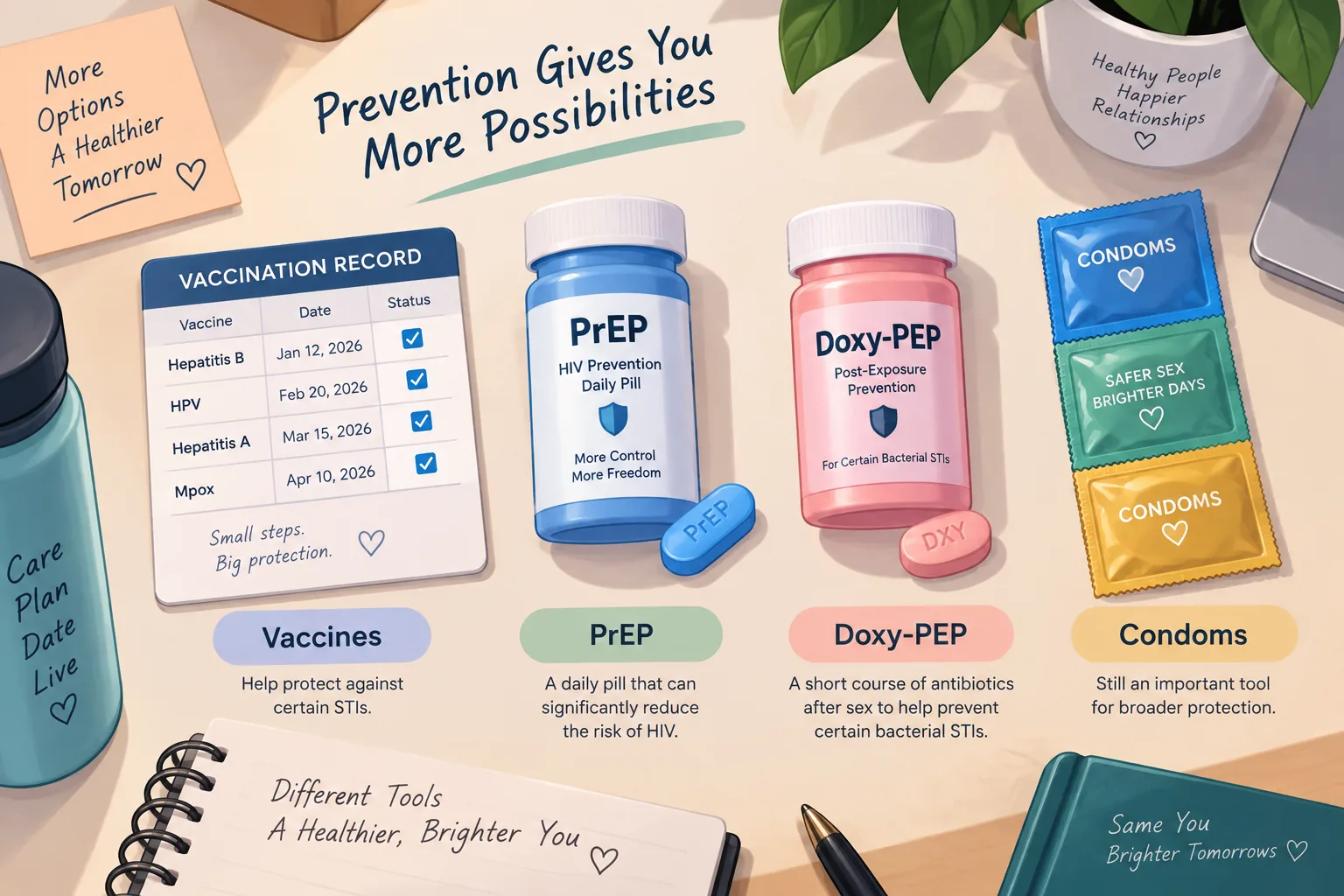
HPV vaccination adds another layer of prevention.
Gardasil 9 protects against nine HPV types, including types associated with genital warts and several cancer-causing types.
Importantly, vaccination prevents new infection with covered HPV types; it does not treat an HPV infection that already exists.
Syphilis
Syphilis is another good example of why condom protection depends on location.
The infection can be transmitted through direct contact with a syphilis sore. If the sore is covered by the condom, the condom can reduce exposure. If the sore is located somewhere the condom does not cover, transmission can still occur.
This is why seeing or knowing about an active lesion matters.
And because some syphilis lesions are painless and may go unnoticed, simply looking for symptoms is not a complete prevention strategy.
Why Condoms Are Still Essential for Skin-to-Skin STIs
Learning that condoms do not eliminate every STI can create an understandable reaction:
"Then why use one?"
Because risk reduction is still valuable even when it is not perfect.
CDC states that consistent and correct condom use reduces the risk of genital herpes and HPV and can reduce syphilis transmission when the infected area is covered.
A condom therefore does two things at once:
It can substantially reduce exposure where it creates a barrier.
It cannot protect areas that remain exposed.
Those statements are completely compatible.
Quantifying the Risk Reduction
This is where STI communication often goes wrong.
There is no single number such as "condoms reduce all skin-to-skin STIs by 50%."
The effect varies according to:
- the infection;
- the partner's sex and anatomy;
- whether the infectious area is covered;
- how consistently condoms are used;
- how correctly they are used;
- frequency of sexual contact;
- and other prevention measures.
CDC specifically describes the evidence for HSV as showing that condoms decrease, but do not eliminate, transmission risk, with protection less complete for some transmission directions than others.
For HPV, CDC similarly states that condoms can lower the chance of infection but may not fully protect because HPV can infect uncovered areas.
So rather than promising:
"A condom reduces your HSV risk by exactly X%."
a more scientifically responsible message is:
"A condom can lower HSV and HPV risk, but the amount of protection varies and depends on whether the infected area is covered."
That is more useful for an individual couple than a single number presented as universal.
What About the "50% HSV Reduction" Number?
One frequently cited figure comes from a clinical trial of daily valacyclovir in heterosexual couples in which one partner had symptomatic genital HSV-2.
In that study, daily valacyclovir reduced overall acquisition of HSV-2 by about 48% and symptomatic acquisition by about 75% compared with placebo.
Those numbers describe suppressive antiviral therapy, not condom use.
That distinction matters.
They should not be presented as:
"Condoms reduce HSV transmission by 50%."
The evidence does not support treating that number as a universal condom effectiveness figure.
Do Condoms Reduce Micro-Tears?
Condoms provide a physical barrier and reduce direct skin and fluid contact.
But they should not be described as a guaranteed way to prevent microscopic skin injuries or as a universal mechanism for preventing every infection.
The practical prevention principle is simpler:
Use an intact condom consistently, use compatible lubrication to reduce friction and breakage risk, and recognize that uncovered skin can still matter.
CDC recommends appropriate lubrication because oil-based products can weaken latex and contribute to condom failure.
The Layered Defense Strategy: Beyond the Condom
Once you understand the condom's boundaries, the next question is:
"What can I add?"
The answer depends on the infection.
There is no single combination that prevents every STI.
Layer 1: Suppressive Therapy When It Is Clinically Appropriate
For a person with genital HSV-2, daily suppressive antiviral therapy can reduce recurrences and reduce transmission risk.
CDC specifically recommends discussing suppressive antiviral therapy as part of a broader strategy that can also include consistent condom use and avoiding sexual activity during recurrences.
In the landmark valacyclovir trial, overall HSV-2 acquisition fell by 48% in the treatment group, while symptomatic acquisition fell by 75%.
This does not mean suppressive therapy eliminates transmission.
It means it adds another useful layer.
Layer 2: Vaccination
Vaccination is especially valuable when an STI has an effective vaccine.
For HPV, Gardasil 9 covers nine HPV types, including types 6 and 11 associated with most genital warts and several high-risk types associated with cancer.
HPV vaccination works best before exposure but can still provide benefit for eligible people who have already been sexually active because previous exposure to one HPV type does not imply exposure to every type covered by the vaccine. CDC recommends routine vaccination through age 26 for those not adequately vaccinated and shared clinical decision-making for certain adults ages 27–45.
Hepatitis B vaccination is another important prevention layer for people who are not already protected.
Layer 3: Symptom Awareness and Outbreak Breaks
When there are visible sores, lesions, or symptoms consistent with an active outbreak, temporarily changing sexual activity can meaningfully reduce exposure.
For genital herpes, CDC recommends avoiding sexual activity with uninfected partners when lesions or prodromal symptoms are present.
This should not be interpreted as:
"No symptoms means no transmission."
Many STIs can be asymptomatic, and HSV can shed without visible lesions.
Instead:
No symptoms means there is no obvious active warning sign. It does not mean zero risk.
Layer 4: Barrier Integrity
A final layer is simply making the barrier itself work as well as possible.
Use a new condom for each act.
Use it for the entire act.
Replace it immediately if it breaks or slips.
Use lubricant compatible with the condom material.
For latex condoms, avoid oil-based products that can weaken latex.
This layer sounds basic, but it is one of the most controllable variables in real-world prevention.
Building a Practical Layered Protection Plan
A useful framework looks like this:
| Prevention layer | What it addresses | Example |
|---|---|---|
| Barrier | Reduces fluid exchange and contact with covered tissue | External condom |
| Treatment | Can reduce transmission for selected infections | HSV suppressive antiviral therapy |
| Vaccination | Prevents specific vaccine-covered infections | HPV vaccine, hepatitis B vaccine |
| Behavioral timing | Avoids periods of higher transmission risk | Avoiding sexual contact during HSV lesions/prodrome |
| Testing | Identifies infections that prevention tools cannot fully prevent | Appropriate site-specific STI screening |
| Communication | Lets both partners make informed decisions | Discussing symptoms, diagnoses, prevention preferences |
Not everyone needs every layer.
A person vaccinated against HPV and hepatitis B may already have two important prevention layers in place.
A person with genital HSV-2 may discuss suppressive therapy and outbreak precautions with a clinician.
A person concerned about HIV may consider PrEP in addition to condoms.
The goal is not to accumulate every imaginable intervention.
It is to cover the risks that actually apply to you.
How to Explain the Risk Gradient to Your Partner
The best STI conversations avoid both false reassurance and unnecessary alarm.
Instead of:
"Condoms don't protect against herpes."
try:
"Condoms give us strong protection against many infections, especially those where fluids are an important transmission route. They also lower the risk of herpes, HPV, and syphilis, but they can't cover every area of skin that could be involved."
That explanation is accurate and balanced.
Script Template: Setting Realistic Expectations
You could say:
"I like using condoms because they provide strong protection against several STIs. They don't make the risk zero for things like HSV or HPV because those can involve skin that isn't covered. So I think of condoms as one layer, not the entire plan."
For a partner with HSV:
"I know condoms can reduce the risk but don't eliminate it. If you're taking suppressive medication and we avoid sex during symptoms or outbreaks, that's another layer we can add."
For a partner concerned about HPV:
"The condom still helps, but HPV can affect skin outside the area it covers. Vaccination is another option for reducing the risk from the HPV types it targets."
These conversations are more productive than trying to promise a precise percentage.
What You Don't Need to Say
You do not need to say:
"This is extremely dangerous."
You do not need to say:
"There is absolutely no risk."
And you do not need to label either partner as "unsafe."
The useful language is:
lower risk
higher risk
covered area
uncovered area
additional prevention layer
Those terms reflect what you can actually control.
The Real Meaning of "Condom Protected"
When someone says:
"We used a condom."
the next question should not be:
"So you're completely protected?"
It should be:
"Protected from what, through which route, and over which area?"
For HIV, gonorrhea, chlamydia, and several other infections, condoms can provide substantial protection by reducing contact with infectious fluids and covered tissues.
For HSV, HPV, and syphilis, protection can be meaningful but incomplete because infected skin, mucosa, or sores may occur outside the condom's coverage.
That is not a failure of the condom.
It is simply the physical limit of a barrier that covers one part of the body.
Knowledge Is Your Best Protection
The goal of understanding STI transmission is not to become frightened of every uncovered inch of skin.
It is to replace all-or-nothing thinking with practical risk management.
Condoms remain one of the most useful sexual-health tools available.
They can substantially reduce the transmission of HIV and several other STIs, especially infections for which genital fluids are an important route of transmission.
They also reduce, but do not eliminate, the risk of infections such as HPV, herpes, and syphilis when the relevant infected area is not fully covered.
That is why the answer is not:
"Condoms are enough."
Nor is it:
"Condoms don't work."
The better answer is:
"Use the condom for the protection it provides, then add the prevention layers that address what it cannot cover."
That might mean vaccination.
It might mean suppressive therapy.
It might mean avoiding sexual contact during an outbreak.
It might mean testing at the body sites that were actually exposed.
Or it might simply mean having a clearer conversation with a partner before becoming intimate.
You do not need perfect control over every possible STI risk.
You need enough accurate information to make deliberate choices.
A condom is not an invisible force field. It is a highly useful layer of protection.
Understanding its boundaries does not make sex more frightening.
It makes your choices more informed.