Oral sex and non-penetrative intimacy can reduce exposure to some forms of STI risk, but not all oral or skin-to-skin sexual contact is risk-free. The safest approach is to match the prevention method to the type of contact and the infection that can actually be transmitted.
A useful way to think about intimacy is not simply "safe" versus "unsafe," but as a risk gradient:
Which body parts are touching? Are fluids involved? Is there direct contact with potentially infected skin or lesions? And which STI are you trying to prevent?
Many STIs can be transmitted through oral sex, including gonorrhea, chlamydia, syphilis, herpes, and HPV. HIV is different: CDC describes oral sex as carrying little to no HIV transmission risk, although other STIs remain possible.
The goal is not to remove intimacy from sex.
It is to make lower-risk choices without treating pleasure as the enemy of prevention.
Rethinking Intimacy: Safety Beyond Penetration
Not having vaginal or anal penetration does not automatically make every other sexual activity risk-free.
At the same time, it would be misleading to treat every form of non-penetrative intimacy as equally risky.
The actual exposure matters.
Dry body-to-body contact is different from oral sex. Oral sex is different from oral-anal contact. And contact with an active herpes lesion is different from contact with intact skin.
The right question is therefore not:
"Is outercourse safe?"
It is:
"What exactly are we doing, what tissues are contacting each other, and which infections could realistically spread through that contact?"
The Intimacy Risk Gradient: From Lower to Higher Exposure
There is no universal numerical risk score for every sexual activity and every STI, so the table below is a practical qualitative guide, not a medical calculator.
| Intimacy activity | Examples | General STI exposure | Main concerns |
|---|---|---|---|
| Non-contact / no genital or oral exposure | Kissing without open sores, mutual conversation, non-sexual touch | Very low for sexually transmitted infections | Specific infections may require specific exposure conditions |
| Outercourse / external genital contact | Dry humping, body rubbing, mutual masturbation | Often lower risk, but not zero | Skin-to-skin infections such as HSV, HPV, and syphilis can matter when infectious areas or lesions are involved |
| Oral sex on the penis | Fellatio | STI risk is infection-specific | Gonorrhea, syphilis, HSV, HPV, and sometimes chlamydia |
| Oral sex on the vulva/genital area | Cunnilingus | STI risk is infection-specific | HSV, HPV, syphilis and other infections can be transmitted |
| Oral-anal contact | Anilingus / rimming | Adds exposure to anal and enteric organisms | Hepatitis A, some enteric infections, HPV, syphilis and other infections depending on the exposure |
CDC lists chlamydia, gonorrhea, syphilis, herpes, HPV, and HIV among infections that can be transmitted through oral sex. The exact probability varies by infection and sexual activity, and CDC notes that evidence is much stronger for some infections than others.
So lower risk does not mean zero risk, and "oral sex" itself is too broad a category to describe with a single number.
What Can and Can't Be Transmitted Through Oral Sex?
Oral sex can expose the mouth and throat to infections that are more commonly discussed as genital infections.
The direction can also work both ways.
An infection in the mouth or throat can potentially reach a partner's genitals, while an infection on the genitals can potentially infect the mouth or throat of the person giving oral sex. CDC specifically notes that oral sex can transmit infections to the mouth, throat, genitals, or rectum.
Viral STIs: HSV and HPV
Oral HSV-1 Can Become Genital HSV-1
Oral HSV-1, commonly associated with cold sores, can spread from the mouth to a partner's genitals during oral sex.
CDC notes that genital herpes can be acquired through oral sex from a partner with oral herpes, and herpes can spread through contact with infected skin, even when obvious sores are not always present.
That means:
A partner does not need visible cold sores for HSV transmission to be possible.
Risk is particularly relevant when there is an active sore or prodromal symptoms such as tingling or burning.
If someone has an active oral herpes outbreak, avoiding oral-genital contact until the area has healed is a straightforward way to reduce exposure.
Barrier methods such as condoms and dental dams can add another layer, but they cannot cover every area of skin that can carry HSV.
HPV Can Also Spread Through Oral Sexual Contact
HPV can spread through intimate skin-to-skin sexual contact, including oral sexual contact.
Unlike HIV, HPV does not require semen or vaginal fluid to be transmitted.
Because condoms and other barriers do not cover all genital or surrounding skin, they reduce but do not completely eliminate HPV transmission risk.
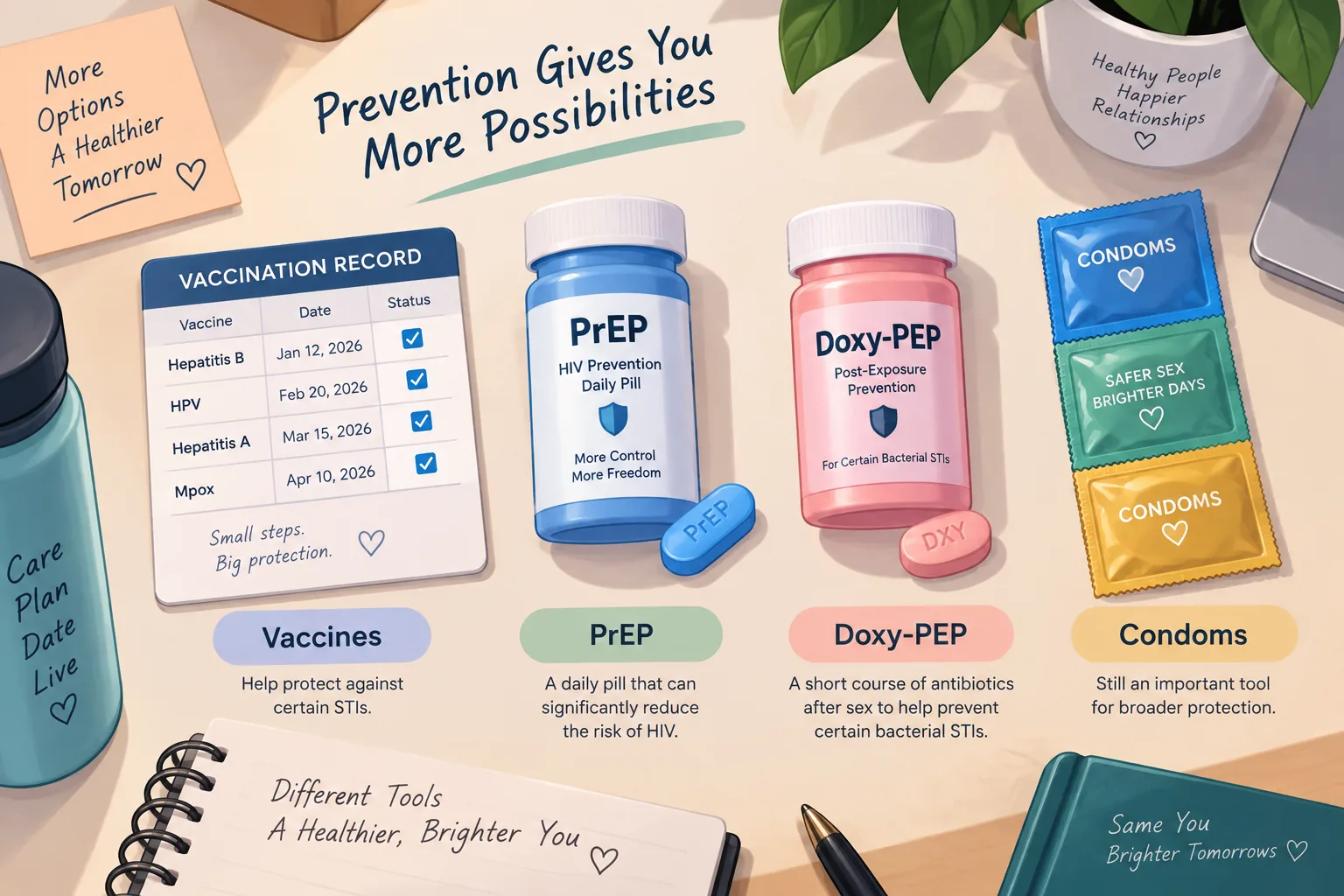
HPV vaccination provides an additional prevention layer by protecting against the HPV types covered by the vaccine. It does not eliminate an infection that already exists.
This is one reason why vaccination and barrier use can complement each other rather than compete with each other.
Bacterial STIs: Gonorrhea, Chlamydia, and Syphilis
Oral Gonorrhea Is a Real Concern
Gonorrhea can infect the throat, and a person can have a throat infection without obvious symptoms.
That means oral sex can be relevant in both directions:
mouth/throat → partner's genitals
and
partner's infected genitals → mouth/throat.
CDC lists gonorrhea among the STIs that can spread through oral sex and notes that infections in the throat can be difficult to recognize because symptoms may be absent.
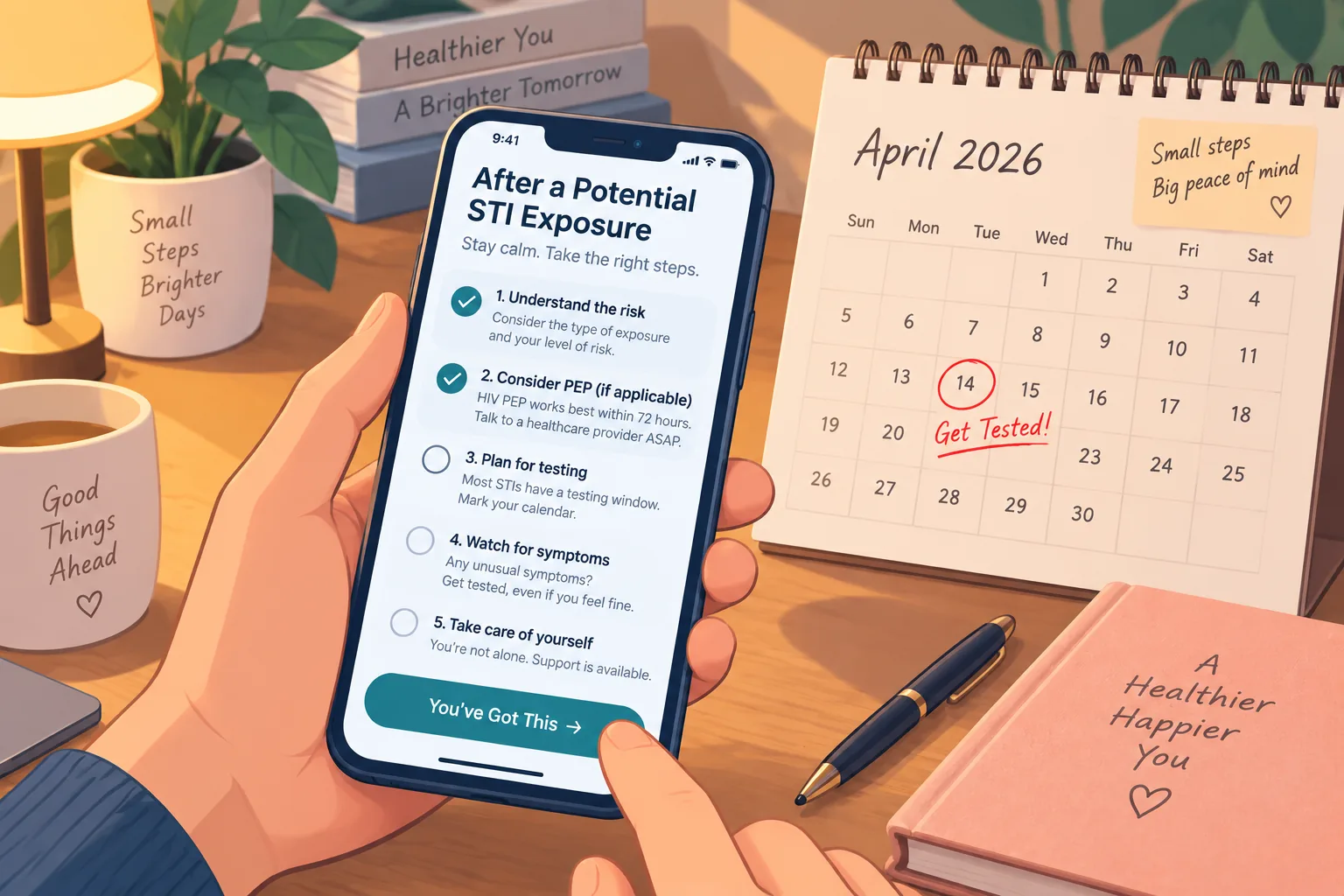
If someone has exposure to gonorrhea through oral sex, the relevant screening strategy may therefore include a throat test rather than relying only on a urine or genital specimen.
Chlamydia Can Also Be Transmitted Through Oral Sex
Chlamydia is another STI that can be transmitted through oral sex.
The exact probability is less well characterized than for some other exposures, but CDC includes chlamydia among the infections that may be transmitted through oral sex.
Again, the important practical point is:
The body site exposed should influence the testing plan.
A person who has only a urine test after oral exposure has not automatically had their throat tested.
Syphilis Can Spread Through Oral Contact
Syphilis can spread through direct contact with infectious lesions.
Those lesions can occur in areas involved in oral sex, including the mouth or genital region.
This means oral sex can transmit syphilis even when penetration does not occur. CDC lists syphilis among the STIs that can spread through oral sex.
Barrier methods can reduce exposure, but avoiding direct contact with visible or suspected infectious lesions is particularly important.
The Low-Risk Good News: HIV
HIV is one of the clearest examples of why STI risk should be infection-specific.
CDC states that there is little to no risk of getting or transmitting HIV through oral sex, and describes oral sex as much less risky for HIV transmission than anal or vaginal sex.
That does not mean that every oral-sex situation should be described as literally zero risk.
CDC notes that unusual circumstances involving blood, open sores, or other factors can affect HIV exposure considerations, although the overall risk remains extremely low.
More importantly, the low HIV risk of oral sex should not be generalized to other STIs.
Someone may face very low HIV risk from oral sex while still having a meaningful risk of gonorrhea, syphilis, HSV, or HPV.
That is why "oral sex is safe" is too broad to be useful.
Barrier Tools for Oral Sex: Dental Dams, Condoms, and Gloves
Barrier methods provide a simple way to reduce contact between the mouth and potentially infectious genital or anal tissue.
CDC specifically recommends condoms, dental dams, and other barriers as ways to reduce the risk of getting or transmitting an STI during oral sex.
How to Use and Enjoy Dental Dams
A dental dam is a thin sheet of latex or polyurethane placed between the mouth and the vulva or anus during oral sex.
CDC's basic instructions are straightforward:
- Use a new dental dam every time.
- Check the package and expiration date.
- Make sure the barrier has no tears or defects.
- Place it flat over the vulva or anus before oral sex begins.
- Keep it in place for the entire activity.
- Do not reuse it.
- Dispose of it after use.
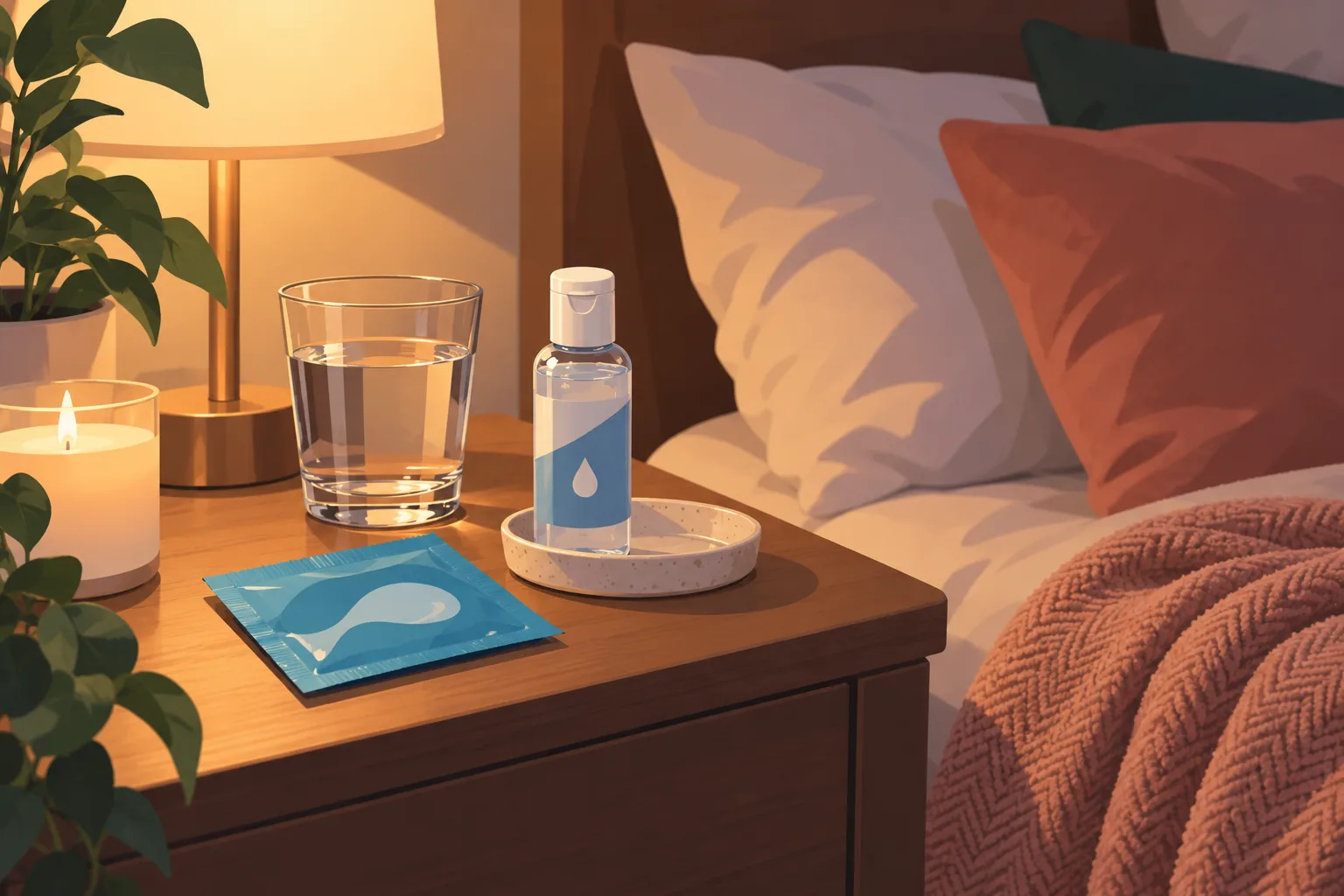
Lubrication can make dental dams more comfortable and reduce the chance of tearing.
CDC recommends water-based or silicone-based lubricant with dental dams and advises against oil-based products because they can damage the material.
One practical rule makes a big difference:
Once one side of the barrier has been exposed to potentially infectious tissue, do not flip it over and use the other side.
The barrier is meant to keep two surfaces separated. Flipping it defeats that purpose.
DIY Dental Dam: Converting a Standard Condom in 3 Steps
You do not need a specialized package of dental dams if one is unavailable.
CDC provides instructions for making one from a standard condom made of latex or polyurethane.
Step 1: Carefully open and unroll the condom.
Step 2: Cut off the tip and the bottom ring.
Step 3: Make one straight cut down the length of the remaining tube and flatten it into a sheet.
The result is a flat barrier that can be placed over the vulva or anus.
Use a new condom for each activity, and do not reuse the resulting barrier.
Condoms for Oral Sex on the Penis
For fellatio, a standard external condom can function as a direct barrier.
A new condom should be used for the entire act of oral sex, and the material should be compatible with the lubricant being used. CDC recommends water-based lubricants with latex condoms and advises avoiding oil-based products that can weaken latex.
Some people prefer flavored products specifically designed for oral sex.
The important thing is not the flavor.
It is whether the product is appropriate for the body area involved, has not expired, and is being used according to its instructions.
If a product contains nonoxynol-9, it should not be treated as a safer STI-prevention upgrade. CDC advises against nonoxynol-9 with dental dams because it can cause irritation.
Gloves and Finger Barriers
For manual sexual contact, gloves or finger cots can provide a physical barrier when someone wants to reduce direct skin or fluid contact.
They can be particularly practical when there are cuts, hangnails, irritated skin, or a known lesion that should not come into direct contact with another person's mucous membranes.
As with other barriers:
Use a new barrier for a new activity, avoid transferring fluids from one body site to another, and stop if the material tears.
Barrier use is a risk-reduction choice, not a requirement that someone prove they are "clean."
Pleasure Hacks: Making Safer Oral Sex Feel Better
A barrier should not have to feel like a medical device dropped into the middle of an intimate moment.
Small adjustments can make it more comfortable.
The Lubricant Trick
A compatible lubricant can reduce friction and help a dental dam stay comfortable against the skin.
CDC specifically recommends water-based or silicone-based lubricant with dental dams to help prevent breakage.
A practical approach is to put a small amount of compatible lubricant on the body-facing side of the dental dam before starting.
The purpose is simple:
less friction + easier movement + less pulling on the barrier.
You do not need a large amount. Too much can make the barrier difficult to position or keep in place.
Always check whether the lubricant is compatible with the barrier material.
For latex barriers, avoid oil-based products such as petroleum jelly, body lotion, or cooking oils because they can cause the material to break.
Temperature and Flavors
Sensation is not only about whether a barrier is present.
You can make the experience more playful by changing:
- temperature;
- pace;
- pressure;
- massage around the barrier;
- the amount and type of compatible lubricant;
- the surrounding sensory environment.
A flavored oral-sex product can also make a barrier feel more intentional rather than purely medical.
But avoid putting substances on the barrier simply because they seem creative or stimulating.
Comfort and material compatibility come first.
The best "pleasure hack" is often not adding more products.
It is making the barrier part of the activity rather than stopping the activity to deal with it.
How to Introduce Oral Barriers in the Moment
The awkwardness around barriers usually comes from what they seem to communicate.
If introducing one sounds like:
"I think you might give me an STI."
the moment can become defensive.
If it sounds like:
"I brought something fun we can use."
the same object can become part of the experience.
Scripts for Seamless Transitions
Fun and Flirty
"I want to take my time with you tonight. I brought a flavored barrier so we can relax and enjoy ourselves."
Direct and Reassuring
"I like using barriers for oral sex. It helps me relax and stay in the moment."
Mutual and Casual
"Want to try this? I've got a dental dam and some lube."
When You're Dating Someone New
"Before we go further, I usually use a barrier for oral. It's just part of how I do safer sex."
When a Partner Asks Why
"It's not about not trusting you. I just like having a prevention routine that works for me."
These scripts work because they frame the barrier as your sexual-health preference, rather than a judgment about the other person's body.
That distinction can make a surprisingly large difference.
When a Partner Does Not Want to Use a Barrier
Do not turn the conversation into a negotiation where either person has to defend their health boundary.
You can say:
"That's okay. I'm still not comfortable doing oral without one."
Or:
"No problem. We can do something else tonight."
Consent works both ways.
A partner is allowed to decline the barrier.
You are equally allowed to decline the activity.
Beyond "Safe" and "Unsafe": Build Your Own Intimacy Menu
One reason sexual-health conversations become unnecessarily stressful is that people sometimes imagine only two choices:
Have penetrative sex and accept the risk.
or:
Avoid sex altogether.
Real intimacy is much broader.
Depending on what both partners are comfortable with, a sexual experience might involve:
kissing → touching → mutual stimulation → outercourse → safer oral sex with barriers → other forms of intimacy
Every step has its own considerations.
For example, dry body rubbing without genital-to-genital contact and oral sex are not medically equivalent exposures. Oral sex creates direct contact between the mouth and genital or anal tissue, so the relevant STI risks change. CDC therefore recommends thinking about the particular sexual activity rather than treating all sexual contact as one category.
The goal is not to label one activity "good" and another "bad."
It is to understand what each activity exposes you to.
That gives you more options.
A Simple Safer-Oral Decision Guide
Before oral sex with a new or casual partner, ask yourself:
Do either of us have visible sores, ulcers, or an active outbreak?
If yes, consider postponing the contact that could expose the affected area.
Do we want an additional barrier?
If yes, use a condom or dental dam correctly from start to finish.
Do we know whether recent STI testing included the relevant body sites?
If not, remember that a urine or genital test does not automatically answer questions about throat or rectal infection.
Are we worried specifically about HIV?
The HIV risk from oral sex is little to none, but other STIs remain relevant.
Would a barrier make one partner more comfortable?
If yes, that matters even if the other person thinks the medical risk is low.
A prevention choice does not have to be justified by a dramatic level of danger.
Sometimes the benefit is simply:
"This makes me feel more comfortable, so I can enjoy myself."
Intimacy Is an Art of Personal Choice
Safer oral sex and non-penetrative intimacy are not failed versions of "real sex."
They are legitimate ways to build pleasure while adjusting exposure to specific health risks.
The science is not binary.
Some infections can spread through oral sex.
Some exposures carry much lower risk than others.
HIV is an especially low-risk transmission route through oral sex, while gonorrhea, syphilis, HSV, and HPV remain relevant considerations.
Barrier methods can reduce exposure, but they do not make every STI impossible to transmit. Dental dams, condoms, and compatible lubricants are practical tools, not symbols of distrust.
And non-penetrative intimacy gives couples more options for deciding how much risk they are comfortable accepting at a particular moment.
You do not have to choose between:
"Protect myself"
and
"Have a good time."
You can choose the activity.
You can choose the barrier.
You can choose when to pause.
You can choose what feels comfortable.
You can also choose something completely different.
Safety and pleasure are not mutually exclusive.
The more accurately you understand the risk gradient, the more freedom you have to design intimacy around both.