
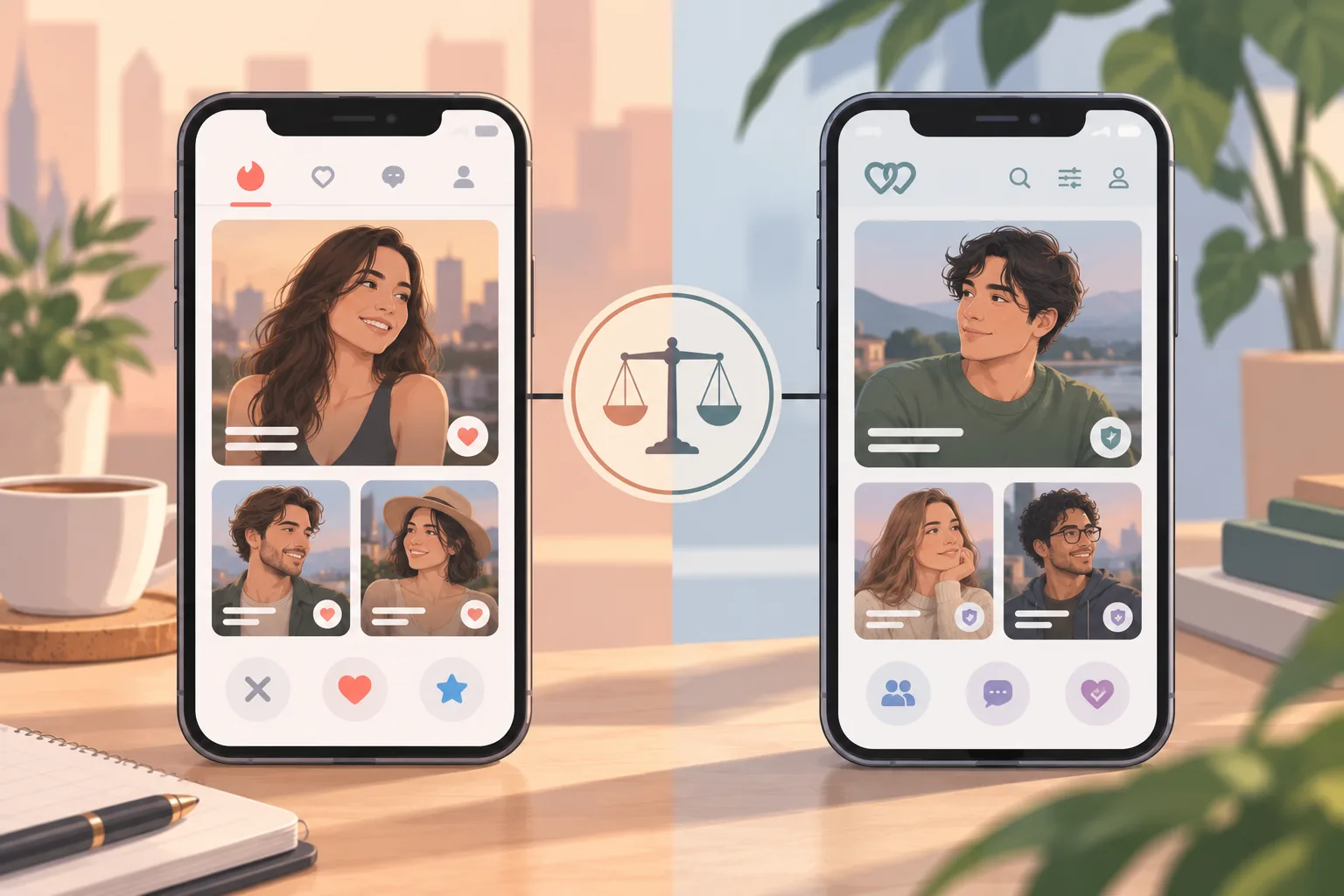
If you are dating with an STI, the choice between a mainstream dating app and an STI-focused dating site is not really a choice between "normal dating" and "STI dating."
It is a choice between different dating environments.
Mainstream platforms such as Tinder, Bumble, and Hinge offer access to broad dating populations and different relationship goals. Tinder says it operates in more than 190 countries, while Hinge describes itself as a mainstream dating app focused on helping people form in-person relationships.
STI-focused platforms take a different approach. PositiveSingles describes itself as a dating and social community specifically for people living with STIs and says it currently has more than 2.8 million registered members, alongside privacy-oriented tools such as profile controls and private photo albums.
Those numbers are platform-reported and not directly comparable: a registered-member count is not the same thing as the number of active people in your city who fit your age, preferences, and relationship goals.
That is the key to making the decision intelligently.
You are not choosing which platform is "better." You are deciding which environment gives you the best balance of:
available matches + privacy comfort + disclosure pressure + geography + relationship goals.
The Dating Pool Dilemma: Matching Volume vs. Psychological Safety
The central question is not simply:
"Where are there more people?"
It is:
"Where can I realistically meet people I am attracted to, while remaining comfortable with how my STI status fits into the dating process?"
Mainstream apps tend to maximize breadth.
Specialized platforms tend to maximize shared context.
Neither advantage is automatically more valuable.
The Core Tension: Exposure Risk vs. Matching Efficiency
The mainstream route offers a very large potential audience, but that broad audience also contains a much wider range of knowledge, attitudes, and comfort levels around STIs.
That can mean:
More potential matches.
But also:
More variation in how people react when sexual-health information becomes relevant.
Tinder, for example, describes itself as a global platform for many kinds of connections and says it is available in more than 190 countries. Hinge similarly positions itself as a broad dating platform focused on helping people move from matching to real-world connection.
The specialized route changes the initial environment.
On PositiveSingles, the platform says people living with STIs—or people open to dating them—can join, and it provides tools specifically designed around privacy and health-context concerns.
That can reduce one major source of friction:
"How will I tell this person?"
But it does not eliminate every dating problem.
You still need:
- attraction,
- personality fit,
- compatible relationship goals,
- geographic practicality,
- communication,
- and mutual interest.
The specialized platform simply moves sexual-health compatibility closer to the beginning of the matching process.
There is also an important privacy nuance.
A specialized platform can reduce disclosure friction, but it does not automatically make you anonymous. PositiveSingles says it blocks search engines and logged-out users from seeing profiles and offers profile-hiding and private-album controls, while also explicitly stating that no system can be completely secure.
So the real distinction is:
Mainstream platform: wider pool, potentially more disclosure friction.
STI-focused platform: narrower health-context pool, potentially less initial disclosure friction.
Neither is risk-free.
Why Platform Selection Is a Strategic Choice, Not an Identity Label
The wrong way to frame the choice is:
"Am I still normal enough to use Tinder?"
or:
"Am I too insecure if I use an STI dating site?"
Neither question is useful.
A dating platform is a channel.
You can use one.
You can use another.
You can change your approach six months from now.
Your STI is a health characteristic. It does not determine which technology you are allowed to use.
Choosing a specialized platform can be a smart privacy or emotional-comfort decision.
Choosing a mainstream app can be a smart market-size or compatibility decision.
You are not declaring anything about your worth by choosing either one.
Mainstream Apps vs. STI Dating Sites: The 5-Dimension Comparison
The most useful comparison is not based on brand reputation. It is based on what happens during the actual dating process.
The Comparative Breakdown Matrix
| Dimension | Mainstream Apps | STI-Focused Dating Sites |
|---|---|---|
| Potential Dating Pool | Broad, with many relationship types and demographics | Narrower by design, with health-related context built into the community |
| Local Match Availability | Often stronger in large and small markets, though actual results depend on local adoption | Can be excellent where the platform has an active local base, but local depth can vary significantly |
| STI Disclosure Pressure | Usually higher because the STI may not be known when matching | Often lower because users enter a health-aware environment |
| Privacy Strategy | Requires deliberate identity separation, profile control, and careful disclosure | May offer specialized privacy controls, but users still need to manage photos and personal information |
| Psychological Experience | More "ordinary dating app" feeling, but greater uncertainty around reactions | More shared-context comfort, but a risk of becoming overly focused on STI status |
| Relationship Variety | Broad range of dating intentions and social backgrounds | Can include dating, friendship, and community-oriented connections, depending on the platform |
| Best Use Case | Expanding your dating pool and meeting people outside an STI-specific environment | Reducing early disclosure friction and finding people already comfortable with STI-related dating |
The table is a strategic framework, not a guarantee. A platform with millions of registered accounts may still have a thin pool for a particular city, age range, orientation, or relationship goal.
Mainstream Apps: Large Reach, More Disclosure Friction
Tinder, Bumble, and Hinge are fundamentally broad-purpose dating platforms.
Tinder describes itself as a global dating platform available in more than 190 countries and supports everything from casual connections to serious relationships. Hinge says its goal is to help people form meaningful in-person connections and describes its audience as being in the tens of millions globally.
That breadth creates several practical advantages.
First, the pool is diversified.
You are not limiting yourself to people who already identify with an STI-focused dating category.
Second, the experience feels like ordinary dating.
Your health status does not define the platform you're using.
Third, location can work in your favor.
If you live somewhere with a relatively small population, a mainstream app may simply give you more realistic options.
But the broader environment also creates more uncertainty.
You do not know in advance whether a match:
- understands the STI,
- has outdated ideas about transmission,
- is comfortable discussing sexual health,
- will respond respectfully,
- or will prefer not to continue after disclosure.
That uncertainty is the main disclosure friction.
It does not mean mainstream apps are inherently unsafe.
It means you should treat privacy and timing as part of the strategy.
Niche STI Sites: Shared Context, But a More Specialized Pool
A platform such as PositiveSingles is designed around a different starting point.
PositiveSingles says it welcomes people living with different STIs and also people who are open to connecting with them. It also advertises privacy controls, profile visibility management, private photo albums, and tools intended to make health-related dating more comfortable.
That can remove one of the biggest psychological barriers to dating after diagnosis:
You do not necessarily have to begin every connection wondering how the person will react to the existence of an STI.
That can be especially useful when you are newly returning to dating and want to rebuild confidence before dealing with repeated disclosure conversations.
But there is a trade-off.
A specialized platform is still a dating market.
You may find people who are:
- geographically too far away,
- looking for something different,
- outside your preferred age range,
- incompatible in personality,
- or simply not attracted to you.
And shared STI context does not guarantee emotional maturity.
PositiveSingles also states that it does not require medical records and does not independently verify members' medical status through medical records.
So do not make the assumption:
"Everyone here definitely has the condition they say they have, therefore I can automatically trust them."
The appropriate mindset is:
Shared context can reduce one barrier to connection. It does not replace normal dating judgment.
There is also a second psychological risk: the patient mindset.
If every profile conversation becomes:
"What STI do you have?"
"How long have you had it?"
"Do you take medication?"
you can accidentally turn a dating environment into a diagnosis marketplace.
That is not what you want.
You are still looking for a partner.
The Decision Framework: 4 Factors to Determine Your Ideal Dating Path
There is no single best dating platform for everyone with an STI.
Your best starting point depends on four variables.
Factor 1: Geographic Location and Local Population Density
Geography can matter more than almost anything else.
A specialized platform may have a large total membership but still have a relatively small pool near you.
That distinction is critical.
Imagine two users:
User A: lives in a major metropolitan area.
They may have many potential matches on both mainstream and STI-focused platforms.
User B: lives in a smaller town.
A specialized platform may technically have members in the same state, but only a small number may be within practical dating distance.
For User B, a mainstream app may provide a much larger effective pool.
This is why national membership claims should not be treated as local market-size guarantees.
When evaluating a platform, ask:
"How many people can I realistically date from where I live?"
not:
"How many members does this company claim worldwide?"
Factor 2: Your Current Emotional Resilience and Rejection Tolerance
Your psychological state matters too.
If you are recently diagnosed and every disclosure conversation feels emotionally exhausting, repeated uncertainty on a mainstream platform may make dating feel like a series of high-stakes tests.
A specialized platform may give you a gentler re-entry.
You can practice:
- flirting,
- messaging,
- setting standards,
- deciding what you want,
- and simply enjoying being desirable again.
But if you are already comfortable discussing your STI and can handle occasional incompatibility without turning it into a judgment of your worth, mainstream platforms may feel much less intimidating.
A useful question is:
"Do I currently need a lower-disclosure-pressure environment, or am I ready for a broader dating pool?"
That answer can change.
Factor 3: The Specific Condition and Its Social Context
Not all STIs carry the same level of public awareness, stigma, or misunderstanding.
Some people may have basic familiarity with herpes or HPV.
Others may know very little about them.
An infection that is less familiar to the general public can create a different disclosure experience than one people have heard about more often.
This does not mean one diagnosis is "easier" or "worse."
It means your anticipated disclosure friction may differ.
Your own comfort with discussing the condition matters just as much as the condition itself.
You should also avoid letting the platform decide what your diagnosis means socially.
You have an STI.
That is one part of your health history.
It does not dictate the type of partner you should seek.
Factor 4: Your Romantic Goals — Casual Dating vs. Long-Term Relationship
Your dating objective should influence your platform strategy.
If you want:
Broad exploration and casual dating
a mainstream app may offer a wider variety of people and intentions.
If you want:
A relationship with someone who already understands the realities of STI dating
an STI-focused platform may reduce one major compatibility question earlier in the process.
If you want:
Something highly specific
such as a particular age range, location, lifestyle, religion, or relationship structure, platform size and filtering options may matter more than the STI-specific nature of the site.
The important point is to choose the environment around the relationship you want, not around the assumption that your STI should define your entire dating strategy.
Practical Tactical Advice: Navigating Mainstream and Niche Platforms
Once you have chosen a platform—or decided to use more than one—the strategy becomes more important than the brand name.
Privacy Protection Protocols for Mainstream Dating Apps
The first rule is simple:
Do not give a new match your entire offline identity on day one.
You can be authentic without making yourself fully searchable.
That means being deliberate about:
Photos
Avoid reusing highly searchable LinkedIn or social-media photos if you are concerned about being identified.
Names
A first name is often enough initially unless the app requires more.
Work
You do not need to provide the precise company address or highly specific workplace details immediately.
Location
A general metro area is different from publishing your exact neighborhood, building, or daily routine.
Social accounts
Do not automatically hand over the Instagram account that contains ten years of your personal life.
Contact details
Use appropriate privacy settings and secondary channels when needed.
Privacy does not require creating a fake personality.
It requires proportional disclosure.
Mainstream apps also increasingly provide tools that can reduce unwanted discovery. Tinder currently offers both Incognito and Block Contacts features, while Bumble's Incognito Mode can hide your profile from everyone except people you have liked. Hinge offers a Block List and a Pause function that stops new users from seeing your profile while preserving existing conversations.
These are useful controls, but they are not invisibility guarantees.
Use them to reduce discoverability, not to assume you are impossible to find.
Avoiding the "Patient Mindset" on Niche STI Sites
The biggest mistake on a specialized platform is letting your diagnosis become your entire personality.
Your profile should still answer:
Who are you?
not only:
What condition do you have?
Talk about:
- hobbies,
- humor,
- music,
- travel,
- food,
- ambitions,
- personality,
- what you are looking for,
- and what makes you enjoyable to spend time with.
Your STI may be part of your dating context.
It does not have to be your headline identity.
This is particularly important because people sometimes enter specialized communities immediately after diagnosis. The emotional relief of finding people who "understand" can be powerful.
Use that relief.
But do not stop dating as a human being.
PositiveSingles itself describes its service as extending beyond dating into friendship, social support, and community.
That can be useful, but it also means you should decide what you are actually looking for.
If your goal is romance, build a romantic profile.
Not a patient profile.
The Hybrid Strategy: Combining Both Paths for Optimal Results
You do not have to choose one ecosystem permanently.
A hybrid strategy can make sense when your goals are broader than one platform can efficiently serve.
For example:
Mainstream app
Use it to maximize the number of potential connections.
STI-focused platform
Use it to reduce early disclosure friction and meet people who already understand the dating context.
Then evaluate the results.
You might spend more of your effort on one platform for several weeks and reassess based on actual outcomes:
- Are you getting meaningful conversations?
- Are matches geographically realistic?
- Are people respectful after learning relevant information?
- Are you enjoying the process?
- Are you getting dates rather than endless chats?
This is better than deciding in advance that one platform "must" be right.
The hybrid strategy also lets your needs change over time.
Immediately after diagnosis:
Specialized environment may feel easier.
After rebuilding confidence:
Mainstream platforms may feel more natural.
If the local specialized pool is too small:
Expand outward.
If mainstream disclosure starts becoming emotionally exhausting:
Increase time in the specialized environment.
There is no reason to treat that change as failure.
It is simply strategy adjustment.
A Simple Platform Decision Tree
You can make the choice without overthinking it.
Question 1: Do you currently want the largest possible pool?
Yes → Start with mainstream apps.
No → Continue.
Question 2: Is disclosure anxiety currently the biggest barrier to dating?
Yes → Consider an STI-focused platform first.
No → Continue.
Question 3: Do specialized platforms have enough active people within practical dating distance?
Yes → They may be a strong standalone option.
No → Add mainstream apps.
Question 4: Are you comfortable managing disclosure when a relationship becomes more intimate?
Yes → Mainstream apps may work particularly well.
No → A specialized platform may provide a more comfortable starting environment while you rebuild confidence.
This is not a ranking.
It is a fit test.
What "Best" Should Mean in STI Dating
Searches such as:
"Tinder or Hinge with herpes?"
sound as though there must be one correct answer.
There usually isn't.
Instead, define best using the metrics that matter to you.
For example:
| Your Priority | What to Look For |
|---|---|
| Largest possible pool | Broad mainstream platforms |
| Lower early disclosure friction | STI-focused platforms |
| Small-city dating | Compare actual local activity across both |
| Maximum privacy control | Platforms with strong visibility/blocking tools |
| Long-term relationship | Evaluate relationship intent and compatibility, not just STI status |
| Rebuilding confidence after diagnosis | Lower-pressure shared-context environments may help |
| Maximum dating variety | Mainstream platforms may offer broader demographics |
The important word is priority.
If privacy is your number-one concern, you may make a different decision from someone whose town has only a handful of viable matches.
If geographical scarcity is your biggest problem, maximizing the pool may matter more.
If disclosure anxiety is currently stopping you from dating altogether, reducing that friction may be the first objective.
Reclaiming Romantic Agency: Your Confidence Matters More Than the App
There is a tendency to think that the right app will solve the hardest part of STI dating.
It won't.
An app can change:
who you encounter,
how quickly you encounter them,
and sometimes:
how much disclosure friction you experience.
It cannot decide:
- who you're attracted to,
- who respects your boundaries,
- whether someone communicates well,
- whether the relationship is emotionally healthy,
- or whether the connection develops into something meaningful.
That part still happens between two people.
So don't use platform choice as another way to judge yourself.
You are not:
"hiding" because you use an STI dating site.
You are not:
"being reckless" because you use Tinder.
You are simply choosing a route.
Mainstream apps can give you breadth.
Specialized platforms can give you shared context.
A hybrid strategy can give you both.
And your needs can change as your confidence, location, goals, and experience change.
The most useful question is therefore not:
"Which dating app should someone with an STI use?"
It is:
"Which dating environment gives me enough opportunity, enough privacy, and enough emotional comfort to date as the person I actually am?"
Start there.
Then adjust based on what happens in real life.
The platform is the channel. You are still the chooser.
Your STI does not determine your dating market.
Your strategy does not define your identity.
And you do not have to choose between protecting your privacy and pursuing a full romantic life.
You can choose the environment that fits you now—and change it when it no longer does.