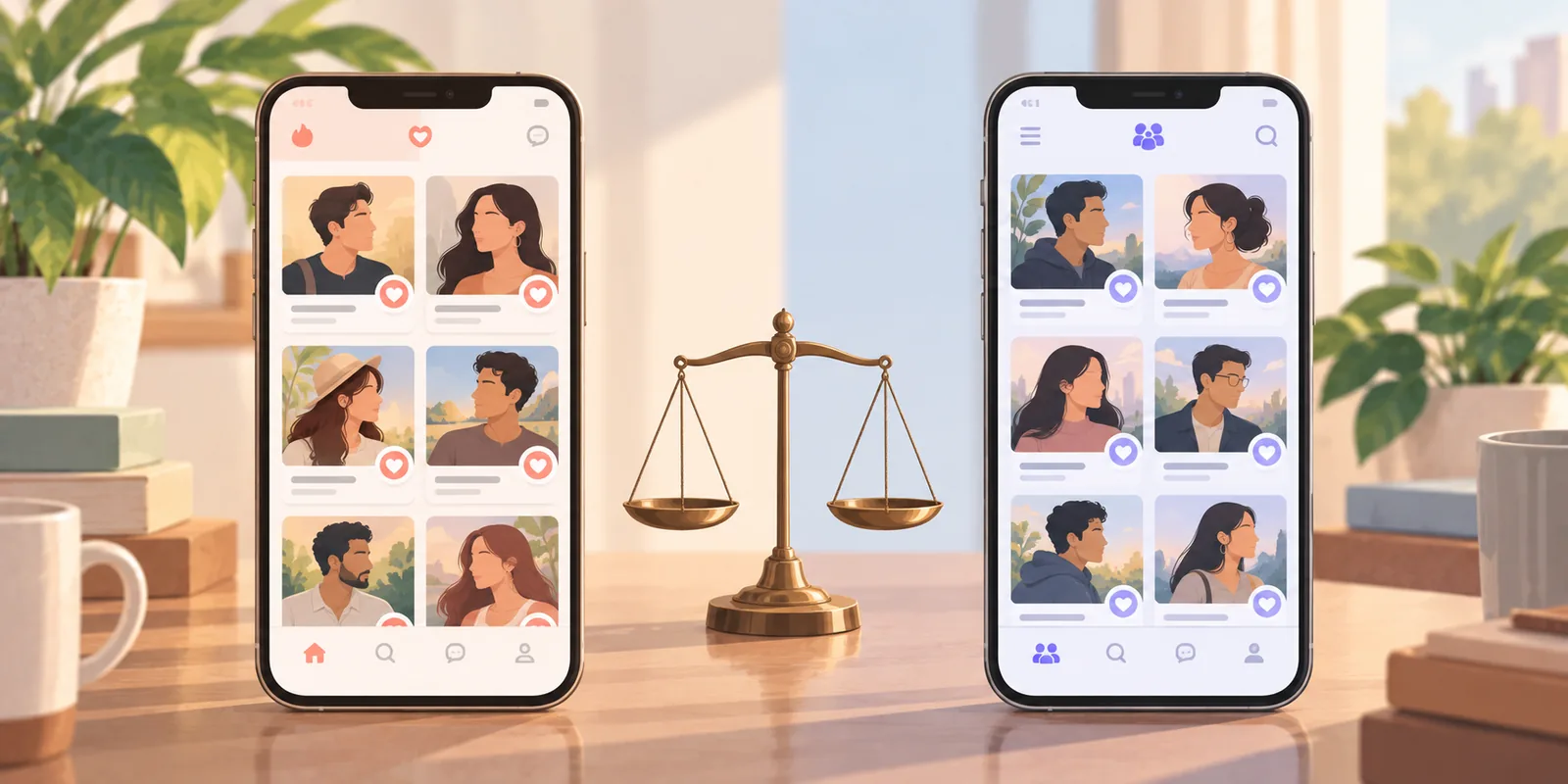
Choosing between a mainstream dating app and an HIV-specific dating platform is not a test of how comfortable you are with your HIV status. It is a channel-choice decision based on user pool, privacy exposure, disclosure pressure, location, and what kind of relationship you want.
A mainstream app can give you access to a much broader dating market, while an HIV-specific platform can reduce the need to explain your status at the beginning of a connection. Neither option is automatically safer, more authentic, or more appropriate for everyone.
The better question is:
Which platform gives you the best balance of reach, privacy, emotional comfort, and matching efficiency right now?
And you do not have to choose only one.
Reframing HIV Dating: Why App Selection Is a Channel Strategy, Not an Identity Test
The Friction: Massive User Pools vs. Disclosure Anxiety
When you first return to dating after an HIV diagnosis, choosing an app can feel much bigger than choosing an app.
A mainstream platform such as Tinder, Hinge, or Bumble may feel attractive because everyone uses it. You can meet people outside an HIV-specific community, potentially access a much broader local dating pool, and interact without making HIV the first defining feature of your profile.
But there is another side.
You may wonder:
What happens when someone becomes interested in me?
When should I disclose?
Will someone screenshot my profile?
What if a match reacts badly?
That can make mainstream dating feel emotionally expensive even when the platform itself has nothing specifically to do with HIV.
HIV-specific platforms solve a different problem.
They create a more targeted environment in which HIV and other STI experiences are already part of the community context. PositiveSingles, for example, currently welcomes people living with HIV and other STIs as well as people open to dating them, and it provides a range of profile, photo, and visibility controls.
That can lower the emotional friction of explaining your status.
But it does not eliminate every concern.
A smaller or more geographically concentrated community can limit your local options. You can still encounter people you know. And a niche platform is still an online platform: profiles, photos, conversations, and personal information can still be copied, shared, or exposed.
So neither platform type should be treated as a perfect solution.
Tool Efficiency Over Identity: Treating Apps Like Distribution Channels
Think about the way professionals choose where to look for work.
Someone might use LinkedIn to reach a large general professional market and an industry-specific community to find highly relevant opportunities.
Neither choice says anything about the person's worth.
Dating works the same way.
Choosing an HIV-specific platform does not mean:
"I'm too different for mainstream dating."
Choosing a mainstream app does not mean:
"I have to prove that HIV doesn't affect me."
It simply means:
"This is the channel I want to use for this part of my dating strategy."
You can also change channels.
You might start with an HIV-specific platform while rebuilding confidence, then add mainstream apps later.
You might prefer mainstream apps in a large city while keeping one HIV-specific platform active as a second channel.
Or you may discover that your local HIV-specific dating pool is too small and decide that mainstream apps are more practical.
Those are market decisions, not identity statements.
The 4-Dimensional Comparison Matrix: Mainstream vs. HIV-Specific
Dimension 1: User Pool Size & Real Liquidity
Mainstream dating apps generally give you access to a much broader local pool because they are designed for the general dating market.
That can matter enormously in a large metropolitan area where there may already be thousands of potential users within reasonable dating distance.
The tradeoff is that HIV compatibility is not built into the core matching model.
You may have to spend more time determining whether someone is comfortable dating a person living with HIV and whether your relationship goals align.
HIV-specific platforms reverse that equation.
The pool is narrower, but HIV or STI status is much more central to the community. PositiveSingles, for example, describes itself as a community for people living with STIs and people open to connecting with them.
That can make each profile more relevant.
But relevance is not the same thing as volume.
In a major city, a niche platform may still provide enough local options.
In a smaller town, the same platform may have far fewer active profiles, making it harder to maintain a steady flow of genuinely compatible matches.
So the important metric is not simply:
"How many members does this platform have?"
It is:
"How many realistic, active, compatible people can I actually meet from where I live?"
Dimension 2: Privacy Exposure & Digital Footprints
Privacy works differently on the two channel types.
On mainstream apps, you may be surrounded by people who know nothing about your HIV status. That can reduce immediate health-status exposure, but it also means more people may encounter your profile who are not relevant to your dating goals.
The larger social environment can create another concern: someone you know personally may see you on the app.
Some mainstream platforms now offer meaningful visibility controls.
Tinder currently offers tools such as hiding your account from the card stack, hiding distance, and—through its paid privacy features—showing your profile only to people you have already liked.
Bumble's current Incognito Mode similarly limits profile visibility to people you choose by liking them first.
Hinge takes a somewhat different approach: its current Pause function prevents your profile from being shown to new users while allowing you to keep chatting with existing matches.
These tools can reduce unwanted exposure, but they do not create absolute anonymity.
Tinder, for example, now blocks screenshots and screen recordings of profiles in some regions, but explicitly warns that no technology can completely prevent someone from capturing or sharing content—for example, by using another device.
HIV-specific platforms can offer even more targeted privacy controls.
PositiveSingles currently describes more than 10 privacy controls, including profile visibility controls, private photos, private albums, location controls, and options to restrict who can see your profile.
But there is an important caveat.
PositiveSingles itself states that no system can be completely secure and advises members to be careful about the personal information they share. Its service agreement also explains that content you post or transmit can be viewed by other members.
So the correct comparison is not:
mainstream = public
HIV-specific = private
It is:
both require active privacy management, but the available controls and the social context differ.
Dimension 3: Emotional Safety & Disclosure Pressure
This may be the biggest difference for someone newly returning to dating.
On a mainstream app, your HIV status may not be part of the initial matching process.
That can feel liberating.
It can also mean that you eventually need to have a more personal conversation with someone who had no prior context about HIV.
For some people, that is perfectly manageable.
For others, repeatedly reaching the disclosure stage can create emotional exhaustion.
HIV-specific platforms can reduce that initial burden because the community is explicitly organized around STI-related dating and support.
PositiveSingles currently describes its community as a space for people living with STIs and for people open to connecting with them, with an emphasis on understanding and stigma reduction.
That does not mean every person on such a platform will respond well to every situation.
It means the probability of encountering someone who already understands the context may be higher.
That distinction matters.
A platform can lower disclosure friction without guaranteeing emotional acceptance.
Dimension 4: Matching Efficiency & Intent Alignment
Mainstream platforms are broad.
That is their strength—and sometimes their weakness.
Depending on the app and your location, you may find people seeking casual dating, exclusive relationships, marriage, friendship, or something much less defined.
The upside is variety.
The downside is filtering.
You may spend substantial time determining:
Are they comfortable dating someone with HIV?
Are they looking for the same type of relationship?
Do they understand U=U?
Are they emotionally mature enough to have a health conversation?
On an HIV-specific platform, the HIV-related compatibility problem is usually less central to the initial screening because the site itself is built around an STI-aware community. PositiveSingles also provides filters and matching tools intended to help members search within that community.
But niche matching can create another limitation: a smaller pool means fewer opportunities to find the exact combination of personality, attraction, geography, lifestyle, and relationship goals you want.
This is why matching efficiency is not the same thing as matching quality.
A smaller pool can be more relevant.
A larger pool can provide more choice.
Your local market determines which advantage matters more.
Core Evaluation Matrix: Mainstream vs. HIV-Specific at a Glance
| Factor | Mainstream Apps | HIV-Specific Platforms |
|---|---|---|
| Potential local reach | Broad general dating pool | Narrower, condition-focused pool |
| HIV context | Usually not built into initial matching | Central to community context |
| Initial disclosure pressure | Often higher | Often lower |
| Main privacy challenge | Broad visibility and possible real-world overlap | Sensitive health-status context and concentrated community |
| Privacy controls | Vary by app; some offer strong visibility tools | Often more health/privacy-specific controls |
| Local liquidity | Often stronger, especially in cities | Can become limited in smaller markets |
| Relationship variety | Broad range | More targeted community |
| Emotional comfort | Depends heavily on individual readiness | Often easier for people who want immediate context |
| Best use case | Maximum reach and mainstream social experience | Lower disclosure friction and targeted compatibility |
| Potential weakness | More filtering and disclosure uncertainty | Smaller local pool and concentrated social overlap |
| Best overall strategy | Useful as one channel | Useful as one channel |
There is no universal winner.
The "best" platform depends on what you are optimizing.
If you optimize reach, mainstream may be more useful.
If you optimize initial HIV-context compatibility, a specialized platform may be more efficient.
If you optimize privacy control, you should compare the actual settings of the specific app rather than relying on its category.
If you optimize emotional comfort, your current stage of recovery from diagnosis may matter more than raw user numbers.
Uncovering the Hidden Pitfalls of Both Channels
Mainstream Apps: Privacy Controls and Stealth Browsing
A common misconception is that the safest mainstream strategy is simply to hide HIV status indefinitely.
Privacy and disclosure are different issues.
You can keep sensitive medical information off a public profile while still deciding how and when to discuss it with someone before sexual intimacy.
The privacy question comes first:
Who can identify me from this profile?
Use the strongest visibility controls available on the specific platform.
On Tinder, for example, paid Incognito can restrict your profile to people you have already liked.
On Bumble, Incognito similarly limits visibility to people you have liked.
On Hinge, Pausing is useful when you want to stop attracting new users while keeping existing conversations alive, although it is not the same as Incognito Mode.
Then reduce the information your profile leaks.
Avoid:
A workplace clearly visible in the background.
A home address or recognizable building.
A car plate.
A highly identifiable daily routine.
The exact same profile photo you use across every public social account.
And remember that platform privacy features have limits.
Even where screenshot protection exists, a person can potentially photograph a screen with another device. Tinder itself makes this limitation explicit.
The safest rule is therefore:
Never put information on a dating profile that would seriously harm you if someone copied it.
HIV-Specific Platforms: Busting the "100% Safe" Myth
An HIV-specific platform can reduce a certain type of exposure: the need to introduce your HIV status into every interaction from scratch.
But it does not eliminate privacy risk.
The community itself may be geographically concentrated.
You may encounter coworkers, former partners, neighbors, or people connected to your offline life.
And because health status is part of the community context, a privacy failure can feel more sensitive than an ordinary dating-app exposure.
PositiveSingles currently offers tools such as hidden profiles, private albums, photo controls, and location-related privacy settings.
But its own privacy materials explicitly say that no system is completely secure.
There is another important point that people sometimes assume incorrectly:
An HIV-specific platform does not necessarily verify every member's HIV status.
PositiveSingles currently says that medical records are not required or verified for membership.
That is not necessarily a flaw.
It simply means you should not confuse:
"This is an HIV/STI-focused community"
with:
"Every profile has been medically authenticated."
The two are not equivalent.
Geographic & Readiness Factors: How Location Dictates Your Choice
Metro Areas vs. Rural Towns: Location-Driven Tactics
Geography can completely change the value of a platform.
In a large metropolitan area, you may have enough people on both mainstream and HIV-specific platforms to test both channels.
That creates flexibility.
You might use an HIV-specific platform to meet people who already understand your experience while keeping a mainstream app active for broader social reach.
In a smaller city or rural area, the situation can reverse.
A highly specialized platform may have too few active local profiles to sustain a meaningful dating pipeline.
You might repeatedly encounter the same people.
You might find profiles that are technically nearby but practically incompatible in age, relationship goals, or lifestyle.
In that situation, mainstream platforms can provide a larger geographic market.
Your privacy strategy then becomes more important.
The choice is not:
"Which platform respects HIV-positive people?"
It becomes:
"Where are the actual people I could realistically date?"
You can also widen your radius strategically.
Instead of judging a platform entirely by your immediate zip code, consider:
How far are you realistically willing to travel?
Would you date someone in the nearest larger city?
Can you use travel or location features to test another market before relocating or committing to a different dating strategy?
For example, Bumble currently offers Travel Mode to Premium users, allowing them to change their displayed city before traveling or exploring another market.
Geography is therefore not a background detail.
It is part of the platform decision.
Matching Choice to Your Emotional Readiness Phase
Your platform choice can also change over time.
During the early period after returning to dating, your primary goal may not be maximum reach.
It may be:
rebuilding confidence.
learning how people respond to you.
having positive dating experiences again.
getting comfortable with intimacy and health conversations.
An HIV-specific platform can sometimes provide a lower-friction environment for that stage because the HIV-related context is already visible within the community.
As confidence grows, you may decide that your main objective is no longer emotional protection.
It may be:
expanding your dating pool.
meeting people who would never search specifically for HIV dating.
building relationships outside the HIV-specific community.
At that point, mainstream apps can become more attractive.
Neither stage is more "advanced."
The right platform is simply the one that solves the problem you actually have at that moment.
The Hybrid Dating Strategy: Maximize Reach While Protecting Emotional Safety
A hybrid strategy can combine the strongest features of both channel types.
Step 1: Use Niche Platforms as a Low-Pressure Testing Ground
You can begin with an HIV-specific platform while rebuilding your dating confidence.
The goal is not to stay there forever.
It is to create a lower-friction environment where you can learn:
What kind of person am I attracted to?
What kind of relationship do I want?
How much privacy do I need?
How quickly do I want to move conversations offline?
What behaviors make me feel respected?
This can help you distinguish dating anxiety from actual platform problems.
It also lets you discover whether the local niche pool is sufficient for your goals.
If it is, there may be no reason to change.
If it is too limited, you have valuable information for the next stage.
Step 2: Scale Up to Mainstream Apps With Strong Privacy Settings
You can then add one mainstream app rather than abandoning the niche platform immediately.
That gives you two different funnels.
Niche platform: higher context relevance.
Mainstream platform: broader market reach.
The key is not to duplicate your entire identity strategy across both.
For mainstream dating, start with strong privacy settings, minimal identifying information, and controlled profile visibility where available.
Then evaluate matches individually.
The goal is to make the mainstream app another channel, not a test of whether you can tolerate rejection.
Step 3: Keep the Channels Independent
A common mistake is allowing someone from a dating app to connect all your digital identities immediately.
You may start with an app username, then move to Instagram, then WhatsApp, then a personal Facebook account, and suddenly the other person knows your workplace, family network, hometown, and daily routine.
Once that chain exists, you cannot easily reverse it.
Use a controlled progression.
Dating app → limited messaging → appropriate verification → phone/video conversation → carefully selected personal channel → in-person date.
You do not need to reveal everything at once simply because the conversation is going well.
Universal Privacy Safeguards Across All Dating Platforms
Account Isolation
Use an email address that is not already publicly associated with your professional or social identity.
For higher privacy requirements, consider a separate phone number where appropriate.
The purpose is not to behave deceptively.
It is to prevent a stranger from instantly connecting your dating profile to every other aspect of your identity.
Visual Privacy
Your profile photos should not reveal information unnecessarily.
Before uploading a photo, check the background for:
workplace signs
street names
house numbers
license plates
recognizable local landmarks
children or relatives
other accounts visible on screens
Be especially cautious with images that are already widely used on public social-media accounts.
A reverse-image search may make it easy for someone to connect your dating profile with a professional page or personal social account.
You do not need a professional spy strategy.
You just need to stop making identity matching effortless.
Information Pace
Do not rush from:
"Nice to meet you"
to:
"Here's my personal Instagram, WhatsApp, workplace, home neighborhood, and full name."
Build information gradually.
The same applies to medical information.
A dating profile does not need to function as a medical chart.
But privacy should never become an excuse to mislead someone about information that is genuinely relevant to their informed sexual-health decisions.
The right goal is:
controlled disclosure, not total concealment.
Protect Conversations and Photos
Assume that anything another person can see can potentially be saved.
Even when an app introduces screenshot protection, technical protections are never absolute. Tinder explicitly warns that users can still capture content using another device.
So avoid sending highly identifying intimate photos until enough trust exists.
And never treat an app's "private" album as a guarantee that another person cannot preserve or redistribute what you shared.
Private access controls limit who can see something inside the platform.
They cannot fully control what another person does after seeing it.
Taking Full Control of Your Dating Journey
The biggest mistake is treating your platform choice as a statement about who you are.
It is not.
Choosing PositiveSingles does not mean you have accepted a smaller life.
Choosing Tinder or Hinge does not mean you have rejected the HIV-positive community.
Using both does not mean you are indecisive.
It means you understand that different channels solve different problems.
The HIV-specific platform may give you:
context
lower initial disclosure friction
more targeted compatibility
The mainstream app may give you:
reach
local liquidity
a broader range of relationship possibilities
a more conventional social environment
Neither category eliminates rejection.
Neither guarantees privacy.
Neither guarantees a successful relationship.
And neither determines your worth.
Your platform is a tool.
You are the person making the choices.
Maybe your best strategy is one HIV-specific platform plus one mainstream app.
Maybe you discover that a niche platform works perfectly where you live.
Maybe your city is too small and mainstream platforms are simply more practical.
Maybe you use a specialized platform while rebuilding confidence and gradually expand outward.
All of those are legitimate strategies.
The real goal is not to find the one "correct" HIV dating app.
It is to build a dating system that gives you enough reach to meet the right people without sacrificing the privacy, emotional safety, and control you need to stay in the process.
You are not choosing between "being normal" and "being HIV-positive."
You are choosing how to distribute your time, attention, privacy, and dating opportunities.
And that is a strategy decision—not an identity verdict.