

How We Review Dating Sites
A dating site review should tell you more than what a platform says about itself.
Our reviews are built around a simple question: what is this dating site actually like for a real user?
To answer that question, we combine hands-on testing, structured research, original visual evidence, quantitative analysis, and third-party information. We look at how a platform works in practice, how easy it is to find and communicate with relevant people, what users can realistically do for free, what they have to pay for, and where the experience falls short of expectations.
We do not treat a list of advertised features as a review. A platform may offer dozens of tools, but that does not tell you whether those tools are useful, whether the user base is active, or whether the overall experience is worth the cost.
Our goal is to provide enough original information and analysis for readers to make their own decision.
This approach also reflects Google's current guidance for high-quality reviews, which emphasizes in-depth analysis, original research, first-hand experience, quantitative evaluation, and evidence rather than simply summarizing information already available elsewhere.
Our Review Process
Every dating site review follows the same general research process.

1. Research

2. Test

3. Document

4. Analyze

5. Compare

6. Score & Review
We begin by understanding what a platform claims to offer and what users are likely to care about. We then test the service directly, record what we encounter, evaluate the evidence, and compare the results with the information provided by the platform and with relevant alternatives.
The exact testing process can vary depending on how a dating site works. A subscription-based platform, a credit-based platform, and a free community site cannot always be tested in exactly the same way.
What remains consistent is the principle behind the evaluation: we test the parts of the experience that materially affect a user's decision.
What We Evaluate
We evaluate dating platforms across a common set of categories so that different services can be compared using a consistent framework.

Profile Quality & User Pool
Completeness, activity, diversity, and the overall quality of the user base.

Search & Matching
Search filters, matching features, and how well results match user preferences.

Communication
Messaging, likes, winks, and how easy it is to actually connect.

Privacy & Safety
Privacy controls, blocking, reporting tools, and how user data is protected.

Pricing & Value
Costs, paid features, refund policies, and overall value for money.

Usability & Mobile
Navigation, design, mobile experience, and overall ease of use.

Customer Support
Response time, helpfulness, and the quality of customer support.
The sections below go into the detail behind each category, including how we distinguish an advertised feature from one that actually helps a real user.
Profile Quality & User Pool
We examine the quality, completeness, diversity, and apparent activity of profiles available within the platform.
Where practical, we look at factors such as profile completeness, photos, descriptions, activity indicators, search-result relevance, and the availability of users in specific locations.
We do not assume that a large registered-member number means that a platform has a large active user base. When we discuss user activity or profile quality, we distinguish between information provided by the platform and what we can actually observe.
Search & Matching
We evaluate how effectively users can find relevant people.
This may include search filters, location controls, age preferences, relationship preferences, activity filters, matching recommendations, and the relevance of the resulting profiles.
A feature is not considered valuable simply because it exists. We are interested in whether it actually helps users narrow down the pool and find people who match their stated preferences.
Communication
We examine how users move from discovering a profile to actually starting and maintaining a conversation.
Depending on the platform, this can include messages, likes, winks, chats, invitations, private communication features, and other interaction tools.
We also pay attention to the difference between what is technically possible and what is realistically available without payment.
Privacy & Safety
Privacy is particularly important for dating services because users may be sharing personal, relationship, health-related, or otherwise sensitive information.
We examine available privacy controls, profile visibility, photo controls, blocking and reporting tools, account management, and other publicly documented safety features.
We distinguish between what a platform claims to provide and what we can independently observe. We do not treat a company's security or privacy claim as independently verified simply because it appears on an official page.
Pricing & Value
We examine not only the advertised price, but the practical cost of using the platform.
This can include subscriptions, credits, messaging costs, premium features, profile boosts, payment methods, cancellation procedures, refund policies, and automatic renewal.
The central question is: what does a user actually get for the money they spend?
Usability & Mobile Experience
We evaluate how easy the platform is to understand and use.
This includes navigation, search, profiles, messaging, account settings, page performance, mobile usability, and the consistency of the experience across devices.
When a platform provides a dedicated app, we evaluate the app separately. When it does not, we do not automatically treat the absence of an app as a flaw; we evaluate the mobile experience that the service actually provides.
Customer Support
We evaluate how easy it is to obtain help when something goes wrong or when a user has an important question.
Where practical, we consider response time, communication quality, usefulness of the response, available contact methods, and whether the issue was actually resolved.
How We Conduct Our Testing
Our testing conditions ensure consistency while allowing flexibility for every platform.

Testing Period
We test each site long enough to go beyond the first-impression sign-up experience. The exact duration depends on the platform's activity and features, not a fixed number of days.

Test Accounts
We use dedicated test accounts, including free and premium, to compare what changes after upgrading and what stays accessible without paying.

Testing Environment
We record the conditions behind every finding:
- Device and browser
- Mobile or desktop
- Testing location
- Account type
- Testing dates

Testing Scope
We focus on the features that materially affect a user's decision: search, communication, privacy, pricing, cancellation, mobile, and support — not every feature gets equal attention.

Sample Size
We record the sample behind a measurable finding — profiles reviewed, searches performed, messages sent. It varies by review, and a limited sample is always identified as such.
How We Collect Original Evidence
We document what we see, not what dating sites claim.

Screenshots
We capture key pages like search results, profiles, pricing, settings, and payment screens — selected to support a specific observation.

Screen Recordings
We record workflows to show how features actually behave, especially multi-step processes like payment or account setup.

Search & Profile Evidence
We record the search criteria and profile context behind an observation — a result without its criteria tells a reader very little.

Pricing & Payment Evidence
We document pricing and payment screens directly, since costs can differ by account type, location, or purchase method.

Support Evidence
We save our questions, responses, and resolution results from customer support, while protecting private information.

Testing Notes
We keep detailed notes during testing so the final conclusion can be traced back to what actually happened.
Our evidence should support the chain:
Observation → Evidence → Analysis → Conclusion
Rather than:
Claim → Screenshot → Conclusion
We also avoid using visual evidence to imply something that the evidence does not actually prove.
How We Evaluate Profile Quality & User Pools
Dating sites are fundamentally different from ordinary software products.
A beautiful interface is of limited value if users cannot find relevant people.
For that reason, user pool quality is one of the most important parts of our evaluation.
We consider factors such as:
- Profile completeness
- Photo availability
- Profile detail
- User activity signals
- Search-result relevance
- Local user availability
- Apparent diversity of the user pool
- Repeated, incomplete, or low-information profiles
We are careful with conclusions about authenticity.
For example, an incomplete profile may be low quality, but it is not automatically a fake profile. A user who does not respond to a message may be inactive, selective, unavailable, or simply uninterested.
We therefore document observable signals rather than turning uncertain observations into definitive accusations.
How We Test Search & Matching
We test search and matching from the perspective of someone who actually needs to find a compatible person.
Where applicable, we test different combinations of filters and observe:
- How many results are returned
- How relevant those results appear
- Whether filters work as expected
- How location affects results
- Whether results change under different criteria
- How recently active users appear
- Whether recommendations appear relevant
The purpose is not to determine whether an algorithm is technically sophisticated. The purpose is to determine whether the feature helps a real user find better matches.
How We Test Communication
A dating platform ultimately needs to help people communicate.
We therefore examine the path between discovering a person and starting a conversation.
Depending on the platform, this can include:
- Likes
- Winks
- Messages
- Chat
- Invitations
- Premium communication features
- Credit-based communication
- Message restrictions
We also distinguish between the existence of a communication feature and its practical usefulness.
For example, a platform may technically allow messaging but restrict it so heavily for free members that meaningful communication is difficult without paying.
That distinction is part of our evaluation.
How We Evaluate Privacy & Safety
We evaluate privacy and safety from the perspective of what users can actually control and what can reasonably be verified.
We look at:
- Profile visibility
- Photo visibility
- Privacy settings
- Blocking tools
- Reporting tools
- Account controls
- Data and account deletion options
- Publicly documented privacy policies
- Other relevant safety features
We separate three different types of information:
- What the platform states.
- What we can observe.
- What we cannot independently verify.
This distinction is especially important when evaluating claims involving security, identity verification, fraud prevention, or data protection.
A feature described in a privacy policy is not automatically evidence that the underlying security implementation has been independently tested by us.
How We Test Pricing & Real-World Cost
We do not evaluate price based solely on the headline subscription figure.
We examine how the pricing model affects actual use.
For example, a service may appear inexpensive until a user discovers that messaging, profile visibility, or other important actions require additional credits.
When possible, we examine:
- Free features
- Premium features
- Subscription tiers
- Credit packages
- Individual action costs
- Payment methods
- Automatic renewal
- Cancellation
- Refunds
- Additional paid features
We then ask a broader question: is the service good value for the type of user it is intended to serve?
A higher-priced platform is not necessarily poor value, just as a free platform is not automatically good value.
How We Evaluate Mobile & App Experience
When a dating platform has a mobile website or dedicated app, we evaluate it as part of the real user experience.
We consider:
- Ease of navigation
- Search
- Profile browsing
- Messaging
- Notifications
- Account controls
- Performance
- Feature availability
- Differences between desktop and mobile
The absence of a dedicated app is not automatically treated as a negative. What matters is whether the available mobile experience adequately serves the platform's users.
How We Test Customer Support
Customer support can be difficult to evaluate from a product page, so when practical we test it directly.
We document:
What we asked → How we contacted support → How long they took to respond → What they told us → Whether the issue was resolved
We do not judge support solely on how polite a response sounds.
The more important question is whether the response was accurate, useful, and capable of solving the user's problem.
How Our Rating System Works
To make reviews easier to compare, we use a weighted rating system based on eight core categories that reflect real user priorities.
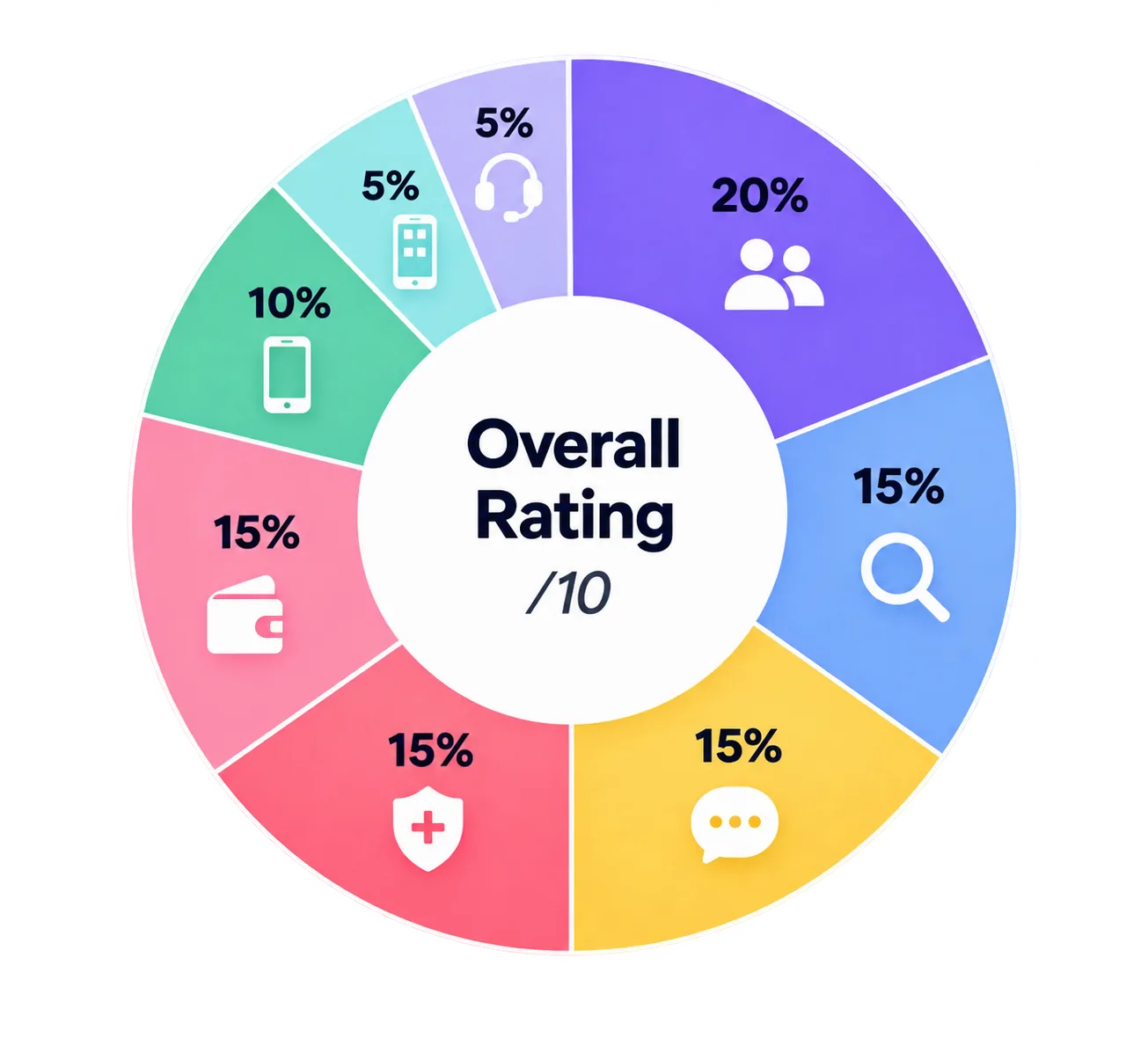
Each category receives an individual score, which is then combined according to its weight to produce the overall rating. The final score reflects the overall experience, not just the number of features a site offers.
We also avoid forcing a platform into a category that does not apply. For example, a service without a dedicated app is evaluated based on its actual mobile experience rather than automatically receiving a penalty simply for not offering an app.
The purpose of the score is to summarize the evidence, not replace it.
A score without an explanation is just a number. Every important score should be supported by the observations and evidence presented in the review.
How We Handle Third-Party Reviews
Third-party reviews can provide useful context, but they are not treated as a substitute for our own testing.
We may examine publicly available feedback from sources such as review platforms, app stores, forums, and other public discussions to identify recurring themes or experiences worth investigating.
We then compare those themes with our own observations. This creates three possible outcomes:
- Matches our findings — external reports are consistent with what we observed.
- Differs from our findings — other users report an experience that we did not observe.
- Requires further investigation — a recurring claim cannot be independently verified.
Google's current Reviews System specifically distinguishes first-party independent review content from third-party user reviews. Our own analysis therefore remains the foundation of the review, while external feedback is used as supporting context rather than republished as if it were our own experience.
We also do not aggregate ratings from other websites and present them as our own rating. Google's current Review structured-data guidelines explicitly prohibit aggregating reviews or ratings from other websites and prohibit fake or undisclosed incentivized reviews.
How We Handle Claims We Cannot Verify
A responsible review needs to distinguish facts from assumptions.
When information cannot be independently verified, we say so. This applies particularly to claims involving:
- Number of active users
- Profile authenticity
- Fraud or bot activity
- Security
- Encryption
- Success rates
- Response rates
- Internal algorithms
- Data handling
- Business claims that cannot be observed directly
We may report that a platform claims something, but we will not automatically turn that claim into our own conclusion.
Similarly, seeing unusual behavior does not automatically prove why it happened.
Our preferred language is:
- What we observed.
- What the available evidence suggests.
- What the platform claims.
- What we could not independently verify.
That distinction helps prevent a review from becoming more confident than the evidence allows.
How We Report Strengths and Weaknesses
A useful review should not be written as either a sales pitch or a takedown.
We report both advantages and disadvantages that are relevant to a user's decision.
Positive findings should be supported by actual observations whenever possible. Negative findings should be held to the same standard.
We do not add criticism simply to make a review appear independent, and we do not hide genuine problems simply because a platform has an affiliate relationship with us.
A weakness is valuable when it helps a reader decide whether the platform is right for them. Likewise, a strength matters most when we can explain why it improves the real user experience.
Affiliate Disclosure & Editorial Independence
Some reviews may contain affiliate links. When an affiliate relationship exists, we disclose it clearly.
Affiliate relationships do not determine our ratings, conclusions, or editorial findings.
We do not promise a positive review in exchange for payment, and we do not increase a platform's rating because it offers a higher commission.
Our purpose is to help readers make an informed choice. That means a review may recommend a platform, recommend an alternative, or conclude that neither option is suitable for a particular type of user.
Google's current structured-data guidance also emphasizes transparency around incentivized reviews and prohibits fake or undisclosed incentivized reviews.
How We Keep Reviews Up to Date
Dating platforms change frequently.
Prices change. Features are redesigned. Apps are updated. Payment systems change. Privacy policies are revised. User activity can also vary over time.
For that reason, a review should not be treated as permanently accurate simply because it was once tested.
When a substantial change occurs, we may revisit the platform and update the relevant findings. Important changes that may trigger a re-evaluation include:
- Major pricing changes
- Significant product redesigns
- Major changes to communication features
- New or removed privacy controls
- Major app changes
- Changes to membership or cancellation policies
- Other developments that materially affect the user experience
Each review should make clear when the information was last tested or updated.
Our Review Principles
Our entire review process can be reduced to a few principles.

Test Before We Judge
We experience the platform ourselves before forming conclusions.

Show the Evidence
We support our observations with original evidence, not just opinions.

Measure What Matters
We focus on factors that truly affect a user's experience and decisions.

Separate Facts From Observations
We clearly distinguish facts, observations, claims, and third-party reports.

Report Strengths & Weaknesses
We highlight both pros and cons so you can make the best decision.

Help You Choose
Our goal is to help you find the right site for you — not just sell you one.
Our goal is to help readers understand who a platform is for, what it actually offers, what it costs, where it performs well, where it falls short, and whether it is the right choice for them. That is what we believe a useful dating site review should do.