
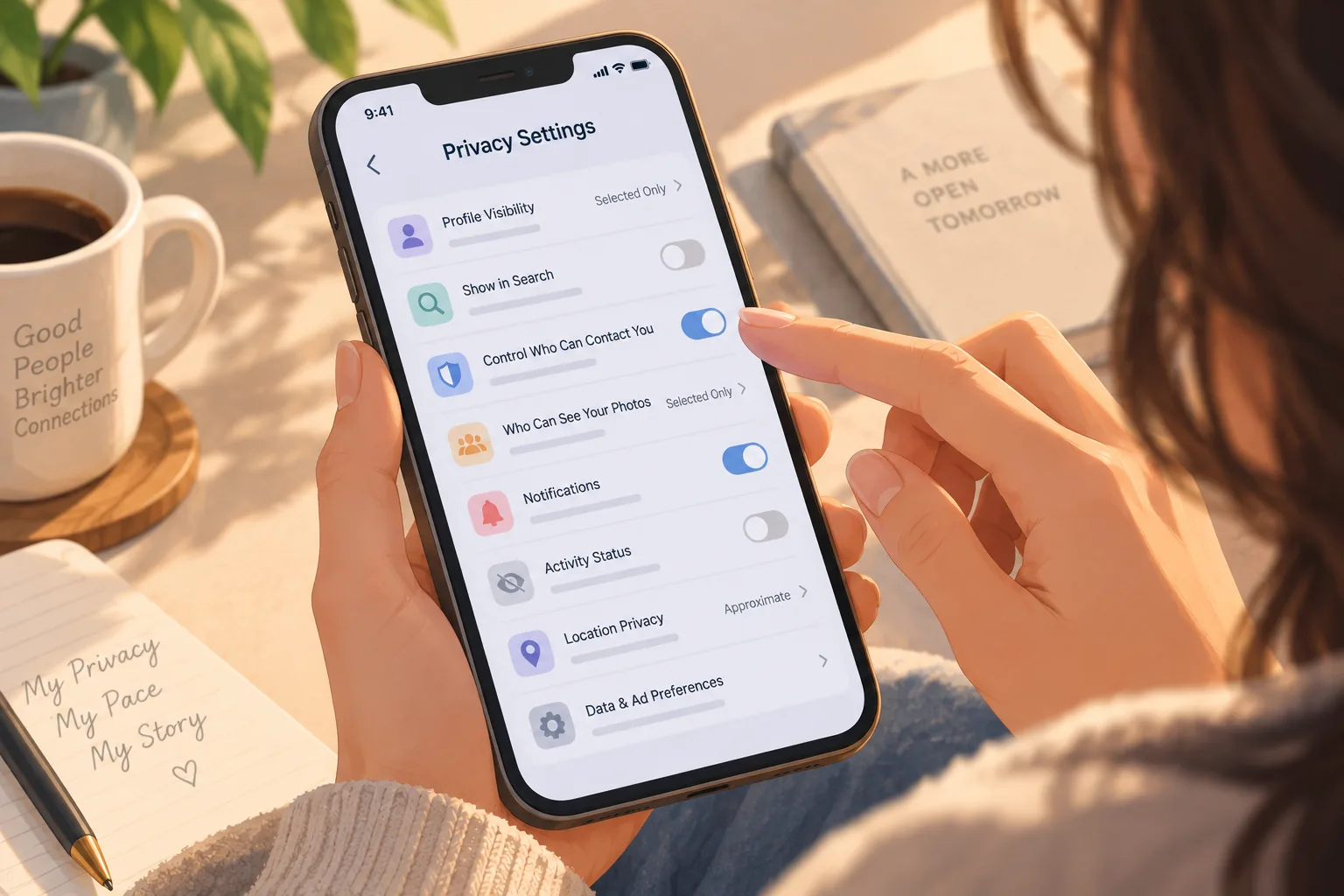
Herpes dating apps and sites can reduce the anxiety of explaining an HSV diagnosis to every new match, but a niche community is not automatically a private, trustworthy, or high-quality one. Before creating a detailed profile or paying for a subscription, evaluate privacy controls, local user density, profile authenticity, billing terms, and account deletion.
The right question is not:
"Which herpes dating site should I join?"
It is:
"Can this platform protect my identity, provide enough real people in my area, and let me leave without unnecessary financial or privacy risk?"
That shift turns herpes dating from an anxiety-driven decision into a normal consumer decision.
1. The Niche Dating Dilemma: Safety Net or Cash Grab?
1.1 The Relief of No-Disclosure Dating
The biggest attraction of an HSV-specific dating platform is often not a particular matching algorithm. It is reduced disclosure friction.
When a community is built around herpes or other STI-related dating, users generally have more context before the conversation even begins. You may not have to explain what HSV is, wonder whether a match has heard of it, or spend the first few dates deciding when to disclose.
That can create an important psychological benefit:
"I don't have to explain why I'm here before someone understands why I'm here."
For someone newly returning to dating after an HSV diagnosis, that can make the process feel much less exposed.
There is also a practical benefit. Some niche services let users filter or identify profiles according to the type of condition they disclose. For example, a current herpes-focused platform describes options around private photos and profile visibility, illustrating how niche services can build features around users' privacy concerns.
But "everyone here understands" should not be interpreted as:
"Everyone here is automatically trustworthy."
A niche dating platform still contains strangers.
You still need to evaluate:
Who can see your profile?
How much location information is exposed?
What happens to your photos after upload?
Can you delete the account?
How does the platform make money?
Are the people you see actually active in your area?
The emotional relief of finding a herpes-specific community is real. It should make you more deliberate about platform selection, not less.
1.2 The Reality of Niche Platforms: Trade-Offs You Must Expect
A niche platform solves one problem—relevance—while potentially creating several others.
The most obvious trade-off is user pool size.
A mainstream dating service may have a large population in your city, while a highly specific niche service may have far fewer active members. That does not make the niche service inferior. It means its value depends heavily on geography and liquidity.
The second trade-off is product maturity.
Smaller services may have fewer privacy controls, fewer sophisticated discovery options, slower product development, older interfaces, or less transparent documentation. None of these characteristics proves that a platform is unsafe, but they justify closer inspection.
The third trade-off is monetization.
A site can be legitimate and still use aggressive subscription mechanics. Free trials, introductory prices, recurring billing, premium messaging, boosts, or restricted communication features can all affect the real cost of using the service.
The FTC recommends checking the exact terms of a trial or subscription, understanding how and when cancellation works, and watching for pre-checked boxes or unclear recurring charges.
So treat a herpes dating service as a tool, not a rescue system.
The platform should earn your trust through its product design.
2. The Pre-Signup Privacy Audit: 5 Non-Negotiable Security Features
Before uploading your face, location, relationship history, or HSV status, evaluate these five areas.
| Privacy question | What you want to see | Red flag |
|---|---|---|
| Photo control | Private albums, restricted photo access, granular visibility | Every photo is public by default |
| Location privacy | City/region display or an option to hide exact distance | Precise location or unnecessary address-level exposure |
| Screenshot protection | Documented in-app protection where available | Platform implies screenshots are impossible without explaining limits |
| Identity separation | Alias/username, non-public email, limited social-account linking | Real name or personal social account required without a clear reason |
| Data deletion | Clear account-deletion process and retention explanation | "Deactivate" is easy; permanent deletion is unclear |
2.1 Private Photo Controls and Blur Options
Your primary photo is often the first thing that can expose you to someone who knows you offline.
A good platform should give you meaningful control over photo visibility.
Look for features such as:
Private albums
Photo access granted only to selected users
Profile-level visibility controls
The ability to change or revoke access
For example, PositiveSingles currently documents a private-photo feature in which users can control who receives access.
That does not mean every platform with a "private album" is equally secure.
You should also ask:
Can someone who receives access keep viewing the photo indefinitely?
Can they save it?
Does the platform warn you about screenshots?
Can you revoke access later?
Is the thumbnail still visible publicly even when the full photo is private?
A useful rule is:
Never upload an image to a dating platform that would seriously harm you if another person eventually copied it.
Privacy controls reduce exposure. They cannot guarantee that information will never leave the platform.
2.2 Location Fuzzing: Hiding Exact Distance
Location is another major identity clue.
A profile that says:
"0.4 miles away"
can reveal considerably more than:
"Los Angeles area."
For someone worried about being recognized by a colleague, neighbor, former partner, or family member, precise distance can make an otherwise anonymous profile surprisingly easy to identify.
Look for the ability to:
- hide exact distance;
- show only a city or region;
- broaden the search area;
- control location permissions on the device;
- avoid displaying workplace or neighborhood-level information.
Do not assume that a platform automatically protects you simply because it asks for your city rather than your street address.
Location privacy also includes the information you volunteer yourself.
A profile saying:
"I live two blocks from the downtown courthouse and work on the 23rd floor of the building next to it"
has already defeated most of the platform's technical privacy controls.
2.3 Screenshot Prevention: Useful Protection, Not a Guarantee
Some modern dating platforms have introduced screenshot or screen-recording controls. Tinder, for example, currently says that profile screenshots and screen recordings are blocked in select regions, with differences between Android and iOS behavior. Tinder also explicitly warns that no technology can completely prevent someone from capturing or sharing content, including by using another device.
That is the correct way to think about screenshot protection:
It is a friction layer, not a force field.
A platform that blocks ordinary screen capture deserves some credit for reducing casual copying.
But no dating service can stop someone from:
- photographing the screen with another phone;
- remembering your profile;
- copying information manually;
- sharing information through another account.
Therefore, ask two separate questions:
Does the platform reduce easy capture?
and:
Would I still be comfortable if someone captured this profile anyway?
The second question is ultimately more important.
2.4 Anonymous Profiles and Alias Support
A herpes dating profile should not automatically become a public bridge to your real-world identity.
Look for:
usernames or aliases;
email addresses hidden from other members;
no mandatory public surname;
limited external social-media integration;
the ability to keep your workplace, phone number, and exact location private.
You can also create identity separation before registering.
For example, use a dating-specific email address rather than your work email, and avoid using the same username that you use publicly on Instagram, Reddit, LinkedIn, or other social platforms.
The goal is not to create a fake identity.
It is to create controlled identity exposure.
You should still provide truthful information necessary for genuine dating. The principle is simply:
Reveal information progressively rather than making your entire offline identity searchable from day one.
2.5 Data Erasure Policies: The Exit Test
A platform's privacy quality is revealed not only by how easy it is to join, but by how easy it is to leave.
Find the answer to these questions before registering:
Can I permanently delete my account myself?
Is deletion different from deactivation?
How long is account data retained?
What happens to private messages and uploaded photos?
Are backups or cached copies retained for a period of time?
Can public comments or community posts survive account deletion?
Some services advertise account deletion, but the detailed terms may distinguish between removing a profile from public view and permanently eliminating all associated information. That distinction matters especially for a health-sensitive dating platform.
Do not rely only on a button labeled:
"Delete"
Read the privacy policy and account terms.
Your goal is to understand the data lifecycle, not just the interface.
3. Spotting Red Flags: How to Avoid Scams, Bots, and Dead Platforms
3.1 Ghost Towns: How to Test Local User Density Without Paying
The fastest way to waste money on a niche dating service is to buy a long subscription before checking whether anyone near you actually uses it.
Test the free experience first.
Set the search location around your real dating area and examine:
How many profiles appear?
How recently were they active?
How many appear genuinely local?
How many have complete profiles?
How many appear repeatedly across search results?
How many profiles are obviously dormant?
The exact radius depends on where you live. In a dense metropolitan area, 10–20 miles may be informative. In a rural region, you may need a much wider search radius.
The important variable is not the number of profiles a site claims to have globally.
It is:
How many plausible, active people could I realistically meet from where I live?
A useful free-user audit is:
Day 1: Search locally and record the number of plausible active profiles.
Day 3–5: Repeat the search.
Day 7: Check whether new profiles or recent activity appear.
You are looking for signs of liquidity, not just a large database.
If almost everything is months old, if the same handful of profiles dominate the results, or if the majority of profiles are geographically irrelevant, paying for six or twelve months makes little sense.
A large total-member number can therefore be almost meaningless for your actual dating market.
3.2 Identifying Bots and Artificial Engagement
A sudden flood of attention can feel especially persuasive when you are newly diagnosed and nervous about dating.
That is exactly why you should slow down.
Potential warning signs include:
Numerous messages arriving immediately after registration with unusually generic language.
Profiles with very little information but highly aggressive romantic interest.
Messages that do not respond naturally to what you wrote.
Repeated wording across apparently different profiles.
Accounts that immediately push you toward another website, messaging service, or payment link.
Profiles that disappear when you ask basic verification questions.
These signs do not prove an account is a bot. Some real users write generic messages, and some genuine users are simply enthusiastic.
The right approach is to look for patterns rather than one suspicious detail.
Government consumer-safety agencies also recommend reverse-image searching profile photos and researching suspicious identities. The FBI specifically advises dating users to research a person's photo and profile, move slowly, and be cautious when someone quickly tries to take the conversation off-platform.
For an HSV-specific platform, there is another useful test:
Does the profile actually engage with the community context, or does it simply use "herpes dating" as a hook?
A convincing profile should still behave like a real person's profile.
And regardless of how genuine someone appears:
Never send money to an online romantic contact you have not met and independently verified. The FTC and FBI both emphasize this as a core romance-scam prevention rule.
3.3 Predatory Billing and Auto-Renewal Traps
A dating site does not become a scam merely because it charges money.
Paid subscriptions can be legitimate.
The problem is unclear pricing, hidden recurring charges, misleading free trials, or difficult cancellation.
Before paying, find these five pieces of information:
Initial price
Renewal price
Renewal frequency
Cancellation method
Refund policy
FTC consumer guidance recommends checking exactly how a trial works, when it converts to paid service, how cancellation works, and whether pre-checked boxes authorize future charges.
The payment channel also matters for convenience.
For subscriptions purchased through Apple, users can manage and cancel App Store subscriptions through Apple's subscription controls. Google Play similarly provides centralized subscription management and cancellation for subscriptions using Google Play billing.
That can make billing administration easier, but it does not automatically mean the underlying dating platform offers better privacy.
A platform should also clearly explain whether cancelling a subscription:
- immediately removes premium access;
- stops future renewal but leaves current access active;
- deletes your account;
- or does none of those things.
These are separate actions.
A particularly useful rule is:
Cancel the subscription first, then delete the account separately if you decide to leave.
Do not assume that uninstalling an app cancels the subscription. Google explicitly warns that deleting an app does not cancel a Google Play subscription.
4. Stealth Mode Setup: Protecting Your Identity on Niche Platforms
4.1 Photo Rules: Never Reuse Social-Media Pictures
Using the same profile photo on every website makes identity matching much easier.
The FBI and FTC both recommend reverse-image searching profile photos as a way to identify stolen or reused images in romance scams.
The same principle works in reverse:
A unique dating photo makes it harder for strangers to connect your niche profile directly to your public social accounts.
Consider creating a small set of photos specifically for the dating platform.
Avoid:
- your LinkedIn headshot;
- your Instagram profile photo;
- photos showing your workplace;
- photos with visible company logos or badges;
- recognizable home interiors;
- car license plates;
- distinctive local landmarks directly outside your home or workplace.
Also inspect the background.
A perfectly anonymous face can still be identifiable because the photo shows:
your apartment building,
your company's conference room,
your child's school,
your gym,
or
the exact restaurant you visit every Friday.
Privacy protection is therefore about the entire image, not only the face.
4.2 Bio Hygiene: Stripping Identifiable Context
The same principle applies to text.
Compare:
"Software engineer working at the downtown office of a 200-person cybersecurity company, living in the apartments next to Central Station."
with:
"I work in tech, enjoy live music and weekend hiking, and I'm looking for a genuine long-term connection."
The second profile still tells a potential date something useful while providing far fewer clues for a stranger trying to identify you.
You do not need to become vague or personality-free.
Instead, avoid unnecessary combinations of:
job title + employer + neighborhood + exact age + unique hobby + specific schedule.
Any one of these may be harmless.
Together, they can become an identity fingerprint.
You should also delay sharing:
work email
home address
personal phone number
private social accounts
financial information
until you have established reasonable trust.
And never let the emotional comfort of "this person understands herpes" cause you to skip ordinary online-safety precautions.
An HSV-specific community reduces one type of social anxiety.
It does not eliminate the normal risks of meeting strangers online.
5. Niche vs. Mainstream: Designing Your Strategic Dating Portfolio
5.1 When Niche Apps Make Sense—and When They Don't
A niche herpes dating platform can make sense when your priority is:
lower disclosure friction,
finding people who already understand HSV,
searching within a relevant community,
or
reducing the emotional cost of explaining your diagnosis repeatedly.
A mainstream platform may make more sense when your priority is:
maximum local user density,
a broader relationship pool,
more mature discovery tools,
or
more sophisticated privacy controls.
For example, mainstream platforms can offer privacy settings such as profile visibility controls or hidden-distance options. Tinder currently documents settings that let users hide their profile, hide distance, and limit who can see them, although feature availability depends on the product and subscription.
That illustrates an important point:
"Mainstream" does not automatically mean "less private."
Likewise:
"Herpes-specific" does not automatically mean "more private."
Privacy is a product feature, not a category label.
The best choice therefore depends partly on your local market.
In a major metropolitan area, a niche service may have enough active users to produce meaningful matches.
In a smaller town, there may simply not be enough local activity to justify limiting yourself to one specialized community.
5.2 The Hybrid Strategy: Combining Both Worlds
You do not have to choose one dating ecosystem permanently.
A hybrid strategy can be more flexible:
Niche platform: lower-pressure environment where everyone understands the basic context.
Mainstream platform: broader local pool and more opportunities to meet people outside the niche community.
This is not about hiding your HSV status.
Disclosure still needs to happen appropriately before sexual activity or any other point where the information is relevant to an informed decision.
The advantage of the hybrid model is that the platform no longer determines your dating identity.
You can test a niche service for a few weeks without making it your entire social world.
You can maintain a mainstream profile without assuming that every match will react negatively.
You can stop paying for a niche subscription if the local pool is weak.
And you can return later if circumstances change.
That flexibility is especially valuable for someone who initially believes:
"Because I have herpes, I have to use a herpes-only dating service."
You do not.
A niche service is an option, not a requirement.
6. You Are a Consumer with Choices, Not an Isolated Dater
6.1 Demanding Standards and Reclaiming Your Agency
Being diagnosed with HSV does not lower the standards you are allowed to have for the products you use.
A herpes dating platform should still be expected to answer basic consumer questions:
Who can see my profile?
Who can see my photos?
How precise is my location?
Can I control discoverability?
Can I delete my account?
How long is my data retained?
How much will I actually pay?
When does the subscription renew?
How do I cancel it?
Are there enough active users where I live?
What happens if I report a fake or abusive profile?
Those are not excessive demands.
They are ordinary consumer standards applied to a service handling unusually sensitive information.
A platform that cannot clearly explain its privacy controls, billing terms, and exit process deserves more scrutiny—not because it is necessarily fraudulent, but because you do not have enough information to justify handing over sensitive data or money.
And remember the most important rule:
You can leave.
You do not owe a dating platform your subscription because you were relieved to find a place where HSV is understood.
You do not owe a niche community your loyalty.
You do not have to stay because you fear that mainstream dating is impossible.
Your diagnosis does not remove your ability to shop around.
The healthiest mindset is therefore not:
"I need this platform because I have herpes."
It is:
"This platform needs to earn a place in my dating strategy."
That change in perspective is powerful.
You can test the free experience.
Check the local user pool.
Audit the privacy controls.
Read the billing terms.
Protect your identity.
Observe how the platform behaves before paying.
And if the product does not meet your standards, close the account and move on.
A herpes-specific dating app can be a useful tool for reducing disclosure friction and finding relevant people. It is not a substitute for judgment, privacy awareness, or consumer standards. Your HSV diagnosis may change how you approach dating—but it does not take away your right to choose where, how, and with whom you date.